Joint probability calculator
Find the probability that A and B both happen. Choose whether the events are independent, dependent, or counted in a two-way table, and the calculator gives P(A ∩ B) with the working.
Decimal, fraction (1/6) or percentage.
Decimal, fraction (4/52) or percentage.
Show the working, step by step
Independent events: one happening does not change the chance of the other, so multiply.
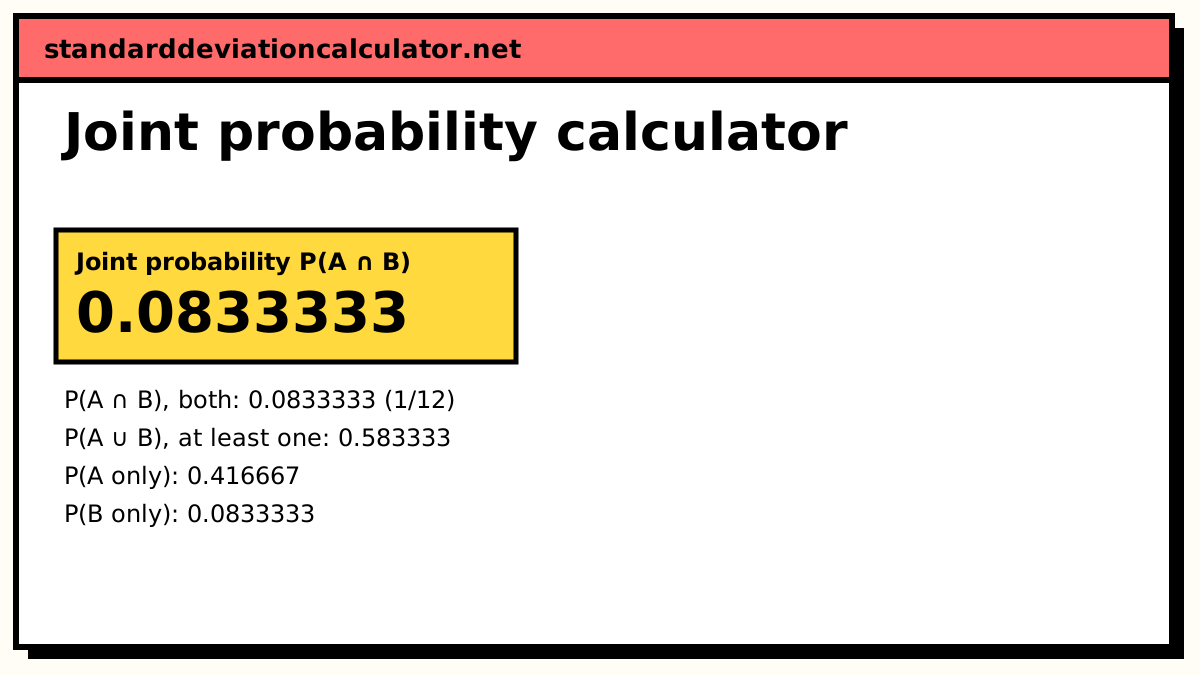
P(A ∩ B) = P(A) × P(B) P(A ∩ B) = 1/2 × 1/6 = 0.0833333
At least one of them (the addition rule):
P(A ∪ B) = P(A) + P(B) − P(A ∩ B) = 0.5 + 0.166667 − 0.0833333 = 0.583333
Neither of them:
P(A′ ∩ B′) = (1 − 0.5)(1 − 0.166667) = 0.416667
The formulas
Independent: P(A ∩ B) = P(A) × P(B) Dependent: P(A ∩ B) = P(A) × P(B | A) From counts: P(A ∩ B) = n(A and B) ÷ n
The first is a special case of the second: when A and B are independent, P(B | A) = P(B). Once you have the joint probability, the addition rule gives the chance of at least one, P(A ∪ B) = P(A) + P(B) − P(A ∩ B).
Worked example: independent events
Toss a coin and roll a die. What is the probability of heads (A) and a six (B)? The coin cannot affect the die, so multiply:
P(A ∩ B) = 1/2 × 1/6 = 1/12 = 0.0833333
The calculator also gives P(A ∪ B) = 0.5 + 0.166667 − 0.0833333 = 0.583333 and the chance of neither, (1/2)(5/6) = 0.416667. The Venn diagram shows the four regions, which add to 1.
Worked example: dependent events
Draw two cards from a deck without replacing the first. What is the chance both are aces? The first is an ace with probability 4/52. If it was, 3 aces remain among 51 cards, so P(B | A) = 3/51:
P(A ∩ B) = 4/52 × 3/51 = 12/2652 = 1/221 = 0.00452489
Treating the draws as independent would give (4/52)² = 1/169, which overstates the chance because it pretends the first ace goes back into the deck.
Worked example: a table of counts
In the table mode, 100 people were asked whether they own a car (A) and a bike (B): 45 own both, 15 only a car, 25 only a bike and 15 neither. Dividing by 100 gives the joint probability table: P(A ∩ B) = 0.45, with marginals P(A) = 0.6 and P(B) = 0.7. If the two were independent the joint probability would be 0.6 × 0.7 = 0.42. The observed 0.45 is a little higher, so in this sample car owners are slightly more likely than average to own a bike.
How to interpret the result
A joint probability is always at most the smaller of P(A) and P(B), because both events happening is a special case of either one happening. Very small joint probabilities are common when several conditions must all hold: the chance of two aces in a row is only 1 in 221 even though each ace on its own is 1 in 13. The “1 in …” figure in the results is often easier to picture than a long decimal.
Common mistakes
- Multiplying probabilities of dependent events as if they were independent. Use P(B | A) for the second factor.
- Adding instead of multiplying. P(A) + P(B) is part of the “or” rule, not the “and” rule.
- Joint probabilities larger than either marginal. P(A ∩ B) can never exceed P(A) or P(B); the calculator rejects inputs that break this.
- Confusing P(A ∩ B) with P(A | B). The joint probability divides by the whole sample, the conditional one only by B.
Common questions
What is joint probability?
The probability that two events both happen, written P(A ∩ B) or P(A and B). For independent events it is P(A) × P(B). For dependent events it is P(A) × P(B | A), the chance of the first times the chance of the second once the first has happened.
How do I know whether two events are independent?
Events are independent when one happening does not change the probability of the other: separate coin tosses, or a coin and a die. Drawing cards without putting them back, or weather on consecutive days, are dependent. With data, check whether P(A ∩ B) equals P(A) × P(B); the table mode does this for you.
What is the difference between joint and conditional probability?
Joint probability P(A ∩ B) is measured against everything that can happen. Conditional probability P(A | B) is measured only within B. They are linked by P(A ∩ B) = P(B) × P(A | B). In the default table P(A ∩ B) = 0.45, but P(A | B) = 0.45 ÷ 0.7 = 0.643.
What is a joint probability table?
A two-way table where each cell holds the probability of a combination of outcomes, so all four cells add to 1. The row and column totals are the marginal probabilities P(A) and P(B). Divide each count in a contingency table by the grand total to get one.
Related calculators
-
Conditional probability
P(A | B) from P(A ∩ B) and P(B), or from a table.
-
Probability of 3 events
Extend the idea to three independent events.
-
Probability calculator
Union, complement and at-least-one for two events.