Password combination calculator
Choose the characters a password can use and its length to see how many passwords are possible, the entropy in bits, and how long it would take to try them all.
e.g. 1 for the space, or the size of a custom set.
10 billion ≈ a GPU rig on a fast hash; 1,000 or fewer for a rate-limited login.
Bar heights are on a log scale, so equal steps up the axis are equal multiples (powers of ten), not equal amounts.
| Length | Possible passwords | Entropy (bits) | Average time to crack |
|---|---|---|---|
| 8 | 218,340,105,584,896 | 47.63 | 3.03 hours |
| 10 | 839,299,365,868,340,224 | 59.54 | 1.3 years |
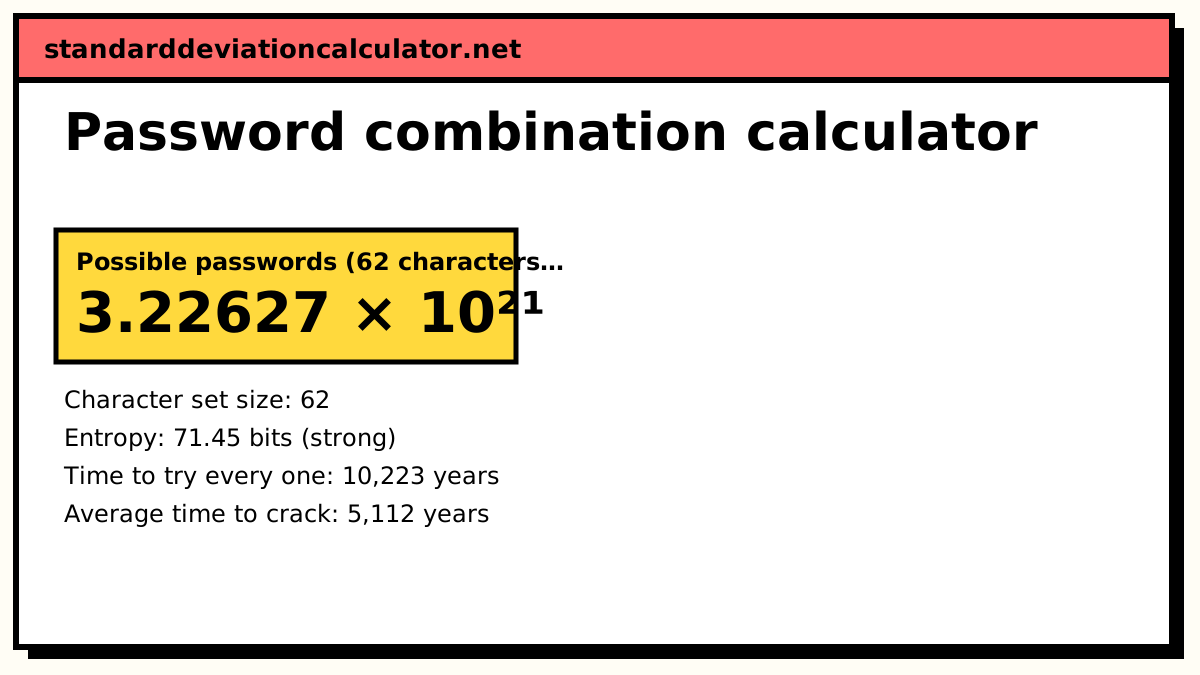
| 12 | 3.22627 × 10²¹ | 71.45 | 5,112 years |
| 14 | 1.24018 × 10²⁵ | 83.36 | 1.96 × 10⁷ years |
| 16 | 4.76724 × 10²⁸ | 95.27 | 7.55 × 10¹⁰ years |
| 20 | 7.04423 × 10³⁵ | 119.1 | 1.12 × 10¹⁸ years |
Show the working, step by step
Add up the characters allowed.
26 + 26 + 10 = 62
Each of the 12 positions can be any of the 62 characters, so multiply.
N = 62¹² = 3.22627 × 10²¹
Entropy is the number of yes/no questions needed to pin one password down.
H = L × log₂(S) = 12 × log₂(62) = 12 × 5.9542 = 71.4504 bits
At 1.00000e+10 guesses per second, trying them all takes N ÷ rate; on average the right one turns up halfway.
3.22627 × 10²¹ ÷ 1.00000e+10 = 3.226e+11 s = 10,223 years average = 5,112 years
These figures hold only for a password chosen uniformly at random. Words, names, dates and keyboard patterns are guessed first and fall in a tiny fraction of this time.
The formulas
N = SL H = L × log₂(S) bits Time to try all = N ÷ guesses per second
S is the size of the character set and L is the length. This is a permutation with repetition: each position is filled independently and characters may repeat. On average an attacker finds a random password after trying half of the possibilities, so the average cracking time is half the worst case.
A worked example
The default is a 12-character password using lowercase letters (26), uppercase letters (26) and digits (10), so S = 62.
N = 62¹² = 3,226,266,762,397,899,821,056 ≈ 3.23 × 10²¹ H = 12 × log₂(62) = 12 × 5.954 = 71.45 bits
At 10 billion guesses per second, trying every password takes 3.23 × 10²¹ ÷ 10¹⁰ = 3.23 × 10¹¹ seconds, about 10,223 years. On average the right one turns up halfway, after about 5,112 years.
The table under the result shows the same character set at other lengths. At 8 characters the average time drops to about 3 hours; at 16 it rises to 7.55 × 10¹⁰ years. Turning on the 32 keyboard symbols (S = 94) at length 12 gives 94¹² ≈ 4.76 × 10²³ passwords and 78.66 bits, an average of about 754,000 years. Lowercase letters alone at length 12 give only 56.41 bits and fall in about 55 days.
How to interpret the result
Treat the numbers as an upper limit on strength. They are exact for passwords generated at random, and far too generous for passwords a person made up. As a rough guide, under 36 bits is weak, 60 bits resists casual attacks, and 80 bits or more is out of reach of brute force with current hardware, even offline.
Guess rates vary by a factor of a billion depending on the attack, so the time estimate is only as good as the rate you enter. The count and the entropy do not depend on the rate at all, which makes entropy the better number for comparing two password policies.
Passphrases
The same maths covers passphrases, with words in place of characters. Four words picked at random from a list of 7,776 (the Diceware list) give 7,776⁴ ≈ 3.66 × 10¹⁵ possibilities, about 51.7 bits. Six words give about 77.5 bits, roughly a random 13-character password from 62 characters, and are far easier to remember. Enter 7776 as other characters with the other sets off and the length set to the number of words to try it.
Common mistakes
- Counting required character types as a big gain. Rules like “one digit and one symbol” barely change SL and push people toward predictable patterns.
- Using S × L instead of SL. Each position multiplies the count; it does not add to it.
- Assuming a site's login limit protects you. Once the password database leaks, the attacker guesses offline at full speed.
- Forgetting reuse. A strong password reused on a breached site is only as strong as that site's storage.
Common questions
How many possible passwords are there?
For a password of length L where each character comes from a set of S characters, there are SL possibilities. With lower and upper case letters and digits (S = 62) and length 12, that is 62¹² ≈ 3.23 × 10²¹.
What is password entropy?
Entropy in bits is log₂ of the number of equally likely passwords: H = L × log₂(S). Each extra bit doubles the number of guesses an attacker needs. A random 12-character password from 62 characters has 71.45 bits.
Does length or character variety matter more?
Length. Adding one character multiplies the count by S (62 times, here), while adding 32 symbols to a 62-character set multiplies it by (94/62)L, about 147 at length 12. Going from 12 to 16 characters multiplies it by 62⁴ ≈ 14.8 million.
What guess rate should I use?
It depends on how the password is stored and attacked. A website that limits login attempts may allow only a few guesses per second or fewer. An attacker with a stolen database of fast, unsalted hashes can try tens of billions per second on graphics cards. Slow hashes such as bcrypt or Argon2 cut that to thousands. The default of 10 billion per second is a pessimistic offline case.
Why is my real password weaker than this says?
The count assumes every character was chosen at random. Human-chosen passwords use words, names, years and patterns such as Password1!, and cracking tools try those first. A password manager's random generator, or a passphrase of several random words, gets close to the figures shown here.
Related calculators
-
Permutation calculator
nʳ and other ordered arrangements.
-
Combination calculator
Count unordered selections.
-
Lottery calculator
Another “1 in a huge number” problem.