Integer calculator
An integer is a whole number that may be negative: −3, 0, 12. This integer calculator adds, subtracts, multiplies and divides any two of them and shows which sign rule decided the answer, so it also works as a negative numbers calculator for homework. Pick an operation, type the numbers with a minus sign where needed, and read the working underneath.
Negative numbers: type a minus sign, for example −17.
Show the working, step by step
One is positive and one is negative: subtract the smaller size from the larger, and keep the sign of the number with the larger size (−17).
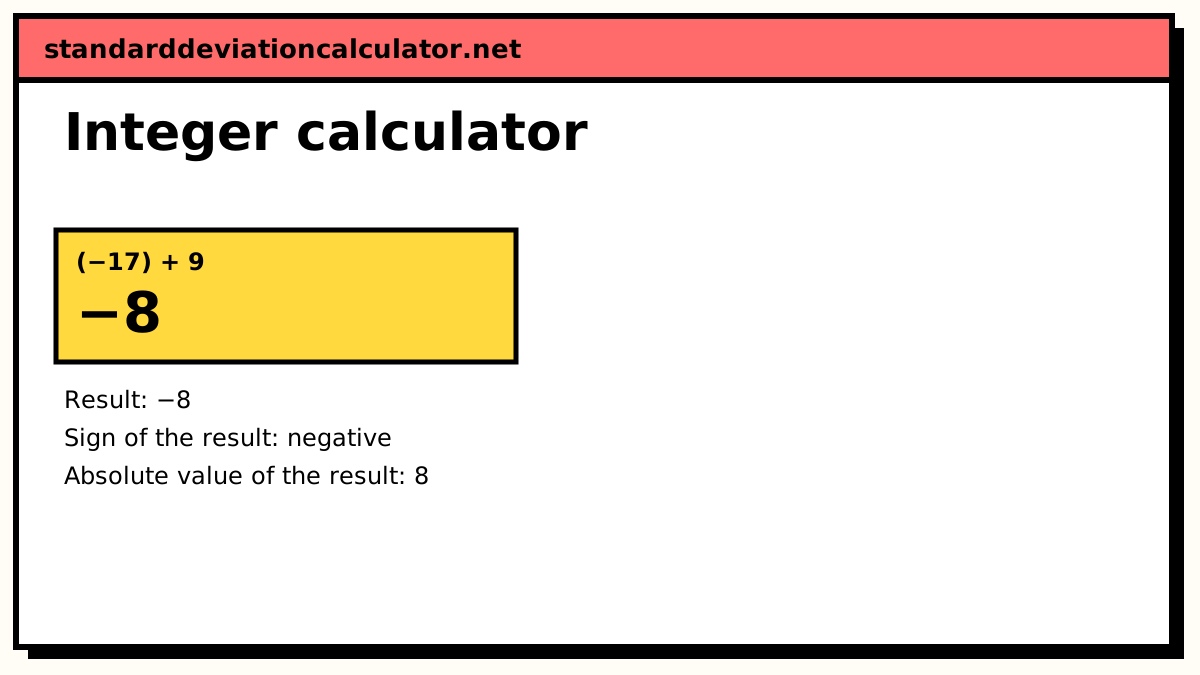
17 − 9 = 8 (−17) + 9 = −8
Integers are the whole numbers and their opposites: …, −2, −1, 0, 1, 2, …. Results are exact for any size you can type here.
The sign rules for integers
Every integer problem reduces to the size of the numbers plus a rule for the sign. Sizes are the absolute values, the numbers with the minus signs dropped.
| Operation | Signs | What to do | Example |
|---|---|---|---|
| Add | same | Add the sizes, keep the sign | −4 + (−6) = −10 |
| Add | different | Subtract the smaller size from the larger; keep the sign of the larger | −17 + 9 = −8 |
| Subtract | any | Add the opposite of the second number | 5 − (−8) = 5 + 8 = 13 |
| Multiply or divide | same | Result is positive | (−6) × (−7) = 42 |
| Multiply or divide | different | Result is negative | (−6) × 7 = −42 |
Subtraction needs no rule of its own. The sign of the second number is flipped, and the problem becomes an addition. That is why subtracting a negative number makes the total go up: taking away a debt of 8 leaves you 8 better off.
Worked examples
Adding with different signs: −17 + 9
- The signs differ, so subtract sizes: 17 − 9 = 8.
- The larger size belongs to −17, so the answer is negative: −8.
Subtracting a negative: 5 − (−8)
- Change to adding the opposite: 5 + 8.
- Same signs (both positive): 13.
Multiplying: (−6) × 7
- Multiply the sizes: 6 × 7 = 42.
- The signs differ, so the product is negative: −42.
Dividing without a remainder, and with one
−45 ÷ 9: 45 ÷ 9 = 5, different signs, so −5. For −17 ÷ 5, 5 does not divide 17 evenly. The decimal is −3.4, and as quotient and remainder, −17 = (−4) × 5 + 3.
Absolute value
The absolute value |a| is the distance of a from zero, so |−23| = 23 and |23| = 23. Choose “Absolute value” in the operation list to get it with the opposite of the number alongside. For the absolute value of a difference, as in |a − b|, subtract first, then take the absolute value.
Common mistakes with negative numbers
- Reading − as “minus” when it means “negative”. In 5 − (−8) the first dash is an operation and the second is part of the number. Brackets around a negative number keep the two apart.
- Applying the multiplication rule to addition. (−3) + (−4) = −7, not 7. “Two negatives make a positive” only holds for multiplication and division.
- Losing the sign of the larger number when the signs differ: −9 + 4 is −5, not 5.
- Treating a remainder as negative. With the usual convention the remainder of −17 ÷ 5 is 3, with a quotient of −4, not a remainder of −2.
To combine several integers and powers in one expression, use the order of operations calculator. It handles negative numbers and parentheses.
Common questions
How do I add and subtract negative numbers?
To add two numbers with the same sign, add their sizes and keep the sign: −4 + (−6) = −10. With different signs, subtract the smaller size from the larger and keep the sign of the larger: −17 + 9 = −8. To subtract, change the subtraction into addition of the opposite: 5 − (−8) = 5 + 8 = 13.
What is a negative times a negative?
A positive. Multiplying or dividing two numbers with the same sign gives a positive result, and with different signs a negative one: (−6) × (−7) = 42, but (−6) × 7 = −42. A zero factor always gives 0, which has no sign.
What is the absolute value of a negative number?
The same number without its minus sign: |−23| = 23. Absolute value is the distance from 0 on the number line, and a distance is never negative. The absolute value of 0 is 0.
What happens when you divide integers that do not divide evenly?
The result is not an integer. The calculator gives the decimal (−17 ÷ 5 = −3.4) and also the quotient and remainder, written as a = q × b + r with the remainder r between 0 and |b| − 1: −17 = (−4) × 5 + 3. The remainder is never negative in this form.
Is zero an integer, and is it positive or negative?
Zero is an integer, and it is neither positive nor negative. The integers are …, −3, −2, −1, 0, 1, 2, 3, …: the whole numbers together with their negatives. Fractions and decimals such as 1/2 or −3.4 are not integers.
Related calculators
-
Addition calculator
Add any list of numbers exactly, with column addition and the carries.
-
Subtraction calculator
Subtract with column working that shows every borrow.
-
Multiplication calculator
Exact products of any size with partial products shown.
-
Division calculator
Quotient, remainder and repeating decimals with long division.
-
GCD and LCM calculator
The greatest common divisor and least common multiple of integers.
-
Order of operations calculator
Evaluate a whole expression, one PEMDAS step at a time.
-
Square root calculator
Square roots, squares and simplified radicals such as 6√2.