Force calculator
Force is mass times acceleration. Choose what you want to find, enter the other two values in SI units, and the calculator returns the force in newtons, the mass in kilograms or the acceleration in metres per second squared. It also gives weight from mass and the net force of several forces.
Standard gravity. Use 1.62 for the Moon or 3.71 for Mars.
One number per force along a single line: positive one way, negative the other.
Show the working, step by step
Use Newton’s second law, rearranged for the unknown.
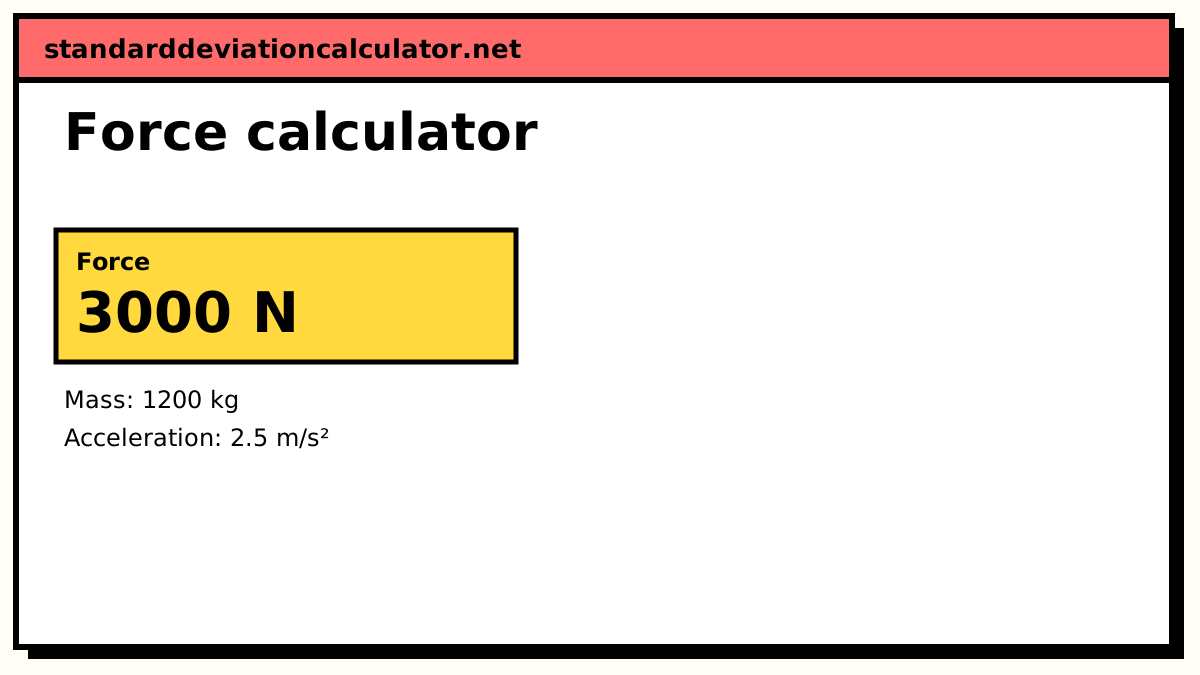
F = m × a = 1200 × 2.5 = 3000 N
SI units: newtons, kilograms and metres per second squared. 1 N = 1 kg·m/s². F is the net force on the object.
How the force calculator works
F = m × a m = F ÷ a a = F ÷ m
These are the three forms of Newton’s second law. F is the net force on the object in newtons (N), m its mass in kilograms (kg) and a its acceleration in metres per second squared (m/s²). Pick the quantity you want in the “Find” list and the calculator rearranges the law for you. Weight uses the same idea with the acceleration of gravity:
W = m × g g = 9.80665 m/s² (standard gravity)
The net-force option adds signed forces along one line. Give each force a plus or minus sign for its direction and the result is the sum.
This page works in SI units only. Convert pounds to kilograms (× 0.45359237) and pounds-force to newtons (× 4.44822) before you enter them.
Worked example: force on a car
A 1,200 kg car speeds up at 2.5 m/s². The calculator’s starting values give the force needed:
F = m × a = 1200 × 2.5 = 3000 N
That is a net force of 3,000 N, or 3 kN, along the direction of motion. Reversing it, the same 3,000 N on a 1,200 kg car gives a = 3000 ÷ 1200 = 2.5 m/s². For weight, a 70 kg person has W = 70 × 9.80665 = 686.4655 N, about 686 N. For net force, 50 N, −20 N and 15 N sum to 45 N.
Units and common mistakes
- Grams or tonnes instead of kilograms. 1 N = 1 kg·m/s². A mass in grams gives a force 1,000 times too large. Divide grams by 1,000 first.
- Using weight as mass. A weight given in newtons is a force. Divide by g to get the
mass before using
F = ma. - Forgetting that F is the net force. A car pulled by an engine force of 4,000 N with 1,000 N of friction has a net force of 3,000 N, and that is what produces the acceleration.
- Mixing km/h with m/s. Divide km/h by 3.6 to get m/s before finding an acceleration.
- Mass of zero or acceleration of zero. The calculator will not divide by them; a = 0 simply means the net force is zero.
Need the acceleration first? Use the acceleration calculator. For speed, see the velocity calculator, and for the full set of motion, energy and momentum formulas the physics calculator.
Common questions
What is the formula for force?
F = m × a: force in newtons equals mass in kilograms times acceleration in
metres per second squared. This is Newton’s second law. F is the net force, the sum of all the
forces acting on the object. One newton is the force that gives a 1 kg mass an acceleration
of 1 m/s².
How do you calculate force without acceleration?
Find the acceleration first from what you do have. If you know the change in velocity and the
time, a = (v − u) ÷ t, then use F = ma. If the object is not
accelerating at all, the net force is zero. For a weight held up by a surface or a rope, the
supporting force equals the weight, W = m × g. See the
acceleration calculator for the first step.
How do I calculate force from mass and speed?
Mass and speed alone are not enough, because force depends on how quickly the speed
changes. With a speed change Δv over a time Δt the force is F = m × Δv ÷ Δt.
A 1,200 kg car going from 0 to 20 m/s in 8 s needs a net force of 1,200 × 2.5 = 3,000 N.
What is the difference between mass and weight?
Mass is the amount of matter, in kilograms, and is the same everywhere. Weight is the
gravitational force on that mass, W = m × g, in newtons, and changes with g. A 70 kg
person weighs about 686 N on Earth (g = 9.80665 m/s²) and about 113 N on the Moon
(g = 1.62 m/s²), while the mass stays 70 kg.
How do I add several forces together?
On a single line, pick a positive direction and add the forces with signs: 50 N forward, 20 N backward and 15 N forward give 50 − 20 + 15 = 45 N forward. Forces at angles must be split into x and y components first and each component added separately.
Related calculators
-
Physics calculator
SUVAT from any three values, energy, power, momentum and projectiles.
-
Acceleration calculator
a from velocity and time, from force and mass, or from distance.
-
Velocity calculator
v = d ÷ t, v = u + at and average velocity between two points.
-
Trigonometric functions
Sine and cosine for resolving a force into components.