Math
Chemistry calculator
The everyday calculations of school and laboratory chemistry. Type a formula to get its molar mass and composition, or pick a calculation and leave the unknown blank. Each result shows the working with your numbers in it.
Brackets and hydrates work: Ca(OH)2, K4[Fe(CN)6], CuSO4.5H2O.
Blank shows the largest share.
Fill in one of mass, moles and particles.
e.g. 3.01e23 or 3.01×10^23
Leave one of mass, volume and molarity blank.
Leave one of the four blank. Use the same units on both sides.
Leave one of P, V, n and T blank.
Concentrations as 2.5e-4 or 2.5×10^-4.
| Element | Atoms | Atomic weight | Mass (g/mol) | Mass % |
|---|---|---|---|---|
| Cu (Copper) | 1 | 63.546 | 63.546 | 25.45% |
| S (Sulfur) | 1 | 32.06 | 32.06 | 12.84% |
| O (Oxygen) | 9 | 15.999 | 143.991 | 57.67% |
| H (Hydrogen) | 10 | 1.008 | 10.08 | 4.037% |
| Total | 249.677 | 100% |
Show the working, step by step
Count the atoms of each element, multiplying through brackets and hydrate coefficients.
Cu × 1, S × 1, O × 9, H × 10
Multiply each count by the standard atomic weight and add:
Cu: 1 × 63.546 = 63.546 g/mol S: 1 × 32.06 = 32.06 g/mol O: 9 × 15.999 = 143.991 g/mol H: 10 × 1.008 = 10.08 g/mol M = 249.677 g/mol
It is a 2-part formula (a hydrate or adduct), so each part can be checked on its own:
CuSO4 = 159.602 g/mol 5 × H2O = 5 × 18.015 = 90.075 g/mol
Atomic weights are the IUPAC abridged standard values (5 significant figures), so the last digit can differ slightly from a textbook that uses rounder values such as Cl = 35.5.
Molar mass from a formula
M = Σ (number of atoms × standard atomic weight)
The calculator reads the formula left to right, multiplies the atoms inside brackets by the
number after the bracket, and treats a dot (·, * or .)
as the start of a new part with its own coefficient, as in hydrates. Nested brackets such as
K₄[Fe(CN)₆] work, and so do fractional coefficients such as CaSO₄·0.5H₂O (plaster of Paris).
Symbols are case-sensitive: Co is cobalt and CO is carbon monoxide.
A worked example: copper(II) sulfate pentahydrate
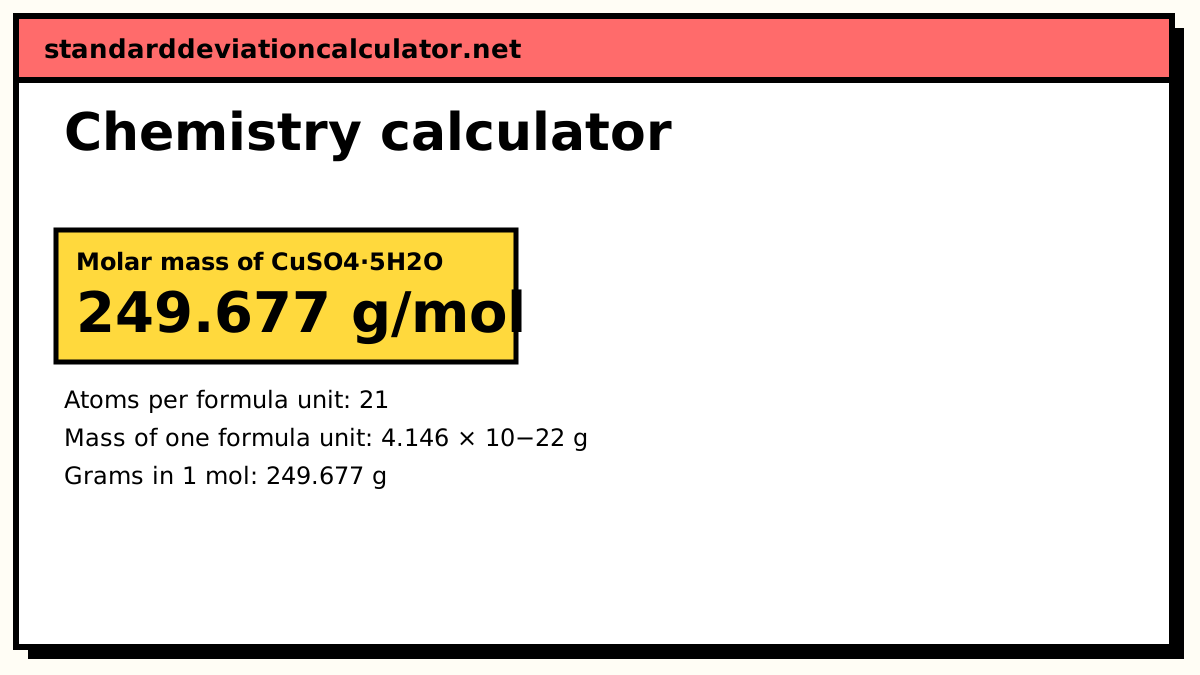
The calculator's default formula is CuSO4·5H2O.
| Element | Atoms | Atomic weight | Mass (g/mol) | Mass % |
|---|---|---|---|---|
| Cu | 1 | 63.546 | 63.546 | 25.45% |
| S | 1 | 32.06 | 32.06 | 12.84% |
| O | 4 + 5 = 9 | 15.999 | 143.991 | 57.67% |
| H | 10 | 1.008 | 10.08 | 4.04% |
| Total | 21 | 249.677 | 100% |
So 10 g of the blue crystals is 10 ÷ 249.677 = 0.040052 mol, or 2.412 × 10²² formula units. The water of crystallisation is 90.075 ÷ 249.677 = 36.08% of the mass, which is why heating the crystals to constant mass loses just over a third of their weight.
The formulas
| Calculation | Formula | Default example |
|---|---|---|
| Moles from mass | n = m ÷ M | 10 g ÷ 249.677 g/mol = 0.040052 mol |
| Particles | N = n × NA | NA = 6.02214076 × 10²³ mol⁻¹ |
| Molarity | C = n ÷ V = m ÷ (M × V) | 11.688 g NaCl in 500 mL = 0.4 mol/L |
| Dilution | C₁V₁ = C₂V₂ | 2 mol/L → 0.5 mol/L, 250 mL: V₁ = 62.5 mL |
| Ideal gas law | PV = nRT | 1 mol at 0 °C and 101.325 kPa: V = 22.414 L |
| pH | pH = −log₁₀[H⁺], pH + pOH = 14 | [H⁺] = 2.5 × 10⁻⁴: pH = 3.602 |
| Percent composition | % = (atoms × Ar) ÷ M × 100 | Cu in CuSO₄·5H₂O: 25.45% |
The constants are the exact 2019 SI values: NA = 6.02214076 × 10²³ mol⁻¹ and R = 8.314462618 J/(mol·K). Atomic weights are the IUPAC abridged standard values; for the elements with no stable isotope (technetium, promethium, and everything after bismuth except thorium, protactinium and uranium) the mass number of the longest-lived isotope is used, and the result says so.
Common mistakes
- Celsius in the gas law. PV = nRT needs absolute temperature. At 25 °C use 298.15 K; putting in 25 gives a volume about twelve times too small.
- Mixing pressure units with R. R = 8.314 J/(mol·K) goes with pascals and cubic metres. With atmospheres and litres R is 0.082057 L·atm/(mol·K). The calculator converts everything to SI first, so either input unit is safe here.
- Volume of water instead of volume of solution. A 0.4 mol/L NaCl solution is 11.688 g made up to 500 mL, not dissolved in 500 mL of water.
- Forgetting the water in a hydrate. Weighing out 159.6 g of CuSO₄·5H₂O for one mole of copper sulfate gives only 0.639 mol, because 36% of the crystal is water.
- Lower-case symbols.
co,NACLandHclare not formulas. Write NaCl, HCl, Co or CO.
Common questions
How do I calculate the molar mass of a hydrate such as CuSO₄·5H₂O?
Add the molar mass of the salt to the coefficient times the molar mass of water.
CuSO₄ is 63.546 + 32.06 + 4 × 15.999 = 159.602 g/mol, and 5H₂O is 5 × 18.015 = 90.075 g/mol,
so CuSO₄·5H₂O is 249.677 g/mol. Type the dot as ·, * or a plain full
stop (CuSO4.5H2O); all three work here.
Why does my textbook give a slightly different molar mass?
Books often round atomic weights (Cl = 35.5, Cu = 63.5, H = 1). This calculator uses the IUPAC abridged standard atomic weights to five significant figures, such as Cl = 35.45 and Cu = 63.546, so the third or fourth significant figure can differ. For NaCl that is 58.44 g/mol here against 58.5 g/mol with Cl = 35.5 and Na = 23.
What is the molar volume of a gas at STP?
At 0 °C and 101.325 kPa (1 atm), one mole of an ideal gas occupies V = nRT ÷ P = 1 × 8.314462618 × 273.15 ÷ 101,325 = 0.022414 m³, which is 22.414 L. Since 1982 IUPAC has defined STP as 0 °C and 100 kPa, which gives 22.711 L/mol; check which definition your course uses.
How do I find pH from the hydrogen ion concentration?
pH = −log₁₀[H⁺]. For [H⁺] = 2.5 × 10⁻⁴ mol/L the pH is 3.602. Then pOH = 14 − pH = 10.398 and [OH⁻] = 10⁻¹⁰·³⁹⁸ = 4.0 × 10⁻¹¹ mol/L. The 14 comes from the ionic product of water at 25 °C, Kw = 1.0 × 10⁻¹⁴.
In C₁V₁ = C₂V₂, do I need to convert to litres?
No, as long as both volumes are in the same unit and both concentrations are in the same unit. The units cancel, so the unknown comes out in the unit you used. Diluting 2 mol/L stock to 250 mL of 0.5 mol/L needs 62.5 mL of stock whether you work in mL or convert to 0.0625 L.
What is the difference between molarity and molality?
Molarity is moles of solute per litre of solution (mol/L, written M). Molality is moles of solute per kilogram of solvent (mol/kg). Molarity changes slightly with temperature, because the solution expands; molality does not. For dilute aqueous solutions near room temperature the two are almost equal.
Related calculators
-
Physics calculator
SUVAT, forces, energy, projectiles, density and pressure.
-
Engineering calculator
Ohm's law, resistor networks, stress, strain and torque.
-
Ratio and proportion
The proportional reasoning behind dilutions and mole ratios.
-
Percentage calculator
Percentages of, and as, a quantity.