Math
Engineering calculator
Eleven formulas that come up in first-year electrical and mechanical engineering, in one place. Choose a calculation, enter what you know in the units you have, and the calculator converts to SI, applies the formula and shows each step.
Fill in any two of the four; leave two blank.
Separate with commas, spaces or new lines.
Across R2. Leave blank for no load.
Separate with commas, spaces or new lines.
Steel ≈ 200 GPa, aluminium ≈ 69 GPa.
━ V = I × 4 Ω
For a fixed resistance, voltage is proportional to current: the slope of the line is R. The power 36 W is the area of the rectangle under the point, V × I.
Show the working, step by step
Convert the two known values to base units (V, A, Ω, W): V = 12 V, R = 4 Ω.
Use I = V ÷ R.
I = 12 ÷ 4 = 3 A
Use P = V² ÷ R.
P = 12² ÷ 4 = 36 W
Check: V = I × R = 3 × 4 = 12 V, and P = V × I = 36 W.
Ohm's law and electrical power
V = I R P = V I = I² R = V² ÷ R
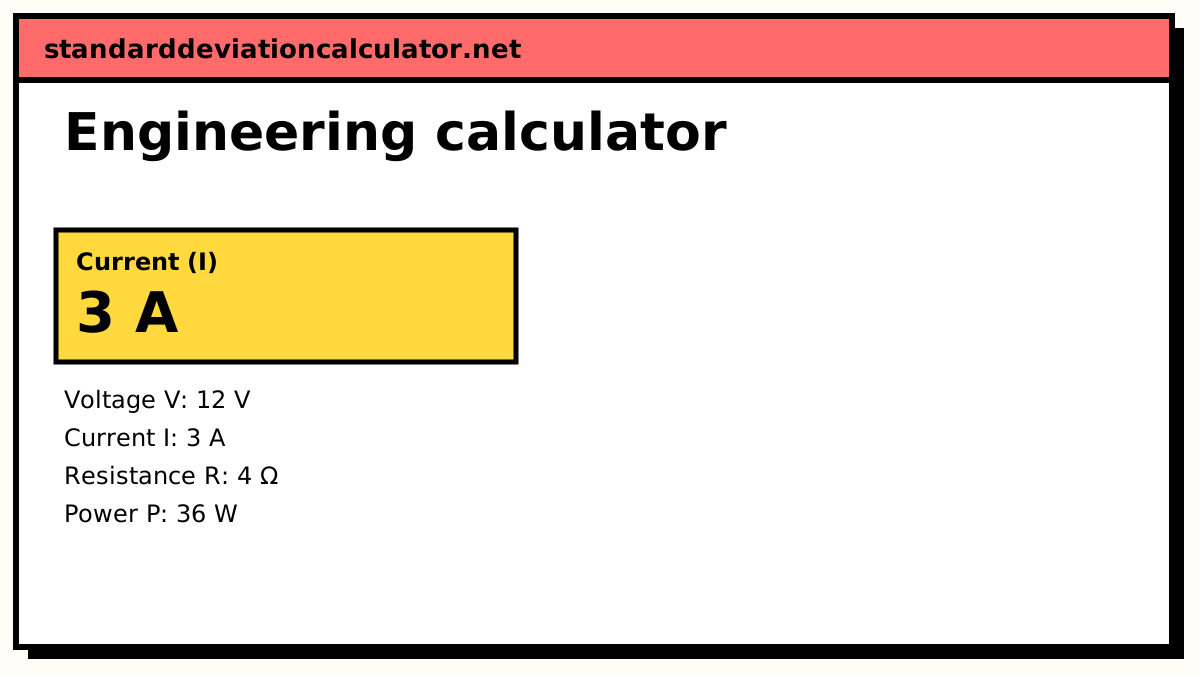
Voltage V (volts), current I (amps), resistance R (ohms) and power P (watts) are tied together by these two laws, so any two of them fix the other two. The default example is a 12 V supply across a 4 Ω resistor: I = 12 ÷ 4 = 3 A, and P = 12 × 3 = 36 W (check: V² ÷ R = 144 ÷ 4 = 36 W). A 36 W load on a quarter-watt resistor would burn it out, which is why the power figure matters as much as the current.
Resistors and capacitors in series and parallel
| Component | Series | Parallel |
|---|---|---|
| Resistors | R = R₁ + R₂ + … | 1/R = 1/R₁ + 1/R₂ + … |
| Capacitors | 1/C = 1/C₁ + 1/C₂ + … | C = C₁ + C₂ + … |
Resistors of 100 Ω, 220 Ω and 330 Ω add to 650 Ω in series. In parallel the reciprocals add: 1/100 + 1/220 + 1/330 = 0.017576, and 1 ÷ 0.017576 = 56.9 Ω. Capacitors swap the rules, so 10, 22 and 47 µF give 79 µF in parallel and 5.998 µF in series. For two components in the reciprocal case there is a shortcut, product over sum: 10 kΩ and 47 kΩ in parallel are 10 × 47 ÷ 57 = 8.246 kΩ.
Voltage divider
Vout = Vin × R2 ÷ (R1 + R2)
Two resistors in series across a supply split the voltage in proportion to their resistance. With 12 V across R1 = 10 kΩ and R2 = 4.7 kΩ, Vout = 12 × 4.7 ÷ 14.7 = 3.837 V, and 816.3 µA flows through both. The formula assumes nothing is connected to the output. A load RL sits in parallel with R2 and pulls the output down: a 4.7 kΩ load makes the bottom leg 2.35 kΩ and Vout falls to 12 × 2.35 ÷ 12.35 = 2.283 V. Enter a load resistance in the calculator to see this. As a rule, keep the load at least ten times R2, or buffer the output.
Stress, strain and Young's modulus
σ = F ÷ A ε = ΔL ÷ L E = σ ÷ ε ΔL = F L ÷ (A E)
A steel bar with a cross-section of 100 mm² and a length of 2 m carries a 20 kN tensile load and stretches 2 mm. Stress σ = 20,000 N ÷ 0.0001 m² = 200 MPa. Strain ε = 0.002 ÷ 2 = 0.001 (0.1%, with no units). Young's modulus E = 200 MPa ÷ 0.001 = 200 GPa, the textbook value for steel. The “Extension from Young's modulus” option runs the calculation the other way: given E, it predicts the 2 mm stretch. Both hold only in the elastic region, below the yield stress; past it the bar deforms permanently and E no longer applies.
The most common slip is units. Stress in pascals needs the area in square metres, and 1 mm² is 10⁻⁶ m², not 10⁻³. Use the unit selectors rather than converting by hand.
Torque and gear ratio
τ = F r sin θ gear ratio = N_driven ÷ N_driver
A 50 N push at right angles to a 0.3 m spanner gives τ = 50 × 0.3 × sin 90° = 15 N·m, or 11.06 lbf·ft. Push at 30° to the handle and only half the force turns the nut (sin 30° = 0.5), so the torque halves to 7.5 N·m. With a speed in rpm, the calculator also gives the power, P = τ × 2π × rpm ÷ 60.
A 12-tooth driver meshing with a 36-tooth gear gives a 3 : 1 reduction. At 1,500 rpm in, the output turns at 500 rpm, and an input torque of 10 N·m becomes 30 N·m at 100% efficiency. Power is conserved (less friction), so what the gear train gains in torque it loses in speed. For a compound train, multiply the ratios of the individual pairs. The same formula works for belt pulleys, using diameters instead of teeth.
RC time constant
τ = R C V(t) = Vs (1 − e^(−t/τ)) f_c = 1 ÷ (2π R C)
A 10 kΩ resistor charging a 100 µF capacitor has τ = 10,000 × 0.0001 = 1 s. The capacitor voltage rises along the curve in the chart: 63.2% of the supply after one τ, then 86.5%, 95.0%, 98.2% and 99.3% after 2τ to 5τ. Discharging is the mirror image, falling to 36.8% after one τ. The same pair used as a low-pass filter has its −3 dB cut-off at 1 ÷ (2π × 1) = 0.159 Hz.
Common questions
How do I use Ohm's law to find current?
Divide the voltage by the resistance: I = V ÷ R. A 12 V supply across a 4 Ω
resistor drives 12 ÷ 4 = 3 A, and the resistor dissipates P = V × I = 36 W. Enter any two of
voltage, current, resistance and power above and the calculator finds the other two.
Why is the parallel resistance smaller than the smallest resistor?
Each extra branch gives the current another path, so the combination conducts better than any one branch alone. Conductances (1/R) add in parallel, and the reciprocal of a larger sum is a smaller resistance. 100 Ω, 220 Ω and 330 Ω in parallel give 56.9 Ω, below the 100 Ω resistor. Two equal resistors in parallel give exactly half of one.
Do capacitors add in series or in parallel?
In parallel. Capacitors follow the opposite rules to resistors: parallel capacitances add (10 + 22 + 47 µF = 79 µF), while in series the reciprocals add, giving 5.998 µF for the same three. Putting capacitors in series lowers the capacitance but raises the voltage the stack can withstand.
What is Young's modulus of steel?
About 200 GPa for structural and carbon steels (roughly 190–210 GPa depending on the grade). Aluminium alloys are about 69 GPa, copper about 117 GPa and titanium about 110 GPa. A higher modulus means a stiffer material: less extension for the same stress.
How long does a capacitor take to charge?
In an RC circuit it reaches 63.2% of the supply voltage after one time constant τ = RC, 86.5% after 2τ, 95.0% after 3τ and 99.3% after 5τ. Engineers usually treat 5τ as “fully charged”. With 10 kΩ and 100 µF, τ = 1 s, so the capacitor is effectively charged after about 5 seconds.
What does a 3 : 1 gear ratio mean?
The driven gear turns once for every three turns of the driver: it has three times as many teeth. Output speed falls to a third and, ignoring friction, output torque triples. A 12-tooth pinion driving a 36-tooth gear at 1,500 rpm gives 500 rpm at the output.
Related calculators
-
Physics calculator
SUVAT motion, forces, energy, power, projectiles and waves.
-
Ratio and proportion
Simplify ratios and solve proportions, as with gear trains.
-
Trigonometric functions
Sine, cosine and tangent of any angle, as used in torque.