Acceleration calculator
Acceleration is how quickly velocity changes. Pick the information you have, whether that is a change in velocity and a time, a force and a mass, or a distance, and the calculator gives the acceleration in metres per second squared with the working. It can also find the magnitude of an acceleration from its x and y components.
Show the working, step by step
Substitute the values.
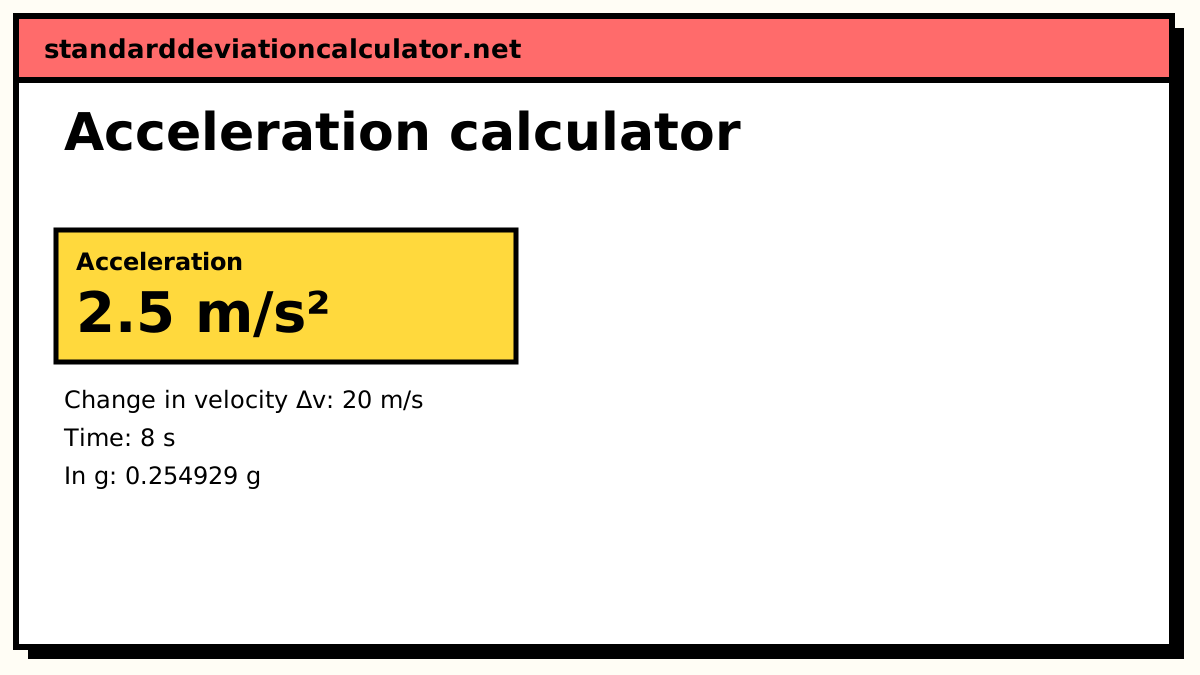
a = (v − u) ÷ t = (20 − 0) ÷ 8 = 2.5 m/s²
SI units: metres per second squared. A negative result means slowing down while moving in the positive direction.
How the acceleration calculator works
a = (v − u) ÷ t a = F ÷ m a = (v² − u²) ÷ 2s a = 2(s − ut) ÷ t²
The first is the definition: final velocity v minus initial velocity u, over the time t. The second is
Newton’s second law rearranged. The third comes from v² = u² + 2as and needs no time. The
fourth comes from s = ut + ½at² and needs no final velocity. The last three assume the
acceleration is constant. Units are SI: velocities in m/s, time in s, distance in m, force in N and mass
in kg. Convert km/h to m/s by dividing by 3.6.
For acceleration in two dimensions, the magnitude is the length of the vector:
|a| = √(aₓ² + ay²) θ = atan2(ay, aₓ)
Worked example
From rest to 20 m/s in 8 s: a = (20 − 0) ÷ 8 = 2.5 m/s², about 0.255 g. A 1,200 kg car pushed by a 3,000 N net force has the same acceleration, 3000 ÷ 1200 = 2.5 m/s². From 0 to 20 m/s over 100 m the distance form gives (400 − 0) ÷ 200 = 2 m/s². Starting at rest and covering 100 m in 8 s gives 2 × 100 ÷ 8² = 3.125 m/s². For components of 3 and 4 m/s², the magnitude is √(9 + 16) = 5 m/s² at 53.13° above the x axis.
Units and common mistakes
- Speed in km/h. 72 km/h is 20 m/s. Entering 72 with seconds gives an answer 3.6 times too big.
- Swapping u and v. Slowing down gives a negative result, which is correct. Keep final minus initial.
- Using total force. In
a = F ÷ m, F is the net force after friction and drag. - Assuming constant acceleration. The distance formulas fail if the acceleration changes during the motion; the first formula then gives only the average acceleration.
- Treating magnitude as signed. |a| is never negative; the direction is given separately.
To go on from here, find the force with the force calculator, the final speed with the velocity calculator, or solve a full constant-acceleration problem in the physics calculator.
Common questions
How do I calculate acceleration?
Divide the change in velocity by the time it took: a = (v − u) ÷ t. A car that
goes from 0 to 20 m/s in 8 s has a = 20 ÷ 8 = 2.5 m/s². If you know the net force and the mass
instead, use a = F ÷ m.
How do you find acceleration without velocity?
Use force and mass, a = F ÷ m, or use distance and time with a known starting
velocity: a = 2(s − ut) ÷ t². From rest (u = 0) this is a = 2s ÷ t², so 100 m covered in
8 s gives a = 200 ÷ 64 = 3.125 m/s². The “start velocity, distance and time” option does this.
How do I find acceleration from distance and velocity?
Without time, use v² = u² + 2as, rearranged to a = (v² − u²) ÷ 2s.
Going from 0 to 20 m/s over 100 m gives a = 400 ÷ 200 = 2 m/s².
Is the magnitude of acceleration always positive?
Yes. The magnitude is the size of the acceleration vector, |a| = √(aₓ² + a_y²),
which is never negative. Components can be negative, and a negative component simply points
along the negative axis. Slowing down gives a negative acceleration along the direction of
motion, but its magnitude is still positive.
What is a good acceleration to compare with?
Standard gravity is 9.80665 m/s², often written as 1 g. The calculator shows an acceleration in g so you can compare: 2.5 m/s² is about 0.255 g.
Related calculators
-
Physics calculator
All five SUVAT equations, solved from any three values.
-
Force calculator
F = m × a, weight and net force.
-
Velocity calculator
v = d ÷ t, v = u + at and average velocity.
-
Average calculator
Mean of a list, for averaging several measured accelerations.