Pace calculator
Pick a race distance and your finish time to get the pace per km and per mile, or enter a target pace to get a finish time. Marathon, half marathon, 10K and 5K are preset.
| Kilometre splits | Split | Elapsed |
|---|---|---|
| 1 km | 5:15 | 5:15 |
| 2 km | 5:15 | 10:30 |
| 3 km | 5:15 | 15:45 |
| 4 km | 5:15 | 21:00 |
| 5 km | 5:15 | 26:15 |
| 6 km | 5:15 | 31:30 |
| 7 km | 5:15 | 36:45 |
| 8 km | 5:15 | 42:00 |
| 9 km | 5:15 | 47:15 |
| 10 km | 5:15 | 52:30 |
| Mile splits | Split | Elapsed |
|---|---|---|
| 1 mi | 8:27 | 8:27 |
| 2 mi | 8:27 | 16:54 |
| 3 mi | 8:27 | 25:21 |
| 4 mi | 8:27 | 33:48 |
| 5 mi | 8:27 | 42:15 |
| 6 mi | 8:27 | 50:42 |
| finish (+0.21 mi) | 1:48 | 52:30 |
Show the working, step by step
Pace is time divided by distance.
0:52:30 ÷ 10 km = 5:15 /km · 8:27 /mi
Pace, speed and time
pace = time ÷ distance speed = distance ÷ time = 60 ÷ pace (minutes per km → km/h)
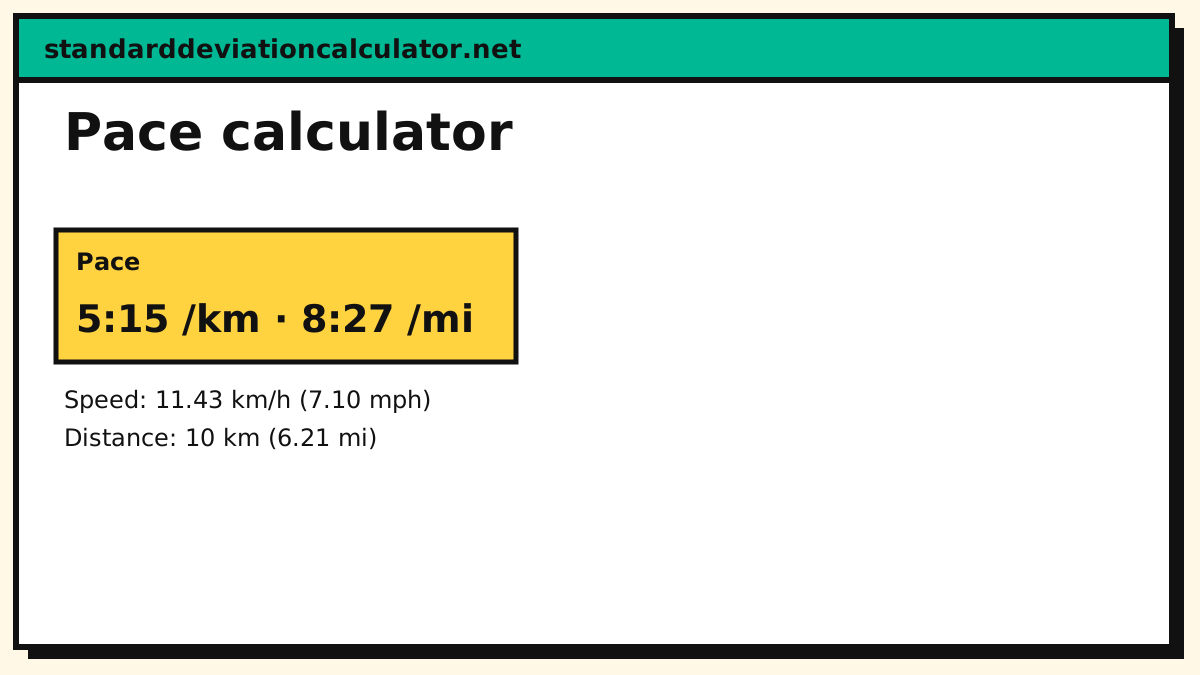
A 52:30 10K is 5:15 per km, which is 8:27 per mile or 11.4 km/h. Pace is minutes per unit of distance, so lower is faster.
How to use the pace calculator
Choose what to solve for. Pace takes a distance and a finish time, Finish time takes a distance and a pace per kilometre, and Distance takes a time and a pace. Pick a race (5 km, 10 km, half marathon or marathon) or choose Custom distance and enter kilometres. Times are typed as h:mm:ss (for example 0:52:30) and a pace as m:ss per kilometre (for example 5:15). The result shows pace per kilometre and per mile, your speed in km/h and mph, and, for pace and finish-time answers, a table of splits at every kilometre and every mile.
The pace formulas
pace = time ÷ distance speed = distance ÷ time = 3,600 ÷ pace (in seconds per km → km/h) pace per mile = pace per km × 1.609344
Pace is how long each unit of distance takes, so a smaller pace is faster, while speed goes the other way. A 5:00 per km pace is 300 seconds a kilometre, which is 3,600 ÷ 300 = 12 km/h, or 7.46 mph.
Worked examples
- A 10K in 52:30: 3,150 seconds ÷ 10 km = 315 seconds, a pace of 5:15 per km, which is 8:27 per mile and 11.43 km/h.
- A 4:00:00 marathon: 14,400 s ÷ 42.195 km = 341 s, so 5:41 per km and 9:09 per mile.
- Finish time from pace: running 5:15 per km for 10 km gives 52:30.
- Distance from time and pace: 30 minutes at 6:00 per km covers 5 km.
- A half marathon in 1:45:00: 6,300 s ÷ 21.0975 km = 298.6 s, which is about 4:59 per km (8:01 per mile) or 12.06 km/h.
Pace chart for common goal times
| Goal | Per km | Per mile | km/h |
|---|---|---|---|
| 5K in 25:00 | 5:00 | 8:03 | 12.00 |
| 5K in 30:00 | 6:00 | 9:39 | 10.00 |
| 10K in 50:00 | 5:00 | 8:03 | 12.00 |
| 10K in 1:00:00 | 6:00 | 9:39 | 10.00 |
| Half marathon in 1:45:00 | 4:59 | 8:01 | 12.06 |
| Half marathon in 2:00:00 | 5:41 | 9:09 | 10.55 |
| Marathon in 3:30:00 | 4:59 | 8:01 | 12.06 |
| Marathon in 4:00:00 | 5:41 | 9:09 | 10.55 |
| Marathon in 5:00:00 | 7:07 | 11:27 | 8.44 |
Reading the split tables
Splits show the time at each kilometre or mile mark if you hold an even pace. If the distance is not a whole number of marks, a final “finish” row covers the leftover part, so the last elapsed time always matches your finish time. Use the kilometre table on a metric course and the mile table on a mile-marked one: for a 10K at 5:15 per km, the mile table shows 6 full miles at 8:27 each and a short final stretch of about 0.21 miles.
Even pace, negative splits and race tactics
Holding the same pace throughout is the simplest plan to calculate and often the most efficient. A negative split means running the second half faster than the first, which many runners find easier on the legs; a positive split is the reverse. The calculator shows even-pace splits only, so to plan a negative split, use a slightly slower pace for the first half and a slightly faster pace for the second, and check that the two halves add up to your goal time with the time calculator.
Converting between pace and speed
Treadmills show speed in km/h or mph, while runners talk in minutes per kilometre or mile. To convert min/km to km/h, divide 60 by the pace in minutes (5:00 → 60 ÷ 5 = 12 km/h; 6:30 = 6.5 min → 9.23 km/h). To convert the other way, divide 60 by the speed. For min/mile and mph, the same rule applies: 8:00 per mile is 7.5 mph. The unit converter handles km, miles and speed units.
Race distances in kilometres and miles
The standard road distances are 5 km (3.107 miles), 10 km (6.214 miles), the half marathon of 21.0975 km (13.109 miles) and the marathon of 42.195 km (26.219 miles). Because the calculator works in kilometres and shows miles beside them, a course marked in miles can be checked against the same goal time: a 4:00:00 marathon is 9:09 per mile for 26.219 miles. If a course is measured slightly long or short by your watch, enter the distance you actually ran in Custom.
Using pace in training
Most training plans describe effort rather than a single pace: an easy run you could hold a conversation at, a steady or tempo run that feels comfortably hard, and short fast repeats. The calculator helps turn a goal into targets for each. Pick the race pace from the finish time you want, then set easy runs noticeably slower than that and repeats faster, and check the plan by timing a few kilometres with the stopwatch. Pace is only a guide: heat, hills, fatigue and wind can make the same effort a different number.
Why real splits drift
Even splits are an ideal. Most runners start a little fast and slow in the second half, and hills, drinks stops and crowds shift individual kilometres. A good approach is to treat the pace table as a target band: staying within a few seconds of each split is a sign that you are on schedule, and a gap that grows is a signal to adjust early rather than late.
Common mistakes and limits
- Reading 5.5 as 5:30. Pace is in minutes and seconds, not decimals: 5.5 minutes is 5:30.
- Mixing km and miles. A pace of 8:00 per mile is much faster than 8:00 per kilometre.
- Assuming a flat course. Hills, wind and heat change real pace; this is an arithmetic tool, not a prediction of what you can run.
- Treating a race-time prediction as a promise. The calculator does not predict times from other races.
Common questions
How do you calculate running pace?
Divide your time by the distance. 52 minutes 30 seconds over 10 km is 5 minutes 15 seconds per km.
What pace do I need for a 4-hour marathon?
Four hours over 42.195 km is about 5:41 per km, or 9:09 per mile.
How do I convert pace per km to per mile?
Multiply by 1.609344: 5:15 per km × 1.609 = 8:27 per mile.
How accurate is the finish time?
It is exact arithmetic on the numbers you enter: pace times distance. Real races differ because of the course, the weather, the start line and how you feel, so use it as a target, not a forecast.
How fast is a 7:00 per km pace?
60 ÷ 7 = 8.57 km/h, which is 5.33 mph, or 11:16 per mile. A 10K at that pace takes 1 hour 10 minutes.
Can I use it for walking or cycling?
Yes. Pace and speed work for any steady movement. A brisk walk at 12:00 per km is 5 km/h; cyclists usually prefer speed, so read the km/h figure.
Is pace the same as speed?
They describe the same movement from opposite ends. Pace is time per distance (minutes per kilometre) and speed is distance per time (kilometres per hour). Faster running means a smaller pace and a larger speed.
Related calculators
-
Time calculator
Add split times.
-
Velocity calculator
Speed formulas.
-
Unit converter
km and miles.
-
Stopwatch
Time your laps.