Unit converter
Choose a measure, enter a value and pick the two units. The result also lists the value in every other unit of that measure, and the steps show the conversion factor.
Show the working, step by step
Multiply by the factor between the two units.
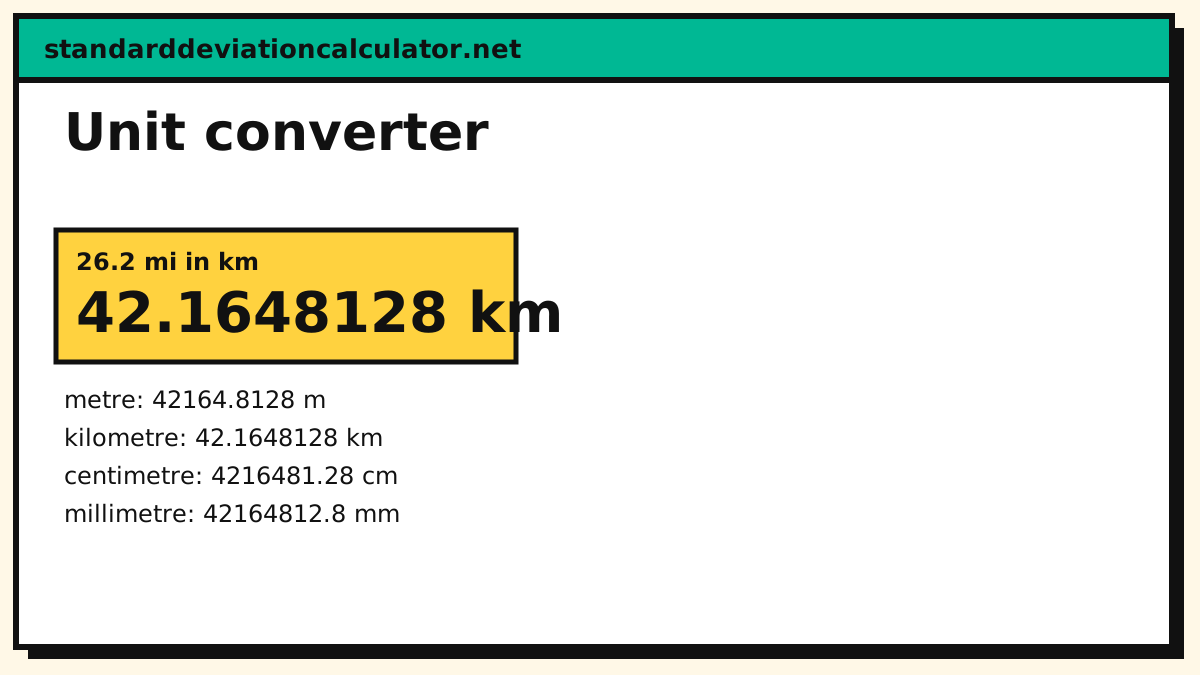
1 mile = 1.609344 kilometre 26.2 × 1.609344 = 42.1648128 km
How conversion works
Most conversions multiply by a fixed factor: 1 mile = 1.609344 km exactly. Temperature is the exception, because the scales have different zero points: °F = °C × 9/5 + 32 and K = °C + 273.15.
How to use the unit converter
Choose a measure (length, mass, area, volume, speed, time, energy, pressure, data or temperature), type the value, and pick the from and to units. The headline shows the converted value; the cells beside it list the same quantity in every other unit of that measure, and the working shows the conversion factor used. Results are shown to about ten significant figures, so exact definitions such as 1 inch = 25.4 mm come out clean.
Exact conversion factors
Most of the factors used here are exact by international agreement, not measurements:
| Quantity | Exact value |
|---|---|
| 1 inch | 25.4 mm |
| 1 foot | 0.3048 m |
| 1 mile | 1,609.344 m |
| 1 pound | 0.45359237 kg |
| 1 US gallon | 3.785411784 L |
| 1 UK (imperial) gallon | 4.54609 L |
| 1 acre | 4,046.8564224 m² |
| 1 calorie (thermochemical) | 4.184 J |
Worked conversion examples
- 26.2 miles to kilometres: 26.2 × 1.609344 = 42.16 km, the marathon distance.
- 5 pounds to kilograms: 5 × 0.45359237 = 2.268 kg.
- 3 US gallons to litres: 3 × 3.785411784 = 11.36 L.
- 100 km/h to mph: 100 ÷ 1.609344 = 62.14 mph.
Temperature conversion
Temperature is different because the scales have different zero points, so you cannot multiply by one factor. The formulas are °F = °C × 9/5 + 32, °C = (°F − 32) × 5/9 and K = °C + 273.15. Body temperature of 98.6 °F is (98.6 − 32) × 5/9 = 37 °C. Water freezes at 0 °C = 32 °F = 273.15 K and boils at 100 °C = 212 °F = 373.15 K (at sea-level pressure). The two scales meet at −40, where −40 °C = −40 °F. Absolute zero is 0 K = −273.15 °C = −459.67 °F.
Length, area and volume
Length units are the base of everything else. One mile is 1,760 yards, 5,280 feet or 63,360 inches, and exactly 1.609344 kilometres. Area and volume follow by squaring and cubing: a hectare is 10,000 m², an acre is 43,560 square feet (4,046.86 m²) and 1 US gallon is 231 cubic inches. A common slip is to convert 1 square metre as 100 square centimetres; it is 100 × 100 = 10,000. A litre is 1,000 cm³ and a cubic metre holds 1,000 litres.
Speed, time and energy
For speed, 1 m/s = 3.6 km/h and 1 mph = 0.44704 m/s exactly. Time uses 60 seconds a minute, 60 minutes an hour and 24 hours a day; the year in this converter is 365 days, so it is not exact for calendar maths. For energy, 1 kWh = 3.6 million joules, 1 kilocalorie (a food “Calorie”) = 4.184 kJ and 1 BTU is about 1,055 J. Use these when comparing electricity bills, fuel and food labels.
Everyday conversions worth remembering
A few reference points make estimates quick. A kilometre is about 0.62 miles, and a mile about 1.6 km. A kilogram is about 2.2 pounds. A litre is a little more than a US quart (1.057 quarts). A hundred kilometres per hour is a little over 62 mph. A cup in US cooking is about 237 millilitres and a tablespoon about 15 millilitres. Body weight, recipes and road signs are usually where these come up, and the converter gives the exact figure when an estimate is not enough.
Converting step by step with unit fractions
Any conversion can be done by multiplying by fractions that equal 1, so the unwanted units cancel. To convert 60 mph to metres per second: 60 mi/h × 1,609.344 m/mi × 1 h/3,600 s = 96,560.64 ÷ 3,600 = 26.82 m/s. Write each unit and cross it out as it cancels, and the final unit tells you whether the arithmetic is right. The calculator does exactly this and shows the factor used in the working panel.
Metric prefixes and unit systems
The metric (SI) system is built on powers of ten with standard prefixes: kilo (10³), centi (10⁻²), milli (10⁻³), micro (10⁻⁶), mega (10⁶) and giga (10⁹). That is why a kilometre is 1,000 metres and a millimetre is a thousandth of one. US customary units (inches, pounds, gallons) and the UK’s imperial units grew from older measures and share names but not always sizes, which is why the same word, gallon, means two different volumes. When a source does not say which system it uses, ask before converting.
Data sizes: GB versus GiB
Storage makers use decimal prefixes (1 GB = 10⁹ bytes) while many operating systems report binary ones (1 GiB = 2³⁰ = 1,073,741,824 bytes). That is why a 500 GB drive shows up as about 465.7 GiB: 500 × 10⁹ ÷ 1,073,741,824 = 465.66. The converter includes both families so you can see the difference.
Common mistakes
- US versus UK gallons. The UK gallon is about 20% larger; check which one a fuel-economy figure uses.
- Mass versus weight. Pounds and kilograms are units of mass here; weight is a force and depends on gravity.
- Converting squared and cubed units. 1 m² is 10,000 cm², not 100 cm²: square the linear factor.
- Rounding before you finish. Convert first, then round the final answer.
For fuel economy between miles per gallon and litres per 100 km, see the gas mileage calculator; for running pace in minutes per kilometre or mile, the pace calculator.
Common questions
How many kilometres is a mile?
1 mile is exactly 1.609344 kilometres, so 26.2 miles is about 42.16 km.
How do you convert Fahrenheit to Celsius?
Subtract 32 and multiply by 5/9: (98.6 − 32) × 5/9 = 37 °C.
Are the gallons US or UK?
The list shows both. A US gallon is 3.785 litres and a UK (imperial) gallon is 4.546 litres.
How many centimetres are in an inch?
Exactly 2.54, because the inch is defined as 25.4 millimetres. So 10 inches is 25.4 cm and 100 cm is about 39.37 inches. A foot is 30.48 cm exactly and a yard is 91.44 cm.
What is a knot, and how fast is it?
One knot is one nautical mile per hour: 1.852 km/h, about 1.151 mph or 0.514 m/s. A nautical mile is 1,852 metres (about one minute of latitude), which is why ships and aircraft use knots.
How do pressure units relate?
Standard atmospheric pressure is 1 atm = 101.325 kPa = 1.01325 bar = 760 mmHg ≈ 14.696 psi. A bar is exactly 100 kPa, and 1 psi is 6.894757 kPa. Gauge pressure (above the atmosphere) and absolute pressure differ by about 1 atm, so check which one a figure means.
Related calculators
-
Percentage calculator
Percent change between values.
-
Number system converter
Binary, octal and hex.
-
Area calculator
Shapes and areas.
-
Volume calculator
Solids and volumes.