GPA calculator
Enter each course with its grade and credits to get a credit-weighted GPA on the 4.0 scale. Use letters (A, B+) or numbers (3.7); add or remove rows as needed.
Fill in both to see your new cumulative GPA.
| Course | Grade | Credits | Points |
|---|---|---|---|
| English | A | 3 | 12.00 |
| Calculus | B+ | 4 | 13.20 |
| Chemistry | A- | 4 | 14.80 |
| History | B | 3 | 9.00 |
| Statistics | A | 3 | 12.00 |
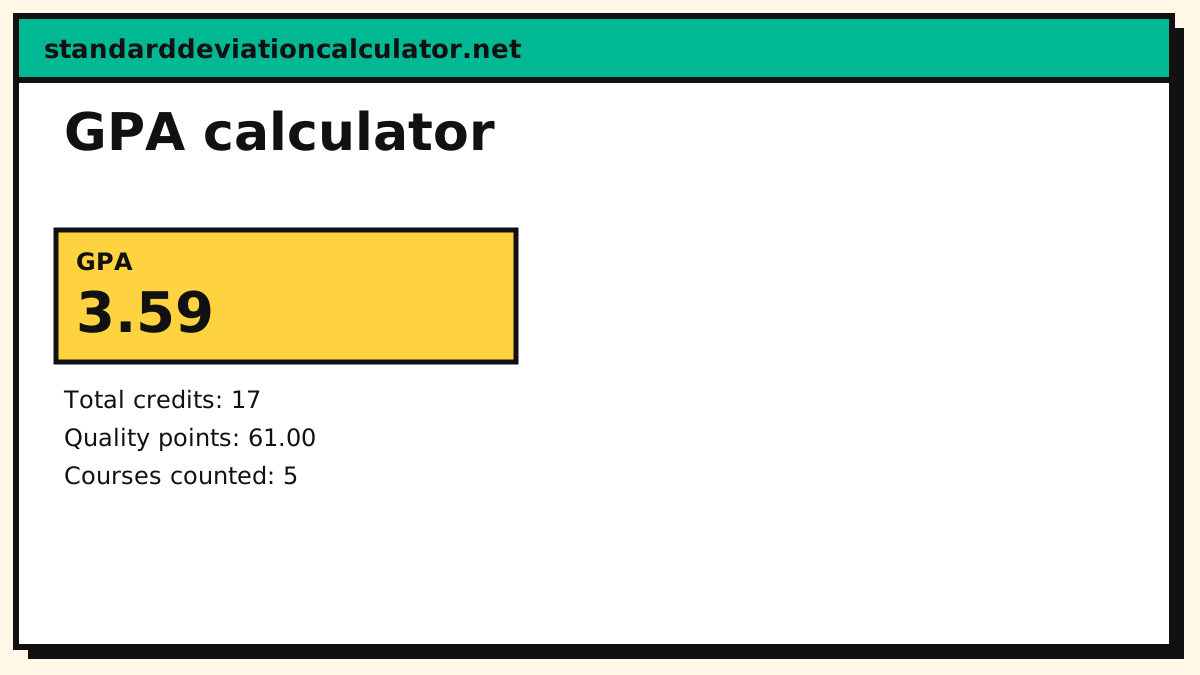
| Total | 17 | 61.00 |
Show the working, step by step
Multiply each grade’s points by its credits to get quality points.
A = 4.0, A− = 3.7, B+ = 3.3 and so on
Divide total quality points by total credits.
61.00 ÷ 17 = 3.59
How GPA is calculated
GPA = Σ (grade points × credits) ÷ Σ credits
An A is 4.0, A− 3.7, B+ 3.3, B 3.0 and so on down to F at 0. A 4-credit course counts four times as much as a 1-credit one. To track consistency across terms as well as the average, see the grade average calculator, which adds the standard deviation.
How to use the GPA calculator
Each row is one course. Type a name (optional), the grade as a letter (A, B+, C−) or as grade points (3.7), and the credits the course is worth. Add rows with the plus control and remove those you do not need; rows with a blank grade or credit are ignored. The headline is your credit-weighted GPA, with the total credits, the quality points and the number of courses counted below it, and a table that shows the points each course earned. To fold in your earlier record, fill in Cumulative GPA so far and Credits earned so far and the result also shows your new cumulative GPA.
The GPA formula
GPA = Σ (grade points × credits) ÷ Σ credits. A course’s quality points are its grade points times its credits, so a 4-credit B+ (3.3) earns 13.2 quality points and a 1-credit A earns 4. Add the quality points of every course and divide by the total credits attempted. The result is a weighted mean: a 4-credit course counts four times as much as a 1-credit one.
Worked example
Five courses: English A (3 credits), Calculus B+ (4), Chemistry A− (4), History B (3) and Statistics A (3). Quality points are 3 × 4.0 = 12, 4 × 3.3 = 13.2, 4 × 3.7 = 14.8, 3 × 3.0 = 9 and 3 × 4.0 = 12, a total of 61 over 17 credits, so the GPA is 61 ÷ 17 = 3.59. Credits change the picture: a 1-credit A and a 4-credit C average (4 + 8) ÷ 5 = 2.4, not the 3.0 you would get by averaging the two grades.
Typical grade-to-points scale
Many US schools use A = 4.0, A− = 3.7, B+ = 3.3, B = 3.0, B− = 2.7, C+ = 2.3, C = 2.0, C− = 1.7, D+ = 1.3, D = 1.0, D− = 0.7 and F = 0. Some give an A+ 4.3 or treat A+ and A alike; others have no plus/minus grades. This calculator reads an A+ as 4.0. If your school uses a different scale, enter your grade points as numbers.
Weighted and unweighted GPA
An unweighted GPA caps at 4.0 and ignores how hard a course is. A weighted GPA adds a bonus for honours or Advanced Placement (AP) courses, commonly 0.5 for honours and 1.0 for AP, so the maximum becomes 5.0. The bonus is school policy, not a standard. To get a weighted GPA here, enter the weighted grade points yourself, for example 5.0 for an A in an AP course.
Cumulative GPA
Your cumulative GPA combines every term. With a record of 3.2 over 60 credits and a new term of 17 credits at 3.59, the new cumulative is (3.2 × 60 + 61) ÷ 77 = 253 ÷ 77 = 3.29. The term only moves the average in proportion to its share of the credits, which is why a strong term raises a long record slowly. You can also work backwards to a target: to reach a 3.4 over 90 credits from 3.2 over 60, you need 3.4 × 90 − 3.2 × 60 = 114 quality points from the next 30 credits, a 3.8 average. A 3.5 target would need 4.1, which is impossible on a 4.0 scale.
How much one grade moves a long record
The more credits you have behind you, the less a single course changes your cumulative GPA. Start from 3.2 over 60 credits (192 quality points). Add a 3-credit A and the GPA becomes (192 + 12) ÷ 63 = 3.24. Add a 3-credit F and it becomes 192 ÷ 63 = 3.05. The same F early on, with only 12 credits behind you at 3.2, would cost far more: (38.4 + 0) ÷ 15 = 2.56. That is why a bad first term hurts more than a bad late one, and why a strong string of terms is needed to repair it. Use the cumulative fields above to test any scenario.
Using the calculator to plan a term
You can enter courses you have not finished yet. Type the grade you are aiming for in each row and read the resulting GPA, then change one grade at a time to see which course matters most. The highest-credit courses move the result the most, so they deserve the most attention. Treat the output as a target, not a prediction.
Withdrawals, pass/fail and other scales
A withdrawal (W), an incomplete (I) or a pass/fail grade usually earns credit or none but no grade points, so leave those rows out of the table. Outside the United States, systems differ: some countries use percentages, a 10-point scale or a scale on which 1.0 is the best grade. Convert using the conversion table your institution publishes before you enter grade points, and be careful with scales that run in the opposite direction.
Common mistakes
- Averaging grades instead of weighting by credits.
- Mixing weighted and unweighted points in one calculation.
- Counting pass/fail courses. Many schools leave them out of the GPA; leave their rows blank.
- Forgetting repeated courses. Some schools replace the old grade, others average both.
GPA rules differ between schools, so treat the result as an estimate and check your institution’s policy. For test scores and class averages with a standard deviation, use the grade average calculator.
Common questions
How do you calculate GPA?
Multiply each course grade’s points by its credits, add those quality points, and divide by total credits. Grades of A, B, A, B at 3 credits each average (4 + 3 + 4 + 3) ÷ 4 = 3.5.
Is an A+ worth more than an A?
On the common unweighted 4.0 scale both are 4.0. Some schools weight honours or AP courses on a 5.0 scale; enter those points as numbers.
What GPA do I need next term?
Take your target GPA × total credits (past plus planned), subtract your current quality points, and divide by the planned credits.
What is a good GPA?
It depends on the school, the program and what you are applying for. On a 4.0 scale a 3.0 is a B average and a 3.5 or above is often the line for honours or competitive programs. Some scholarships and graduate programs set a minimum between 3.0 and 3.5. Always check the exact requirement, because many programs also look at the last two years, major courses or test scores.
How can I raise my GPA?
High-credit courses move it most, and the earlier in your record the less any single course matters. With 60 credits at 3.2, a 3-credit A lifts the cumulative GPA to 3.24 and a 3-credit F drops it to 3.05. If your school lets you retake a course and replaces the grade, that can help more than extra courses. Ask whether replacement or averaging applies.
Do transfer credits count in my GPA?
Usually the credits count towards graduation but the grades do not enter the GPA at the new school. Policies differ, so check your registrar’s rules before you enter transfer courses.
Related calculators
-
Grade average calculator
Class average and consistency.
-
Weighted average
Any weights.
-
Mean calculator
A simple average.
-
Percentage calculator
Scores as percents.