How to solve integrals step by step
To solve an integral, reverse differentiation. Pick the method that matches the shape of the function, find an antiderivative F(x), then add + C for an indefinite integral or evaluate F(b) − F(a) for a definite one. Three methods cover most textbook problems.
Step 1. The power rule
∫ xⁿ dx = xⁿ⁺¹ ÷ (n + 1) + C, for n ≠ −1
Raise the power by 1, divide by the new power, and handle each term separately. Constants come outside, so ∫ 3x² dx = 3 · x³ ÷ 3 = x³.
Example. ∫ (3x² + 4x − 5) dx = x³ + 2x² − 5x + C.
The one exception is n = −1, because ∫ 1/x dx = ln|x| + C.
Step 2. A definite integral
Use the same antiderivative, drop the C, and subtract the value at the lower limit from the value at the upper limit. For F(x) = x³ + 2x² − 5x on [0, 2]:
- F(2) = 8 + 8 − 10 = 6
- F(0) = 0
- ∫₀² (3x² + 4x − 5) dx = 6 − 0 = 6
The result is signed area. Where the curve is below the x-axis it counts as negative, so the number can be smaller than the area you see.
Step 3. U-substitution
Use it when the integrand holds a function and, nearby, that function's derivative.
Example. ∫ 2x (x² + 1)³ dx
- Let u = x² + 1. Then du = 2x dx.
- The integral becomes ∫ u³ du = u⁴ ÷ 4 + C.
- Substitute back to get (x² + 1)⁴ ÷ 4 + C.
For a definite integral, either convert the limits to u or substitute back before evaluating. Mixing the two is the commonest error.
Step 4. Integration by parts
∫ u dv = uv − ∫ v du
Use it for a product of two different kinds of function. Choose u to be the part that gets simpler when differentiated (logs, then algebraic terms, then trig and exponentials, in that order).
Example. ∫ x eˣ dx
- Let u = x, dv = eˣ dx, so du = dx and v = eˣ.
- ∫ x eˣ dx = x eˣ − ∫ eˣ dx.
- The answer is x eˣ − eˣ + C, or eˣ(x − 1) + C.
How to check your answer
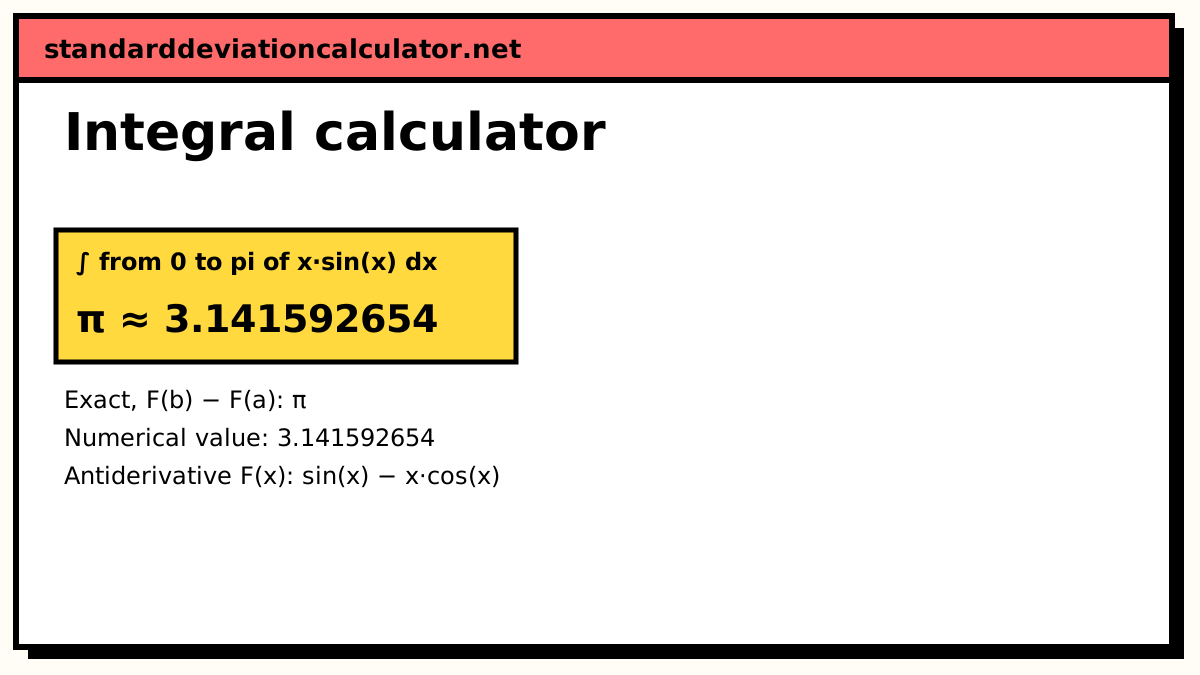
Differentiate the result. For x eˣ − eˣ the product rule gives eˣ + x eˣ − eˣ = x eˣ, the original integrand. The derivative calculator does this for any answer, and the integral calculator shows the numeric value and the shaded area for a definite integral.
Common mistakes
- Forgetting + C on an indefinite integral.
- Using the power rule on 1/x, which needs ln|x|.
- Not changing the limits when substituting in a definite integral.
- Choosing u badly in parts, so the new integral is harder than the old one.
Related calculators
-
Integral calculator
Definite and indefinite integrals, with the area plotted.
-
Derivative calculator
Differentiate your answer to check it.
-
Graphing calculator
Plot the function and see the area.
Common questions
What is the difference between a definite and an indefinite integral?
An indefinite integral gives a family of functions, F(x) + C. A definite integral has limits and gives a single number, F(b) − F(a), the signed area under the curve.
Why do you add + C?
Every constant differentiates to zero, so x² + 1 and x² − 7 have the same derivative. The C stands for the unknown constant. Drop it for definite integrals, where it cancels.
How do I know which method to use?
Try the power rule first. If you see a function and its derivative multiplied together, use substitution. If you see a product of unrelated types, such as x·eˣ or x·sin x, use integration by parts.
How can I check an integral?
Differentiate your answer. You should get the original function back. The integral calculator also plots the area for definite integrals.