Ideal gas law calculator
Choose the quantity you want, enter the other three, and get the answer from PV = nRT with the units converted for you. Defaults show the famous result: one mole of gas at 0 °C and 1 atm takes up 22.4 litres.
Show the working, step by step
Convert to base units: kPa, litres, moles and kelvin.
R = 8.314462618 kPa·L ÷ (mol·K)
Rearrange PV = nRT.
V = nRT ÷ P
Substitute and solve.
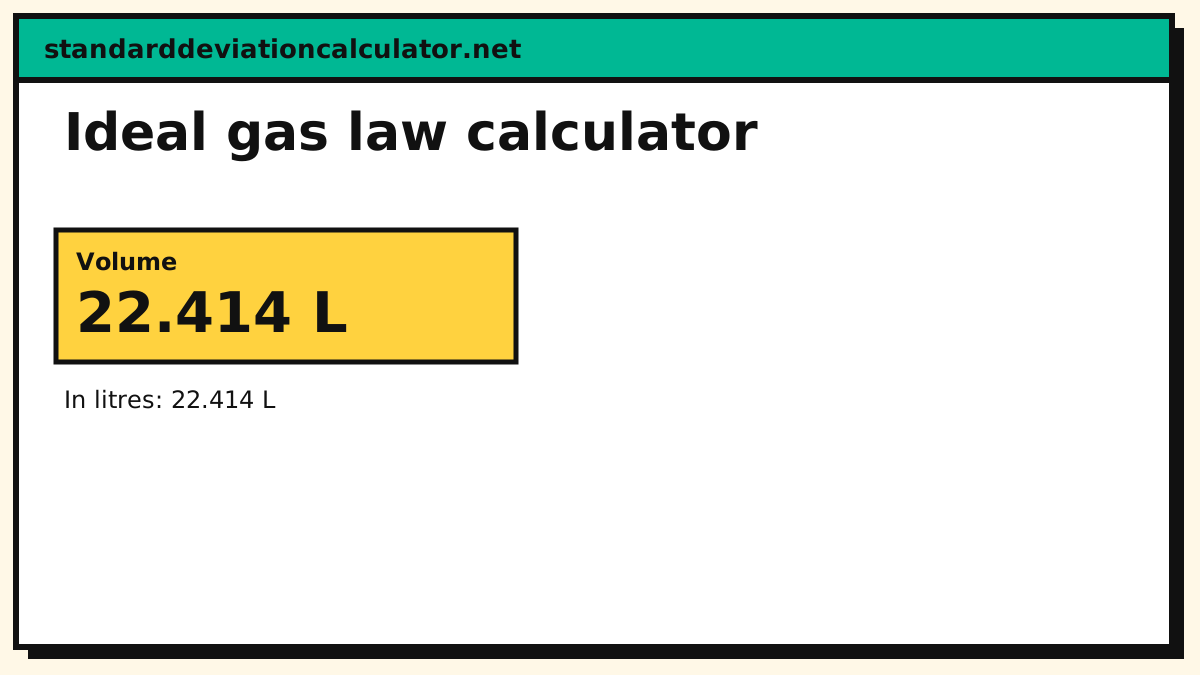
22.414 L
At 0 °C and 101.325 kPa one mole of an ideal gas occupies about 22.414 L. Real gases deviate at high pressure or low temperature.
The formula
PV = nRT V = nRT ÷ P, P = nRT ÷ V, n = PV ÷ RT, T = PV ÷ nR
R is the gas constant, 8.314462618 kPa·L/(mol·K). Use pressure in kPa, volume in litres, moles of gas and temperature in kelvin, or let the calculator convert from the units you have.
Worked example
How much volume do 2.5 mol of gas take at 25 °C and 150 kPa? Convert the temperature: 25 + 273.15 = 298.15 K. Then V = nRT ÷ P = 2.5 × 8.314462618 × 298.15 ÷ 150 = 41.3 L. Solving for pressure instead: a 10 L cylinder holding 0.5 mol at 300 K has P = 0.5 × 8.3145 × 300 ÷ 10 ≈ 124.7 kPa, about 1.23 atm.
Where it is used
- Converting between moles and volume of a gas in a chemical reaction (stoichiometry).
- Finding how pressure changes when a sealed container is heated.
- Estimating gas density: with the molar mass from the molecular weight calculator, density = P × M ÷ (R × T).
Limits of an ideal gas
The law assumes molecules have no volume and do not attract each other. That is accurate near room conditions for gases like nitrogen or helium and poor for gases near their boiling point or under high pressure. For other chemistry formulas such as molarity, dilution and pH, see the chemistry calculator.
Common questions
What is the ideal gas law?
PV = nRT: pressure times volume equals the amount of gas in moles times the gas constant times the absolute temperature. It links the four variables of a gas, so if you know any three you can find the fourth.
Which value of R does it use?
R = 8.314462618 J/(mol·K), which is the same as 8.314462618 kPa·L/(mol·K). The calculator converts your pressure, volume and temperature units to kPa, litres and kelvin first, so you never need to pick a matching R by hand (0.08206 L·atm/(mol·K) is the same constant in other units).
Why must temperature be in kelvin?
The law uses absolute temperature, where 0 K is the lowest possible. A gas at 0 °C is at 273.15 K, not 0. Typing a temperature in °C or °F is fine: the calculator converts it, and rejects anything at or below absolute zero.
What is the molar volume of a gas at STP?
One mole of an ideal gas at 0 °C and 101.325 kPa (1 atm) occupies 22.414 litres. Try it: leave the defaults and solve for volume.
When does the ideal gas law stop working?
At high pressure or low temperature, where molecules take up real space and attract each other. Real gases such as carbon dioxide near liquefaction depart from PV = nRT. Use a real-gas equation such as van der Waals for those cases.
Related calculators
-
Chemistry calculator
Molarity, dilution, pH and more.
-
Molecular weight calculator
Moles from grams.
-
Unit converter
Pressure, volume and temperature units.
-
Physics calculator
Formulas for motion and energy.