Velocity calculator
Velocity is how fast and in which direction something moves. Choose a method, enter your values in metres and seconds, and the calculator gives the velocity in m/s and km/h. Use it for distance over time, for the speed reached after accelerating, or for the average velocity between two points.
Show the working, step by step
Substitute the values.
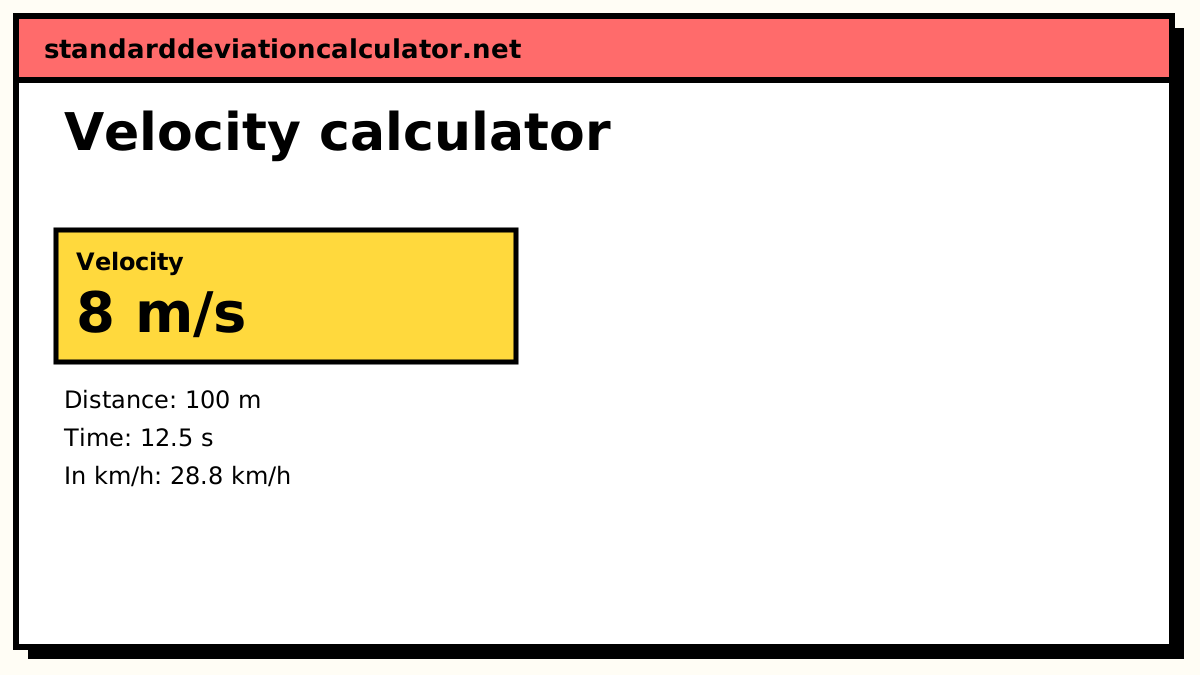
v = d ÷ t = 100 ÷ 12.5 = 8 m/s
Distance over time gives average speed or, for a displacement in a straight line, average velocity. Use SI units: metres and seconds.
How the velocity calculator works
v = d ÷ t v = u + at v̄ = (x₂ − x₁) ÷ (t₂ − t₁)
The first is distance over time. The second adds the velocity gained from a constant acceleration a over time t to the starting velocity u. The third is average velocity, the change in position over the change in time. In the third form the positions are signed numbers on one line, so a negative answer means motion in the negative direction. SI units only: metres, seconds and m/s. For other units, divide km/h by 3.6 or multiply mph by 0.44704 first.
Worked example
A runner covers 100 m in 12.5 s: v = 100 ÷ 12.5 = 8 m/s, which is 28.8 km/h. A cyclist who starts at 5 m/s and accelerates at 2 m/s² for 12.5 s reaches v = 5 + 2 × 12.5 = 30 m/s. An object at 20 m at t = 2 s and at −10 m at t = 8 s has average velocity (−10 − 20) ÷ (8 − 2) = −5 m/s.
Units and common mistakes
- Speed versus velocity. Total distance over time is average speed. Velocity uses displacement, so a round trip has an average velocity of 0.
- Minutes or hours with metres. Convert time to seconds, or the answer is not in m/s.
- Dropping the sign. A negative velocity means the opposite direction, not a mistake.
- Equal times. If t₁ = t₂ the average velocity is undefined, so the calculator refuses.
- Changing acceleration.
v = u + atneeds a constant a.
Related pages: the acceleration calculator, the force calculator and the physics calculator for the full set of motion equations.
Common questions
What is the formula for velocity?
Average velocity is displacement divided by time, v = d ÷ t. When the acceleration is
constant and known, the velocity after time t is v = u + at, where u is the initial
velocity.
What is the difference between speed and velocity?
Speed is distance travelled divided by time and has no direction. Velocity is displacement divided by time and has a direction. Run once round a 400 m track in 50 s: average speed is 8 m/s, but the average velocity is 0, because you finish where you started.
How do I find average velocity from two points?
Subtract the positions and the times: v = (x₂ − x₁) ÷ (t₂ − t₁). From x = 20 m at t = 2 s
to x = −10 m at t = 8 s, v = −30 ÷ 6 = −5 m/s: 5 m/s in the negative direction.
How do I convert m/s to km/h?
Multiply by 3.6. 8 m/s is 28.8 km/h. To go the other way, divide km/h by 3.6.
Can I use v = u + at when the acceleration changes?
No. It holds only for constant acceleration. If the acceleration varies, use the average acceleration over a short enough interval, or the area under the acceleration-time graph.
Related calculators
-
Physics calculator
Distance, velocity, acceleration and time from any three SUVAT values.
-
Acceleration calculator
a from velocity change, force or distance.
-
Force calculator
F = m × a, weight and net force.
-
Average calculator
The mean of several measured velocities.