Gas mileage calculator
Favorites
No favorites yet. Press Favorite on any page to keep it here.
Enter the miles driven and the fuel used to get your mpg, or enter your mpg and a distance to get the trip’s fuel and cost. Results include litres per 100 km and km per litre.
Show the working, step by step
Miles per gallon is distance divided by fuel.
350 ÷ 12.50 = 28.0 mpg
The formulas
mpg = miles ÷ gallons L/100 km = 235.215 ÷ mpg (US) trip cost = miles ÷ mpg × price per gallon
Fill the tank, reset the trip meter, drive normally, then refill. Miles driven ÷ gallons added is your real mpg, which is usually a little under the sticker figure.
How to use the gas mileage calculator
Choose fuel economy from distance and fuel used to work out your mpg, or trip fuel and cost to plan a journey. For the first, enter the miles driven since your last fill-up, the US gallons the next fill-up took and, if you want the cost, the price per gallon. For a trip, enter the distance, your car’s mpg and the fuel price. The result shows the headline figure plus miles per gallon, litres per 100 km, kilometres per litre, fuel used and the cost per mile.
How to measure your real mpg
Fill the tank to the automatic click-off and reset the trip meter. Drive as you normally do, then fill up again the same way, at the same pump if you can. Divide the miles on the trip meter by the gallons added. One tank can mislead because pumps stop at slightly different points, so repeat for three or four tanks and average the results. The car’s dashboard figure is an estimate and often reads a little optimistic.
Formulas and conversions
mpg = miles ÷ gallons L/100 km = 235.215 ÷ mpg (US gallons) km/L = mpg × 0.425144 trip cost = miles ÷ mpg × price per gallon
Fuel economy is written two opposite ways. Miles per gallon, where bigger is better, and litres per 100 km, where smaller is better. 28 mpg is 8.4 L/100 km, or 11.9 km per litre. UK miles per gallon use a larger imperial gallon of 4.546 litres, so 28 imperial mpg is only about 23.3 US mpg. This calculator uses US gallons.
Worked examples
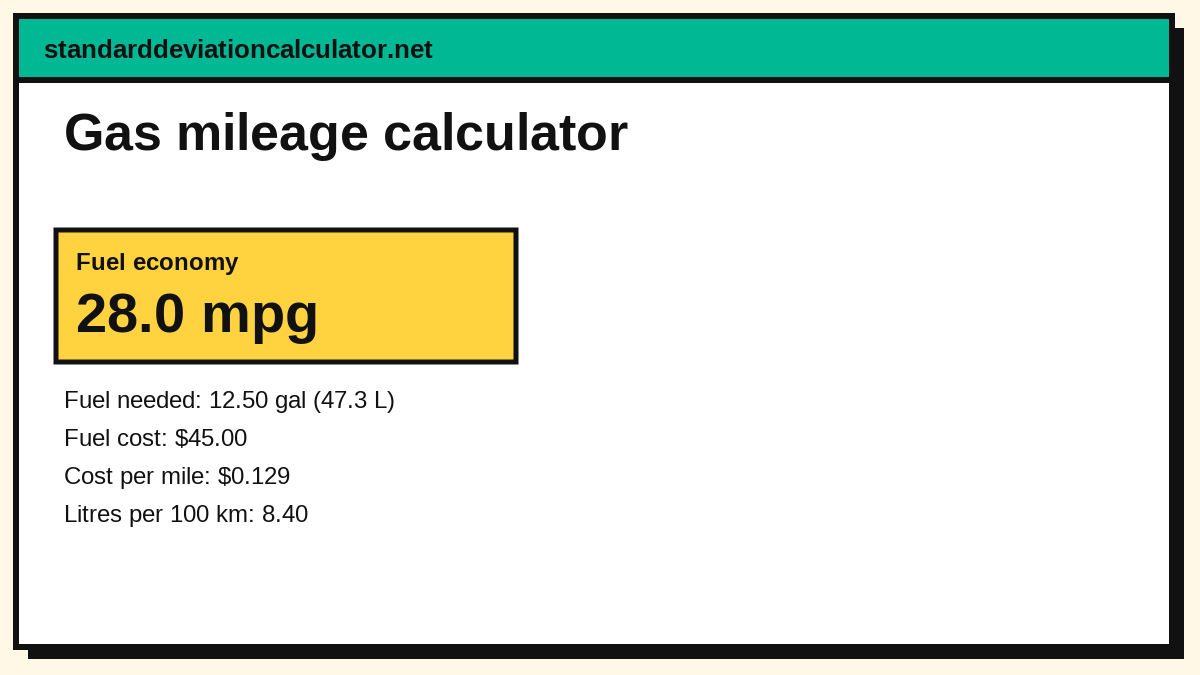
- Working out mpg: 350 miles on 12.5 gallons is 350 ÷ 12.5 = 28 mpg, or 8.4 L/100 km.
- Trip cost: a 350-mile trip in a 28 mpg car uses 12.5 gallons. At 3.60 a gallon that is 45.00, or 12.9 cents a mile.
- Comparing cars: over 12,000 miles a year at 3.60 a gallon, a 28 mpg car costs about 1,543 and a 40 mpg car costs 1,080, a saving of roughly 463.
Why mpg misleads: the gallons per 100 miles view
Gains in mpg get smaller in fuel terms as the number rises. Going from 15 to 20 mpg saves 1.67 gallons on every 100 miles, while going from 30 to 40 mpg saves only 0.83 gallons. Upgrading the least efficient vehicle saves the most fuel, which is why litres per 100 km is the fairer way to compare.
What changes your mileage
- Speed: aerodynamic drag grows quickly, so most cars use noticeably more fuel at 75 mph than at 60.
- Driving style: hard acceleration and braking waste energy that smooth driving keeps.
- Tyre pressure: under-inflated tyres increase rolling resistance.
- Weight and roof racks: extra load and cargo carriers cost fuel.
- Short trips and cold weather: a cold engine uses more fuel, and winter blends and heating cost a little more.
- Air conditioning: it draws power from the engine, especially in city driving.
Estimating a yearly fuel bill
Multiply miles per year by price per gallon and divide by mpg. For 12,000 miles at 28 mpg and 3.60 a gallon, that is 12,000 ÷ 28 × 3.60 = 1,543, or about 129 a month. Doing the calculation for a second car shows whether a more efficient model would repay a higher price. Over a five-year ownership, a car that saves 460 a year saves 2,300 in fuel.
Metric and imperial quick conversions
For a quick check, 30 mpg is about 7.8 L/100 km, 40 mpg about 5.9 and 50 mpg about 4.7. To go the other way divide 235.215 by the L/100 km figure. Prices quoted per litre become per gallon by multiplying by 3.785, so 0.95 a litre is 3.60 a gallon.
Common mistakes and limits
- Mixing gallons. A US gallon is 3.785 litres and an imperial gallon is 4.546 litres.
- Not filling to the same point. Different click-off points bend a single-tank result.
- Using the trip figure for electric cars. This tool is for fuel, not kWh.
- Forgetting the return leg. A round trip doubles the distance and the cost.
Common questions
How do you calculate miles per gallon?
Divide the miles driven by the gallons of fuel used. 350 miles on 12.5 gallons is 28 mpg.
How do I convert mpg to L/100 km?
Divide 235.215 by the US mpg. 28 mpg ≈ 8.40 L/100 km.
How much will a road trip cost in fuel?
Divide the distance by your mpg to get gallons and multiply by the price per gallon.
How do I calculate miles per gallon?
Divide the miles driven by the gallons of fuel used. 420 miles on 15 gallons is 28 mpg.
How do I convert mpg to litres per 100 km?
Divide 235.215 by the US mpg. 30 mpg is 7.84 L/100 km and 40 mpg is 5.88 L/100 km.
What is a good mpg?
It depends on the vehicle. Many modern petrol cars achieve 25 to 35 mpg in mixed driving, small efficient cars and hybrids often exceed 40 and large trucks and SUVs are commonly below 20.
Why is my real mpg lower than the sticker figure?
Official tests use standard cycles that are gentler than real driving. Speed, short trips, weather, tyre pressure and load all push real figures lower, often by 10% or more.
Related calculators
-
Unit converter
Miles, km, gallons, litres.
-
Pace calculator
Speed and distance.
-
Velocity calculator
Speed formulas.
-
Mean calculator
Average several fill-ups.