Construction materials calculator
Pick a material, enter the area and depth, and get the volume in cubic yards with a waste allowance, the approximate weight, or the gallons of paint a room needs.
Show the working, step by step
Volume = length × width × depth, then convert cubic feet to cubic yards (÷ 27).
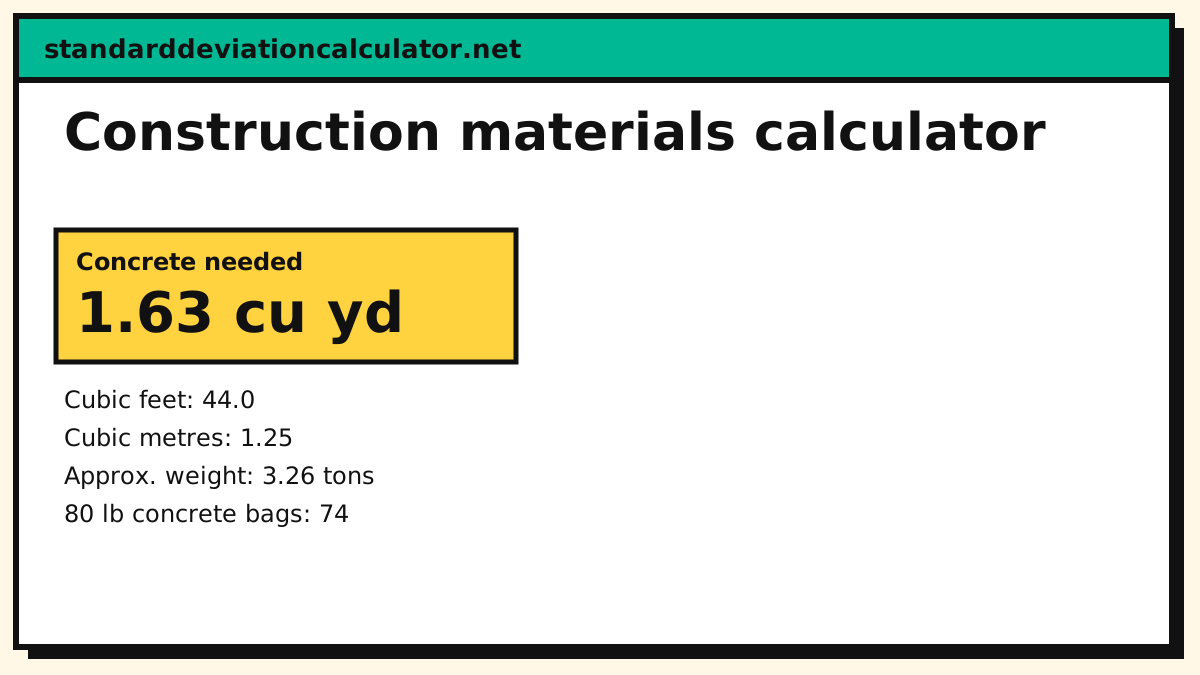
12 × 10 × 0.333 ÷ 27 × 1.10 = 1.63 cu yd
Weights and coverage vary by supplier; confirm with yours.
How the volume is worked out
cubic yards = length (ft) × width (ft) × depth (ft) ÷ 27
Enter depth in inches, which is divided by 12. Add 5 to 10% for waste and uneven ground. Paint covers about 350 sq ft per gallon per coat, so walls are perimeter × height less doors and windows. Weights are typical; suppliers vary.
How to use the materials calculator
Choose the material (concrete, gravel, topsoil, mulch or sand), enter the length and width of the area in feet and the depth in inches, and set an allowance for waste (10% is a common starting point). The result is the volume to order in cubic yards, with cubic feet, cubic metres, an approximate weight in tons and, for concrete, the number of 80 lb bags. For paint, enter the room’s length and width, the wall height, the number of coats and the area of doors and windows to subtract; the result is gallons. The last option gives the square footage and perimeter of a room.
The formulas
cubic yards = length (ft) × width (ft) × depth (in ÷ 12) ÷ 27 with waste: × (1 + waste %) paint gallons = wall area × coats × (1 + waste %) ÷ 350 wall area = 2 × (length + width) × height − openings
A cubic yard is 3 ft × 3 ft × 3 ft = 27 cubic feet, which is why the volume in cubic feet is divided by 27. Depth is typed in inches because that is how slabs and beds are specified, then divided by 12 to match the feet used for length and width. One gallon of paint typically covers about 350 square feet per coat, but check the label of the product you buy.
Worked examples
- A 12 ft × 10 ft concrete slab, 4 in thick: 12 × 10 × 0.3333 ÷ 27 = 1.48 cubic yards; with 10% waste, 1.63 cubic yards. In 80 lb bags (0.6 cubic feet each) that is about 67 bags without waste and 73 with it.
- A 20 ft × 10 ft patio, 4 in thick: 2.47 cubic yards, or 2.72 with 10% waste, roughly 122 bags of 80 lb mix.
- A gravel driveway strip, 30 ft × 10 ft, 4 in deep: 3.70 cubic yards, which at about 1.4 tons a cubic yard is roughly 5.2 tons.
- Mulch over a 20 ft × 20 ft bed at 3 in: 3.70 cubic yards, about 1.5 tons at 0.4 tons a cubic yard.
- A raised bed, 8 ft × 4 ft × 12 in: 32 cubic feet, 1.19 cubic yards of topsoil.
- A 12 ft × 10 ft room with 8 ft walls and 40 sq ft of doors and windows: 312 sq ft of wall; two coats with 10% waste need 312 × 2 × 1.10 ÷ 350 ≈ 1.96 gallons.
Bags of concrete, and how many in a yard
Bagged mix is sold by weight, and the volume it makes depends on the size: roughly 0.30 cubic feet for a 40 lb bag, 0.45 for 60 lb and 0.60 for 80 lb. A cubic yard needs about 90 bags of 40 lb, 60 of 60 lb or 45 of 80 lb. For anything larger than a few bags, compare the cost with ordering ready-mix delivered by truck: suppliers often have a minimum load and a short-load fee, so ask before you decide. The calculator’s bag count uses the 80 lb size.
Weights and densities
Materials are sold by volume (cubic yards) or by weight (tons), and suppliers convert with a typical density. The calculator assumes about 2 tons a cubic yard for concrete, 1.4 for gravel, 1.35 for sand, 1.1 for topsoil and 0.4 for mulch. Real values change with moisture, grading and the supplier, and wet mulch or soil can weigh much more than dry, so use the weight as a guide for loading and hauling and confirm with your supplier.
How much waste to allow
Order a little more than the calculated volume. A common allowance is 5 to 10% for concrete and 10% or more for gravel, mulch and soil, which settle, spill and compact. Add more where the ground is uneven, the formwork may bulge, or the material will be hauled in several trips. Running short on a concrete pour is far more expensive than ending up with a little extra.
Preparing for the pour or the spread
The calculator gives the volume of the material itself, not of the work around it. A concrete slab normally sits on a compacted sub-base of gravel or crushed stone, so calculate that layer separately with the gravel option and its own depth. Formwork, reinforcement (rebar or mesh), control joints and curing are not volume items but matter to the result. For soil and mulch, loosen the ground first and keep material away from tree trunks and house walls. When a job has several layers, run the calculator once per layer and add the totals.
Estimating cost
Multiply the volume by your supplier’s price per cubic yard (or per ton), and add delivery, any short-load fee and sales tax. Bagged products cost more per cubic yard than bulk, so for volumes above a couple of yards ask for a bulk or ready-mix quote. The sales calculator adds tax to a quoted price.
Other units
One cubic yard is 27 cubic feet, 0.7646 cubic metres and about 202 US gallons. For metric dimensions, convert to feet and inches first with the unit converter, or multiply length, width and depth in metres to get cubic metres directly. For the area and volume of other shapes see the area calculator and the volume calculator.
Common mistakes and limits
- Entering depth in feet. The depth box is in inches: 4 inches, not 0.33.
- Forgetting waste. Order the volume with the allowance, not the bare number.
- Using it for non-rectangular shapes. Columns, circular slabs, stairs and footings are not modelled. Work out the volume yourself (area times depth) and use the calculator for the conversion.
- Treating weights as exact. Densities vary; confirm with your supplier.
This is a planning aid, not a structural specification. For slabs, footings and anything load-bearing, follow local building codes and your engineer or contractor.
Common questions
How much concrete do I need for a slab?
Multiply length × width × thickness in feet and divide by 27. A 12 × 10 ft slab 4 inches thick is 12 × 10 × 0.333 ÷ 27 = 1.48 cubic yards, about 1.63 with 10% extra.
How many bags of concrete is a cubic yard?
About 45 bags of 80 lb mix (0.6 cu ft each) make a cubic yard.
How much paint do I need?
Wall area × coats ÷ 350 sq ft per gallon, plus 10% extra.
Can I use it with metric measurements?
Convert length and width to feet and the depth to inches first, or skip the calculator’s units: volume in cubic metres is length × width × depth, all in metres. A 4 m × 3 m slab 0.1 m thick is 1.2 cubic metres, about 1.57 cubic yards.
How thick should a concrete slab be?
A common thickness for patios and walkways is 4 inches. Driveways and garage floors are often 4 to 6 inches, and heavier loads need more plus reinforcement and a prepared base. Follow your local code and your contractor for anything structural.
How many 80 lb bags of concrete make a cubic yard?
About 45. An 80 lb bag yields roughly 0.6 cubic feet, and a cubic yard is 27 cubic feet, so 27 ÷ 0.6 = 45 bags. Plan on a few more for waste.
How much does a cubic yard of gravel weigh?
Roughly 1.4 tons (about 2,800 pounds), though it varies with the stone type, size and moisture. Ask your supplier for the weight of the product you are buying, especially for trailer or truck loads.
Related calculators
-
Area calculator
Shapes and areas.
-
Volume calculator
Solids and volumes.
-
Unit converter
ft³, yd³ and m³.
-
Rectangle and square
Room dimensions.