Discount, tax, tip and margin calculator
Five everyday money calculations in one place: a discounted price, sales tax added or taken back out, a tip split between friends, and the markup and margin on a sale.
Show the working, step by step
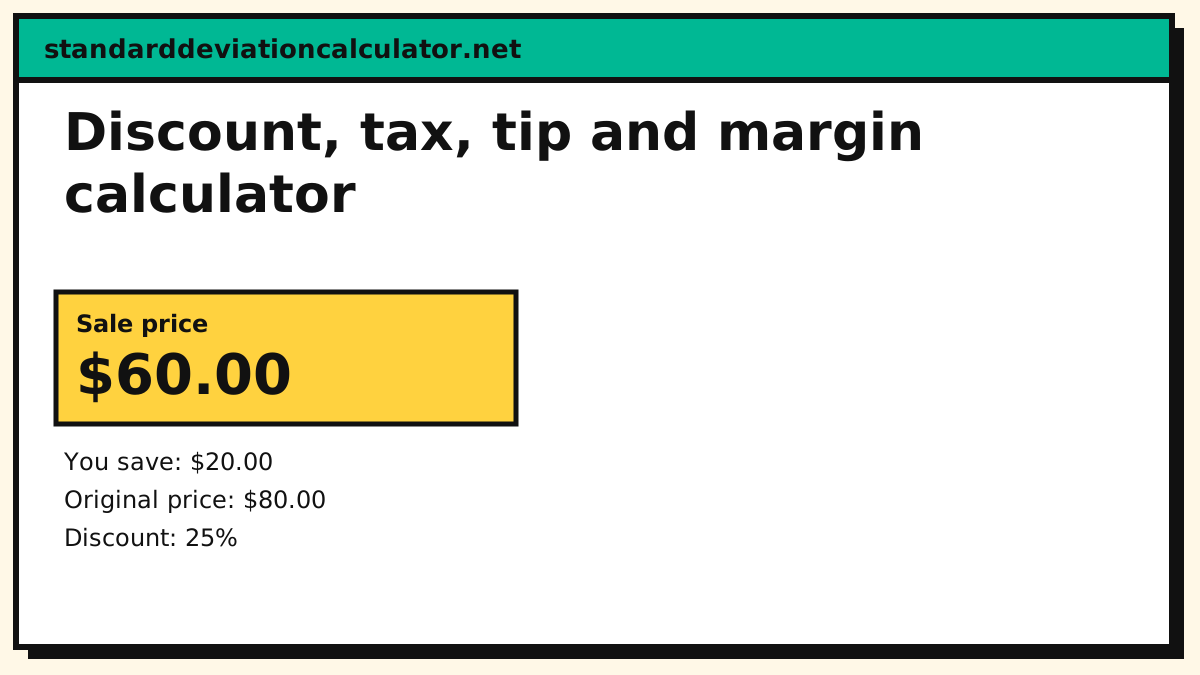
Multiply the price by the discount rate.
$80.00 × 25% = $20.00
Subtract it.
$80.00 − $20.00 = $60.00
Markup is not margin
Both measure profit, but against different bases. Markup = profit ÷ cost; margin = profit ÷ selling price. Buying at 80 and selling at 120 is a 50% markup but only a 33.3% margin.
How to use the discount, tax, tip and margin calculator
Pick the calculation, then fill in the boxes that appear. Discount takes the original price and a percentage off. Sales tax adds a tax percentage to a price, and reverse sales tax takes a price that already includes tax and shows what it was before. Tip takes the bill, a percentage and the number of people, and price from margin turns a cost and a target margin into a selling price. Markup and margin takes a cost and a selling price and shows both percentages. The result shows the headline answer with the working under it.
Discounts and sale prices
sale price = original × (1 − discount ÷ 100) you save = original × discount ÷ 100
A jacket priced at 80 with 25% off saves 80 × 0.25 = 20, so the sale price is 60. Discounts stack by multiplying, not adding: 20% off and then a further 10% off is 0.80 × 0.90 = 0.72, a total of 28% off, not 30%. If you know the sale price and the original, the discount is (original − sale) ÷ original.
Adding and removing sales tax
To add tax multiply by 1 plus the rate: 60 with 7% tax is 60 × 1.07 = 64.20. To take tax back out of a total, divide instead of subtracting the percentage, because the tax was charged on the pre-tax price. A receipt total of 107 at 7% tax was 107 ÷ 1.07 = 100 before tax, with 7 of tax. Subtracting 7% of 107 would give 99.51, which is wrong. Apply a discount before tax when the shop does: 200 with 25% off and 8% tax is 200 × 0.75 × 1.08 = 162.
Tipping and splitting a bill
Enter the bill, the tip percentage and the number of people to see the tip, the total and each person’s share. A 60 bill with an 18% tip is a tip of 10.80 and a total of 70.80; split four ways that is 17.70 each. Tipping customs differ widely by country and by venue, and a service charge may already be on the bill, so check before you add one. Whether the tip is worked out before or after tax is up to you; the calculator uses the amount you type.
Markup versus margin
markup = (price − cost) ÷ cost margin = (price − cost) ÷ price
Buying at 80 and selling at 120 gives a profit of 40. The markup is 40 ÷ 80 = 50% and the margin is 40 ÷ 120 = 33.3%. Margin can never reach 100% but markup has no upper limit. A 100% markup is only a 50% margin. Confusing the two is a classic way to underprice: someone who wants a 40% margin and adds 40% to cost ends with only a 28.6% margin.
Setting a price from a target margin
To hit a margin, divide the cost by 1 minus the margin. With a cost of 80 and a 40% margin the price is 80 ÷ 0.60 = 133.33, which is a markup of 66.7%. The price-from-margin mode does this for you. Remember that costs such as delivery, fees and returns come out of the margin, so a quoted margin is usually larger than what is left at the end.
Worked examples
- Sale then tax: 80 with 25% off is 60; with 7% tax the checkout shows 64.20.
- Backing out tax: a 107 total at 7% tax is 100 before tax.
- Group dinner: 240 bill, 15% tip, 6 people: 276 in total, 46 each.
- Shop pricing: cost 80, margin 40%, price 133.33.
Percentage change and “percent off” in reverse
If an item cost 80 and now costs 100, the price rose 25% (20 ÷ 80). If it then falls back from 100 to 80, that is a fall of only 20% (20 ÷ 100). The same 20-point gap is a different percentage because the base changed. This catches people out in sales: a price raised by 25% needs a 20% discount to return to where it started, and a price cut by 20% needs a 25% rise.
Pricing checks for small sellers
If you sell for 100 and your cost is 60, the margin is 40% and the markup is 66.7%. If a marketplace takes a 15% fee, you keep 85 and the margin drops to (85 − 60) ÷ 85 = 29.4%. Always work out margin after fees, shipping and returns. A discount hurts more than it looks: with a 40% margin, a 10% discount cuts profit from 40 to 30 per 100, a 25% fall in profit for a 10% fall in price.
Common mistakes and limits
- Adding discounts together. Successive discounts multiply.
- Subtracting tax as a percentage of the total. Divide by 1 plus the rate instead.
- Treating markup as margin. They only match at zero.
- Mixed tax rates. Some goods are taxed at different rates or not at all; the calculator applies one rate to the whole price.
Common questions
How do you calculate a discount?
Multiply the price by the discount rate and subtract: 80 less 25% = 80 − 20 = 60.
How do you remove sales tax from a total?
Divide the total by 1 plus the tax rate: 107 at 7% tax is 107 ÷ 1.07 = 100 before tax.
What is the difference between markup and margin?
Markup is a percentage of cost, margin a percentage of the selling price, so margin is always the smaller number.
How do I calculate a percentage discount?
Multiply the price by the discount percentage divided by 100 to find the saving, then subtract it. 25% off 80 is 80 × 0.25 = 20, leaving 60.
How do I find the price before tax?
Divide the total by 1 plus the tax rate as a decimal. A total of 53.50 with 7% tax is 53.50 ÷ 1.07 = 50 before tax.
Is 20% off and then 10% off the same as 30% off?
No. The second discount applies to the already reduced price, so the total is 28% off. In a 100 item that is a final price of 72, not 70.
What margin does a 50% markup give?
A markup of 50% means the price is 1.5 times the cost, so margin = 0.5 ÷ 1.5 = 33.3%. A 100% markup is a 50% margin and a 25% markup is a 20% margin.
Related calculators
-
Percentage calculator
Percent change and difference.
-
ROI, CAGR and NPV
Investment returns.
-
Loan calculator
Financing a purchase.
-
Inflation calculator
Prices over time.