Loan calculator
Enter the amount, rate and term to get the monthly payment, total interest and an amortization schedule. Works for mortgages, car loans, personal loans and EMIs; add an extra monthly payment to see the interest you save.
Added to the years, e.g. 5 years 6 months.
| Year | Principal paid | Interest paid | Balance |
|---|---|---|---|
| 1 | $2,794 | $16,168 | $247,206 |
| 2 | $2,981 | $15,981 | $244,224 |
| 3 | $3,181 | $15,781 | $241,043 |
| 4 | $3,394 | $15,568 | $237,649 |
| 5 | $3,621 | $15,341 | $234,027 |
| 6 | $3,864 | $15,098 | $230,163 |
| 7 | $4,123 | $14,839 | $226,041 |
| 8 | $4,399 | $14,563 | $221,642 |
| 9 | $4,694 | $14,269 | $216,948 |
| 10 | $5,008 | $13,954 | $211,940 |
| 11 | $5,343 | $13,619 | $206,597 |
| 12 | $5,701 | $13,261 | $200,896 |
| 13 | $6,083 | $12,879 | $194,813 |
| 14 | $6,490 | $12,472 | $188,323 |
| 15 | $6,925 | $12,037 | $181,398 |
| 16 | $7,389 | $11,573 | $174,009 |
| 17 | $7,884 | $11,078 | $166,126 |
| 18 | $8,412 | $10,551 | $157,714 |
| 19 | $8,975 | $9,987 | $148,739 |
| 20 | $9,576 | $9,386 | $139,163 |
| 21 | $10,217 | $8,745 | $128,946 |
| 22 | $10,902 | $8,061 | $118,044 |
| 23 | $11,632 | $7,330 | $106,413 |
| 24 | $12,411 | $6,551 | $94,002 |
| 25 | $13,242 | $5,720 | $80,760 |
| 26 | $14,129 | $4,833 | $66,632 |
| 27 | $15,075 | $3,887 | $51,557 |
| 28 | $16,084 | $2,878 | $35,473 |
| 29 | $17,162 | $1,800 | $18,311 |
| 30 | $18,311 | $651 | $0 |
Show the working, step by step
Convert the annual rate to a monthly rate.
i = 6.5 ÷ 12 ÷ 100 = 0.00541667
Apply the payment formula with n monthly payments.
M = P·i ÷ (1 − (1 + i)−n) = $1,580.17
Each month interest is balance × i; the rest of the payment reduces the balance.
Month 1 interest = $1,354.17
The loan payment formula
M = P · i / (1 − (1 + i)^−n) i = annual rate ÷ 12, n = number of monthly payments
Each month interest is the remaining balance times i; whatever is left of the payment reduces the balance, so interest shrinks and principal grows over time.
How to use the loan calculator
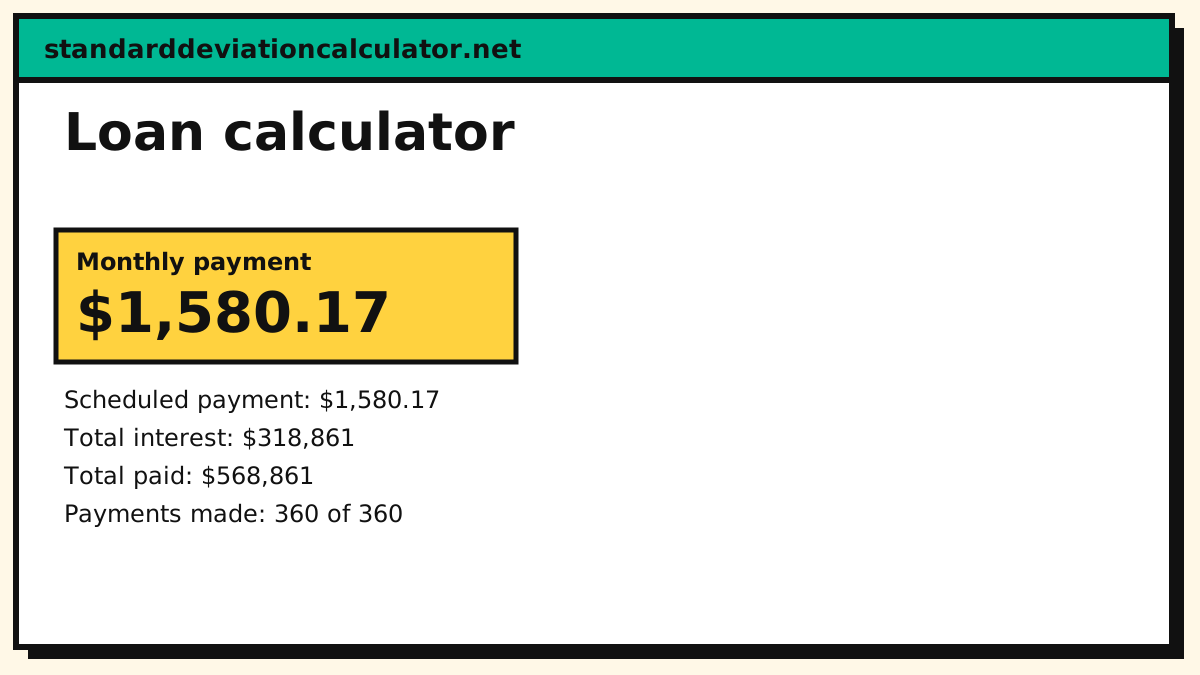
Enter the loan amount, the annual interest rate and the term as years plus any extra months (5 years and 6 months is 5 and 6). Optionally add an extra payment per month to see how paying early changes the loan. Choose your currency symbol if it is not the dollar. The headline number is the monthly payment including any extra amount; the cells show the scheduled payment, the total interest, the total paid and how many payments were needed. If you added an extra payment, two more cells show the interest saved and the months saved. The table underneath is the amortization schedule by year.
The loan payment formula
For a fixed-rate loan repaid in equal monthly instalments, the payment is M = P × i ÷ (1 − (1 + i)−n), where P is the amount borrowed, i is the monthly rate (the annual rate ÷ 12) and n is the number of payments. Each month the interest is the outstanding balance times i; whatever remains of the payment reduces the balance. Because the balance starts high, early payments are mostly interest, and the share going to principal grows over time. At a 0% rate the formula collapses to P ÷ n.
Worked example: a $20,000 car loan
Borrow $20,000 at 7% for 5 years. The monthly rate is 0.07 ÷ 12 = 0.005833 and n = 60, so the payment is $396.02. Over 60 payments you repay $23,761, which means about $3,761 in interest. On a larger loan the same arithmetic gives the earlier $250,000 example: at 6.5% over 30 years the payment is $1,580.17 and the interest comes to $318,861, more than the amount borrowed.
Extra payments: what they save
Extra money goes straight to principal, so every later month’s interest is charged on a smaller balance. Adding $100 a month to the car loan above shortens it from 60 payments to 47 and cuts the total interest from $3,761 to about $2,868, a saving of roughly $893. On the $250,000 loan, $200 extra a month ends the loan after 265 months (22 years and 1 month instead of 30) and saves about $97,618 of interest. The earlier you start, the larger the effect, because the balance is highest at the start. Check your loan agreement first: some lenders charge a prepayment penalty or require you to say that extra money is for principal.
Choosing a term: payment versus total interest
The same $20,000 at 7% costs very different amounts depending on how long you take. Over 3 years the payment is $617.54 and the total interest $2,232. Over 5 years it is $396.02 and $3,761. Over 7 years it is $301.85 and $5,356. Each extra year cuts the monthly strain but adds interest, and a longer car loan also leaves you owing more than the car is worth for longer. Pick the shortest term whose payment fits comfortably in your budget, then use extra payments for flexibility rather than committing to a bigger required payment.
Interest rate or APR?
The interest rate is the cost of borrowing the money alone. The APR (annual percentage rate) adds certain fees and charges to express the whole yearly cost, so it is usually a little higher and is the better figure for comparing offers. This calculator uses the rate you enter in the formula; if you only know the APR, you can still use it for a close estimate, but the lender’s disclosed payment is the number that counts. An EMI (equated monthly instalment), the term used in India and elsewhere, is exactly this monthly payment.
Refinancing: when does a new loan pay off?
Refinancing replaces a loan with a new one at a better rate or a different term. It only pays if the saving covers the cost of switching. The break-even point is the refinancing cost divided by the monthly saving: if a new loan saves $120 a month and costs $3,600 in fees, you break even after 30 months, so it only makes sense if you will keep the loan longer than that. Remember that restarting a 30-year clock after years of payments can raise the total interest even when the payment falls. Run the new loan through the calculator with the remaining balance as the amount and compare the total interest.
Simple interest versus amortizing loans
This calculator is for amortizing loans, where interest is charged on the remaining balance and every payment is the same. Some short-term loans use simple interest on the original amount instead, or charge a fixed fee. For those, the total cost is not the payment formula’s, so compare them on total repaid and the APR the lender must disclose, not on the quoted rate alone.
The amortization schedule
The yearly table lists the principal paid, the interest paid and the balance at the end of each year, so you can see when a loan is half repaid in money terms (later than half the term, because of the front-loaded interest). Any extra payment is included and the table stops when the balance reaches zero.
Common mistakes and limits
- Comparing loans on the monthly payment alone. A longer term lowers the payment and raises the total interest.
- Ignoring fees. Origination fees, insurance and add-on products are not in the payment formula.
- Assuming a fixed rate. Variable-rate loans change the payment; this tool assumes the rate never changes.
- Treating the result as a quote. It is an estimate to plan with; your lender’s disclosure governs.
For a home purchase, including property tax, insurance and PMI in the monthly figure, use the mortgage calculator; for the effect of interest on savings rather than debt, see the compound interest calculator.
Common questions
How is a monthly loan payment calculated?
With M = P·i ÷ (1 − (1 + i)^−n), where P is the amount borrowed, i the monthly rate and n the number of payments. A 250,000 loan at 6.5% over 30 years costs about 1,580 a month.
Does an extra payment shorten the loan?
Yes. Extra money goes straight to principal, so later interest is charged on a smaller balance and the loan ends earlier.
Is this an EMI calculator?
Yes: EMI is the same level monthly payment, so enter the amount, annual rate and tenure.
Can I use this for a car loan or personal loan?
Yes. Any fixed-rate loan repaid in equal monthly payments works: enter the amount borrowed, the annual rate and the term. For a car loan, subtract your down payment or trade-in value from the price first, then enter what you actually borrow. Sales tax and fees financed into the loan should be included in the amount.
Does paying every two weeks help?
A bi-weekly plan pays half a payment every two weeks, which is 26 half-payments or 13 full payments a year instead of 12. That is the same as one extra monthly payment a year. On the $250,000 loan at 6.5% it behaves like about $131.68 extra each month, which ends the loan after 290 months and saves roughly $72,700 of interest. Enter that figure as the extra payment to see it. Confirm with your lender how bi-weekly payments are applied.
What is the difference between a fixed and a variable rate?
A fixed rate never changes, so every payment is the same, which is what this calculator models. A variable (adjustable) rate moves with a market index, so the payment can rise or fall. Compare the loan’s worst-case rate cap, not just its starting rate.
Related calculators
-
Finance calculator (TVM)
Solve N, I/Y, PV, PMT or FV.
-
Compound interest
Growth instead of debt.
-
Investment calculator
Saving toward a target.
-
ROI, CAGR and NPV
Judge a return.