Depreciation calculator
Enter the cost, salvage value and useful life to get a full depreciation schedule with accumulated depreciation and book value each year, by four standard methods.
| Year | Depreciation | Accumulated | Book value |
|---|---|---|---|
| 1 | $4,400.00 | $4,400.00 | $20,600.00 |
| 2 | $4,400.00 | $8,800.00 | $16,200.00 |
| 3 | $4,400.00 | $13,200.00 | $11,800.00 |
| 4 | $4,400.00 | $17,600.00 | $7,400.00 |
| 5 | $4,400.00 | $22,000.00 | $3,000.00 |
Show the working, step by step
Spread the depreciable amount evenly over the life.
($25,000.00 − $3,000.00) ÷ 5 = $4,400.00 a year
The methods
Straight line = (cost − salvage) ÷ life Declining balance = book value × (factor ÷ life) SYD = (cost − salvage) × (remaining life ÷ sum of years)
Straight line spreads the cost evenly. The other three front-load it, charging more in the early years when an asset loses value fastest. Tax rules (MACRS in the US) may require a specific method, so check yours.
How to use the depreciation calculator
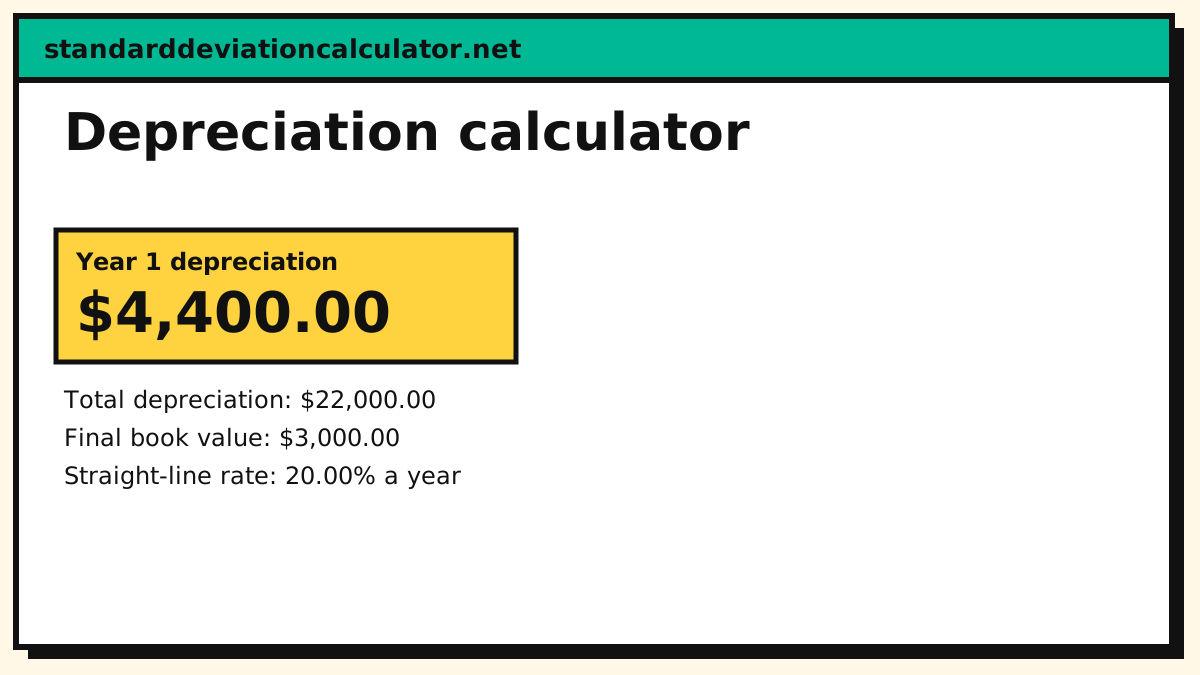
Enter the asset cost, its expected salvage value (what it should be worth at the end of its life, which can be zero) and its useful life in whole years, then choose a method: straight line, double declining balance, 150% declining balance or sum of the years’ digits. You can pick the currency symbol too. The result shows the first year’s depreciation, the total that will be depreciated, the final book value and the straight-line rate, and a table lists each year’s depreciation, the accumulated depreciation and the book value at year end. The calculator never takes the book value below the salvage value.
What depreciation is and why it is recorded
When a business buys equipment, a vehicle or a building, the cost does not all belong to the year of purchase: the asset helps earn income for many years. Depreciation spreads the cost over that life, so each year’s profit carries a fair share of it. It is an accounting allocation, not a cash payment, and the book value (cost minus accumulated depreciation) is not the same as the market value. In many tax systems depreciation also reduces taxable income, but the rules for tax are separate from the accounting methods here and differ by country.
The four methods and their formulas
- Straight line: (cost − salvage) ÷ life. The same amount every year.
- Declining balance: each year, opening book value × (factor ÷ life). The factor is 2 for double declining and 1.5 for 150% declining. The amount falls every year, the last year is trimmed so the book value ends exactly at salvage, and it never goes below it.
- Sum of the years’ digits (SYD): (cost − salvage) × (years remaining ÷ sum of the years). For a 5-year life the sum is 5 + 4 + 3 + 2 + 1 = 15, so year 1 takes 5/15, year 2 takes 4/15 and so on.
Worked example: a $25,000 asset
Cost $25,000, salvage $3,000, life 5 years, so $22,000 will be depreciated in total.
| Year | Straight line | Double declining | 150% declining | Sum of years’ digits |
|---|---|---|---|---|
| 1 | $4,400.00 | $10,000.00 | $7,500.00 | $7,333.33 |
| 2 | $4,400.00 | $6,000.00 | $5,250.00 | $5,866.67 |
| 3 | $4,400.00 | $3,600.00 | $3,675.00 | $4,400.00 |
| 4 | $4,400.00 | $2,160.00 | $2,572.50 | $2,933.33 |
| 5 | $4,400.00 | $240.00 | $3,002.50 | $1,466.67 |
Every column adds up to $22,000. The accelerated methods charge more in the early years: double declining takes $10,000 in year 1 (40% of $25,000, because 2 ÷ 5 = 40%) and only $240 in year 5, when the book value has fallen to $3,240 and the remaining $240 brings it to salvage. In the declining-balance columns the final year is whatever is left to reach salvage, which is why year 5 is not a smooth continuation.
A second example: a $50,000 machine over 10 years
With a $5,000 salvage value the straight-line charge is $4,500 a year. Double declining starts at $10,000 and shrinks: $10,000, $8,000, $6,400, $5,120, $4,096, $3,277, $2,621, $2,097, $1,678 and $1,711 in the final year. Sum of the years’ digits (the sum is 55) starts at 10 ÷ 55 × $45,000 = $8,182 and falls by $818 a year to $818 in year 10. Run the numbers for your own asset to see how much of the cost falls in the first three years under each method.
Which method should you use?
Straight line suits assets that give about the same benefit each year, such as buildings or furniture. Accelerated methods suit assets that lose value or usefulness fastest when new, such as vehicles, computers and machinery. Many businesses also keep separate records for accounting and for tax. Use the method your accounting framework or tax authority requires for the purpose at hand; if you are unsure, ask an accountant.
Book value and the gain or loss on a sale
Book value is cost minus accumulated depreciation. If you sell the asset for more than its book value you have a gain, and for less a loss. In the $25,000 example, after 3 years the straight-line book value is $11,800 and the double-declining book value is $5,400. Selling for $9,000 would be a $2,800 loss under straight line but a $3,600 gain under double declining. The method you chose changes the profit you report, not the cash you receive.
Salvage value and useful life
Both are estimates. Useful life is how long the business expects to use the asset (not how long it could physically last), and salvage value is what it expects to get when it disposes of it. A salvage value of zero is common for equipment that will have no resale value. Revising an estimate later is normal, and the schedule should then be recalculated from the new book value, which this calculator does not do mid-life.
Where depreciation appears in the accounts
Each year’s depreciation is an expense on the income statement. On the balance sheet the asset stays at its cost, and the running total of depreciation appears as accumulated depreciation, a deduction from it; the difference is the book value. So in year 3 of the $25,000 straight-line example the asset is shown at $25,000, accumulated depreciation is $13,200 and the book value is $11,800. When the asset is sold or scrapped, both the cost and the accumulated depreciation are removed and any difference from the proceeds is a gain or loss.
Depreciation, amortization and depletion
The three words describe the same idea for different things. Depreciation spreads the cost of physical assets such as machinery and vehicles. Amortization does the same for intangible assets such as patents or software (and is also the word for paying off a loan gradually). Depletion allocates the cost of natural resources such as timber or minerals as they are used. This calculator handles depreciation of a tangible asset by four time-based methods.
Checking a schedule against a spreadsheet
Spreadsheets have matching functions, so you can confirm any figure. For the $25,000 example, =SLN(25000,3000,5) returns 4,400, =DDB(25000,3000,5,1) returns 10,000 for year 1 and =SYD(25000,3000,5,1) returns 7,333.33. Two quick checks catch most mistakes: the yearly charges must add up to cost minus salvage, and the book value must never fall below the salvage value.
What is not covered
- MACRS and other tax systems. United States tax depreciation uses prescribed recovery periods and tables rather than these four methods.
- Units of production. Depreciation based on output or hours used, not time, is not modelled.
- Partial years. The schedule assumes the asset is in use for whole years from the start of year 1.
- Land is generally not depreciated; only buildings and improvements on it are.
The results are for illustration and bookkeeping practice, not tax or accounting advice. For the cost of financing an asset see the loan calculator, and for whether a purchase pays back, the ROI, CAGR and NPV calculator.
Common questions
What is salvage value?
The amount you expect the asset to be worth at the end of its useful life. Depreciation stops when book value reaches it.
Which depreciation method is best?
Straight line is simplest; accelerated methods match assets that lose value quickly. Use the one your accounting or tax rules require.
How is double declining balance calculated?
Each year, multiply the opening book value by 2 ÷ useful life, without going below salvage.
What useful life should I use?
Use the period you expect to get value from the asset, which your accounting policy or tax rules may fix by asset class. Computers are often depreciated over a few years, vehicles and equipment over several, and buildings over decades. A shorter life front-loads the expense; a longer one spreads it thinly. Be consistent from year to year.
Do vehicles depreciate the same way in accounts and in the market?
No. A car’s market value usually drops fastest in its first years, which the accelerated methods resemble, but the accounting schedule is a policy choice and does not track resale prices. The book value is what your records say, not what a buyer would pay.
What is the double declining balance rate?
Twice the straight-line rate: 2 ÷ useful life. For a 5-year life the straight-line rate is 20% so double declining is 40% of the opening book value each year; for a 10-year life it is 20%.
Can the salvage value be zero?
Yes. Enter 0 for an asset you expect to scrap or give away. The whole cost is then depreciated over the life: $25,000 over 5 years straight line is $5,000 a year.
Is depreciation a cash expense?
No. The cash leaves when you buy the asset. Depreciation is a yearly accounting charge that spreads that cost over the asset’s useful life, so it lowers reported profit without any payment in that year.
Related calculators
-
Loan calculator
Financing the asset.
-
ROI, CAGR and NPV
Judge the purchase.
-
Inflation calculator
Replacement cost.
-
Discount and margin
Pricing.