Math
Physics calculator
The standard formulas of school and first-year mechanics in one place. Pick a calculation, fill in what you know, and leave the unknown blank where the form says so. Every answer comes with the rearranged formula and the numbers put in.
Fill in any three and leave two blank.
Leave one of F, m and a blank.
Give a time to get the average force.
Standard gravity. Moon 1.62, Mars 3.71.
Leave one of ρ, m and V blank.
Leave one of P, F and A blank.
Leave one of v, f and λ blank.
The slope of the line is the acceleration; the area between the line and the time axis is the displacement, 36 m.
| Equation | Check with these values |
|---|---|
| v = u + at | 13 = 13 |
| s = ut + ½at² | 36 = 36 |
| s = (u + v)t ÷ 2 | 36 = 36 |
| v² = u² + 2as | 169 = 169 |
| s = vt − ½at² | 36 = 36 |
Show the working, step by step
Known: u = 5 m/s, a = 2 m/s², t = 4 s. Unknown: s and v.
Pick the equation that contains the three knowns and one unknown, rearrange, and substitute:
v = u + at = 5 + 2 × 4 = 13 m/s
Then use the new value to find the last unknown:
s = ut + ½at² = 5 × 4 + ½ × 2 × 4² = 36 m
All five SUVAT equations hold only while the acceleration is constant. Take one direction as positive and give velocities and accelerations against it a minus sign.
The SUVAT equations
v = u + at s = ut + ½at² s = (u + v)t ÷ 2 v² = u² + 2as s = vt − ½at²
These hold for motion in a straight line while the acceleration stays constant. Each equation
leaves out one of the five quantities, which is why three known values are always enough: the
calculator picks the equation that contains your three knowns and one unknown, solves it, and
then uses the new value to find the fifth. When the unknown is the time and the equation is
quadratic (s = ut + ½at² with t missing), it takes the earliest positive root, the
first moment the body reaches that displacement.
A worked example
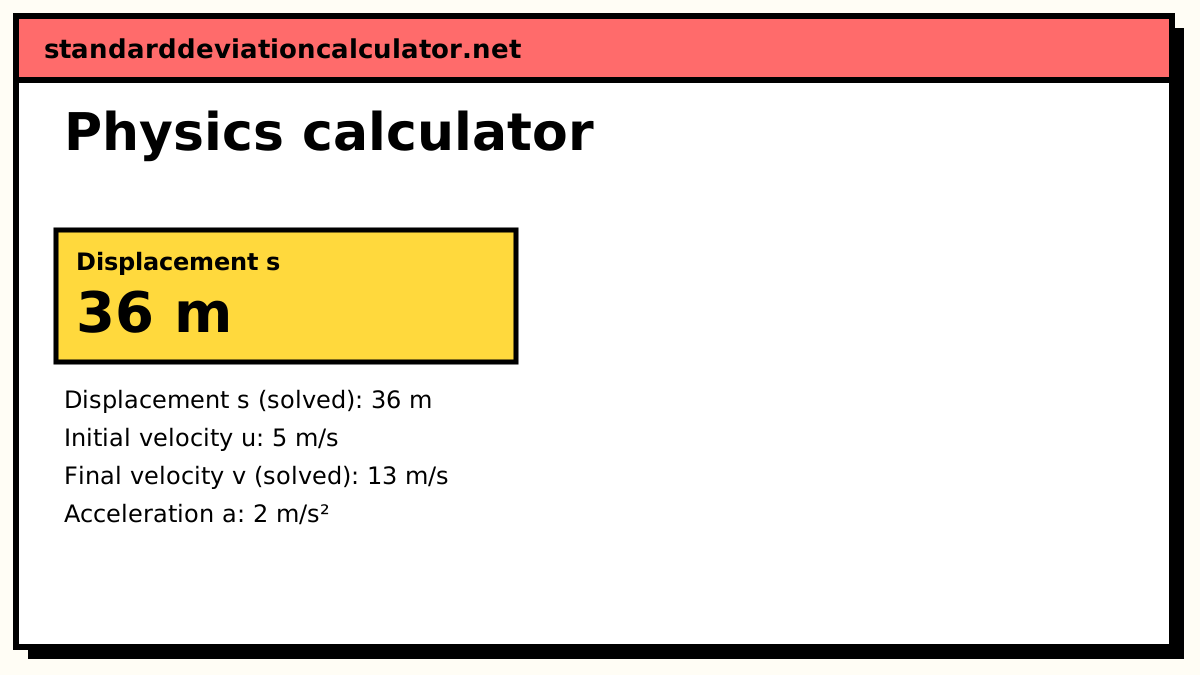
The calculator's default: a cyclist moving at u = 5 m/s accelerates at a = 2 m/s² for t = 4 s. How fast is she going, and how far does she travel?
- The known values are u, a and t, so s and v are unknown.
v = u + at = 5 + 2 × 4 = 13 m/s.s = ut + ½at² = 5 × 4 + ½ × 2 × 4² = 20 + 16 = 36 m.- Check with an equation that was not used:
v² = 13² = 169andu² + 2as = 25 + 2 × 2 × 36 = 169. They agree.
Projectile motion
vₓ = v₀ cos θ vᵧ = v₀ sin θ t = (vᵧ + √(vᵧ² + 2gh₀)) ÷ g R = vₓ t H = h₀ + vᵧ² ÷ 2g
Without air resistance the horizontal and vertical motions are independent. Horizontally nothing acts, so vₓ stays constant; vertically the acceleration is −g, so the vertical motion is a SUVAT problem. Launched at 20 m/s and 45° from level ground, vₓ = vᵧ = 14.142 m/s, the flight lasts 2.884 s, the range is 40.79 m and the peak is 10.20 m. Set a launch height h₀ for a ball thrown from a cliff or a shot put released at shoulder height.
The other formulas
| Quantity | Formula | SI unit | Default example |
|---|---|---|---|
| Force (Newton's second law) | F = ma | N | 10 kg × 3 m/s² = 30 N |
| Weight | W = mg | N | 10 kg × 9.80665 = 98.07 N |
| Work | W = Fd cos θ | J | 50 N × 8 m × cos 30° = 346.4 J |
| Kinetic energy | KE = ½mv² | J | ½ × 10 × 12² = 720 J |
| Potential energy | PE = mgh | J | 10 × 9.80665 × 5 = 490.3 J |
| Power | P = W ÷ t = Fv | W | 4,500 J ÷ 15 s = 300 W |
| Momentum, impulse | p = mv, J = FΔt = Δp | kg·m/s, N·s | 10 × (6 − 0) = 60 N·s |
| Density | ρ = m ÷ V | kg/m³ | 10 kg ÷ 0.004 m³ = 2,500 kg/m³ |
| Pressure | P = F ÷ A | Pa | 500 N ÷ 25 cm² = 200 kPa |
| Wave speed | v = fλ | m/s | 440 Hz × 0.78 m = 343.2 m/s |
Common mistakes
- Mixing units. Convert to kilograms, metres and seconds before using a formula. 25 cm² is 0.0025 m², not 0.25 m², which is why the pressure example above comes to 200,000 Pa. The unit menus here do the conversion for you.
- Forgetting signs. Choose a positive direction and stick to it. A ball thrown upwards at 15 m/s under gravity has u = 15 and a = −9.80665 if up is positive.
- Using SUVAT when the acceleration changes. A falling object with air resistance, or a car whose engine force varies, does not have constant acceleration; the equations then give only an approximation.
- Using the whole force in the work formula. Only the component along the motion, F cos θ, does work. Pulling a sledge with 50 N at 30° to the ground does 43.3 N worth of useful pulling.
- Mass for weight. A bathroom scale reads in kilograms but measures a force; in a physics answer weight is in newtons.
Common questions
What are the SUVAT equations?
Five equations for motion in a straight line with constant acceleration, linking
displacement s, initial velocity u, final velocity v, acceleration a and time t:
v = u + at, s = ut + ½at², s = (u + v)t ÷ 2,
v² = u² + 2as and s = vt − ½at². Each leaves out one of the five
quantities, so with any three known there is always one equation with a single unknown.
Which launch angle gives the longest range?
45°, when the projectile lands at the height it was launched from and air resistance is
ignored. The range is R = v₀² sin 2θ ÷ g, and sin 2θ is largest (1) at θ = 45°.
At 20 m/s that is 20² ÷ 9.80665 = 40.79 m. Launching from a height moves the best angle
below 45°, and real air resistance lowers it further.
What value of g should I use?
Standard gravity is exactly 9.80665 m/s², the value used for defining the kilogram-force and the default here. Actual g varies from about 9.78 m/s² at the equator to 9.83 m/s² at the poles. Many school courses round to 9.8 or 9.81 m/s², or even 10 m/s²; change the g field to match your course so your answer agrees with the mark scheme.
What is the difference between mass and weight?
Mass (kg) is the amount of matter and does not change from place to place. Weight is the
gravitational force on that mass, W = mg, measured in newtons. A 10 kg mass
weighs 98.07 N on Earth and 16.2 N on the Moon, where g is 1.62 m/s².
Why is the work done zero when I carry a bag horizontally?
Work is W = Fd cos θ. Holding a bag up needs a vertical force, but the bag
moves horizontally, so θ = 90° and cos 90° = 0. Your muscles still use energy, but none of it
goes into the bag. Lifting the bag through a height h does work mgh.
How are impulse and momentum related?
Impulse is force multiplied by the time it acts, J = FΔt, and it equals the
change in momentum, Δp = mv − mu. A 10 kg trolley going from rest to 6 m/s gains
60 kg·m/s of momentum; if that happens in 0.2 s the average force was 300 N. Spreading the
same change over a longer time, as an airbag or a crumple zone does, cuts the force.
Related calculators
-
Engineering calculator
Ohm's law, resistor networks, stress and strain, torque and gear ratios.
-
Chemistry calculator
Molar mass from a formula, moles, molarity, dilution and the ideal gas law.
-
Quadratic equation
The algebra behind solving s = ut + ½at² for the time.
-
Trigonometric functions
Sine, cosine and tangent for resolving forces and velocities.