Date calculator
Find the time between two dates, work out an age on any date, add or subtract days, or look up the weekday a date falls on.
Dates like 2026-11-26, separated by commas or spaces. Weekends are always skipped.
Show the working, step by step
Subtract the start date from the end date, borrowing from the previous month when the days run short.
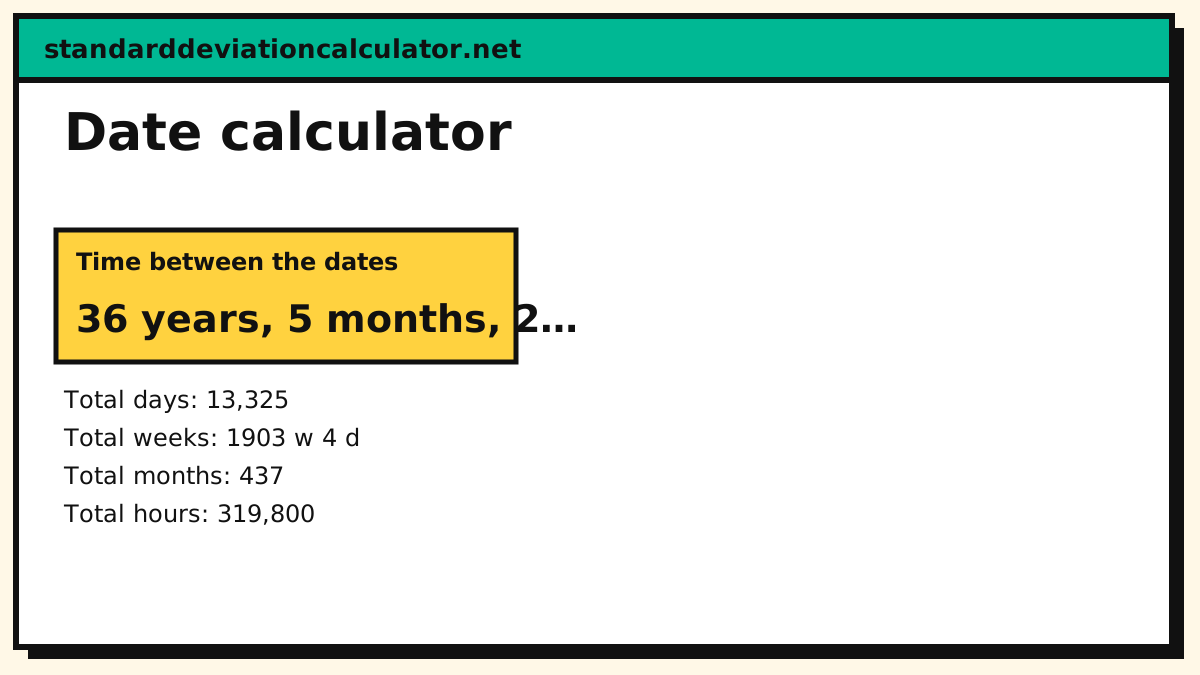
1990-05-15 → 2026-11-07 = 36 y 5 m 23 d
How the dates are counted
Whole calendar years and months are counted first; the remaining days borrow the length of the previous month when needed. Total days use exact UTC midnights, so daylight-saving changes never add or remove an hour.
How to use the date calculator
Pick a calculation, then enter the dates. Days between two dates and Age on a date take a first and a second date; age treats the first as a birth date and the second as the “as of” date. Business days between two dates counts Monday to Friday only, lets you include or exclude the end date and skip holidays you list (dates like 2026-11-26, separated by commas or spaces). Add or subtract days moves a date forward or back by any number of days, and Day of the week names the weekday of a date. Results show years, months and days, total days and weeks, and the working.
How the dates are counted
The calculator first counts whole calendar years and months, then the remaining days. When the days run short it borrows the length of the previous month, exactly as you would by hand. Total days come from midnight-to-midnight UTC timestamps, so a daylight-saving change never adds or removes an hour. The end date is not counted in a plain days-between result (it is a difference), so 1 January to 2 January is 1 day. Add one if you want both ends included.
Worked examples
- Days in a year: from 2026-01-01 to 2026-12-31 is 364 days (365 if you count both ends).
- Adding days: 90 days after 2026-11-07 is 2027-02-05.
- Age: someone born on 1990-05-15 is 36 years, 5 months and 23 days old on 2026-11-07, with 189 days to the next birthday.
- Weekday: 2026-11-07 is a Saturday.
Counting business days
Business days are the weekdays in a range, minus any holidays you name. From Monday 2 November to Friday 13 November 2026 there are 10 business days counting both ends and 9 if you stop the day before the end. If one of those days is a holiday, for example Wednesday 11 November, include it in the holiday box and the count drops to 9. In a month, January 2026 has 22 weekdays; December 2026 has 23, and 22 once Christmas Day (a Friday) is skipped. Public holidays differ by country, region and employer, so the calculator never assumes any: list the ones that apply to you.
Leap years
A year is a leap year when it is divisible by 4, except century years, which must also be divisible by 400. So 2024 and 2028 are leap years, 1900 and 2100 are not, and 2000 was. A leap year has 366 days because February has 29. The calculator uses the real calendar, so a range that crosses 29 February is counted correctly. 2026 is not a leap year.
Working out age and the next birthday
Age is counted in completed years: you turn a year older on your birthday, not before. The calculator also gives the extra months and days since the last birthday and the number of days until the next one. A person born on 29 February has their birthday on 28 February or 1 March in non-leap years, depending on local rules; the calculator treats 1 March as the day after 28 February in the arithmetic.
Everyday date questions
How long until a deadline, an event or a holiday? From 2026-11-07 to Christmas Day, 2026-12-25, it is 48 days (23 days to the end of November plus 25 in December). A 30-day notice period that starts on 2026-11-07 ends on 2026-12-07. Remember that “a month” is not a fixed number of days: one month after 31 January is the last day of February, and counting in months and in days can differ by up to three days. When a contract or deadline matters, check which counting rule it uses (calendar days, business days, inclusive or exclusive) and enter the same one here.
Planning ahead with date arithmetic
Add-or-subtract mode is useful for project and personal planning: a warranty of 365 days from a purchase date, a 14-day return window, a 90-day probation period, or a pregnancy-free example such as a library loan of 21 days. Work forward from a start date to get a deadline, or back from a deadline to find when to begin. To skip weekends when planning, use the business-days mode and compare the two results.
Common mistakes
- Counting the end date twice or not at all. Decide whether both ends count.
- Assuming every month has 30 days. Months run from 28 to 31 days.
- Forgetting that “business days” need holidays. Weekends alone are not the whole story.
- Mixing date formats. Use year-month-day (2026-11-07), which cannot be misread as day-month.
Common questions
How many days are between two dates?
Subtract the earlier date from the later one: the calculator reports the total days plus the same span as years, months and days.
How is age calculated?
Count completed years since the birth date, then the remaining months and days. Age on a chosen date works for past and future dates.
Is the end date included?
The count is the difference, so the end date is not counted. Add 1 day if you want both ends included.
How many days are there between today and a date?
Enter today’s date as the first date and the target as the second. The calculator does not read your computer’s clock, so it always uses the dates you type. The total-days cell is the answer.
How many weeks are in a year?
A common year has 365 days, which is 52 weeks and 1 day (365 ÷ 7 ≈ 52.14). A leap year has 52 weeks and 2 days. That is why the same date moves one weekday later each year, and two weekdays after 29 February.
What happens to a range that crosses a leap day?
It is counted on the real calendar, so a range from 1 February to 1 March has 28 days in 2026 and 29 in 2028. Years, months and days and total days both stay correct.
Related calculators
-
Unit converter
Convert time units.
-
Percentage calculator
Share of a period.
-
Countdown timer
Count down to a date or a task.
-
Word counter
Count text.