Numbers to words converter
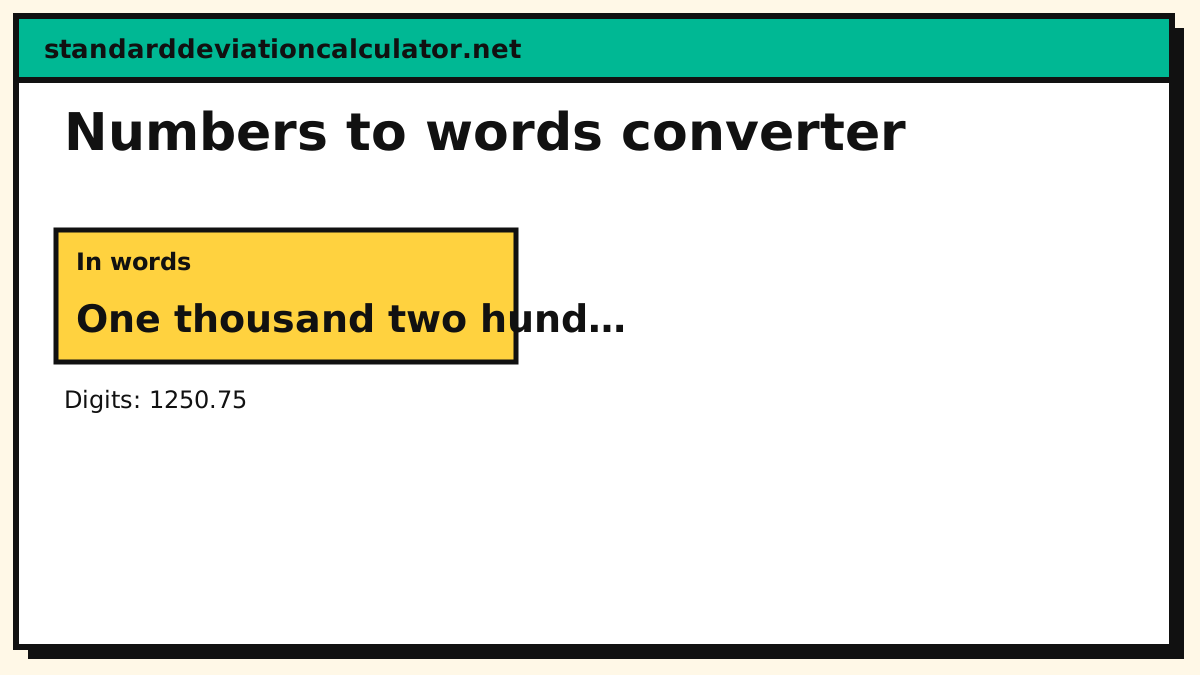
Type a number to see it spelled out in words, or switch to cheque style to get “One thousand two hundred fifty and 75/100 dollars”.
Up to 36 digits; commas are fine.
Show the working, step by step
How numbers are named
English groups digits in threes: thousand, million, billion, trillion and so on. Each group is read as hundreds, tens and ones, then given its scale word. 1,250,000 is “one million two hundred fifty thousand”. Hyphens join tens and ones from 21 to 99. In cheque style the cents are written as a fraction of 100.
How to use the numbers to words converter
Type a number into the box. Commas are fine and a dollar sign is ignored. Choose A plain number to write it out in words, or A cheque amount to get dollars with the cents as a fraction of 100, as banks require. The whole part can run to 36 digits, up to “nine hundred ninety-nine decillion”. A decimal part is read digit by digit after the word “point”.
Examples
- 1,250,000 → one million two hundred fifty thousand
- 1,250.75 → one thousand two hundred fifty point seven five
- 1,250.75 as a cheque → One thousand two hundred fifty and 75/100 dollars
- 45 → forty-five
- 0 → zero
- −7 → negative seven
How English names big numbers
Digits are grouped in threes from the right: each group is read as hundreds, tens and ones and then given its scale word. In 3,405,018 the groups are 3 | 405 | 018, so it is read “three million four hundred five thousand eighteen”. A group that is all zeros, such as the thousands in 5,000,012, is skipped. The tens from 21 to 99 are joined with a hyphen (twenty-one, ninety-nine), as the rules of formal writing require.
Short scale and long scale
This converter uses the short scale used in the United States and in modern British English, in which a billion is 109. Some countries still use the long scale, where a billion is 1012. The names in order are thousand, million, billion, trillion, quadrillion, quintillion, sextillion, septillion, octillion, nonillion and decillion. Check which scale a document uses before relying on a translation of a very large figure.
Writing cheques and contracts
On a cheque or legal document, the amount in words guards against alteration of the digits. The usual form writes the dollars in words, then “and” and the cents as a fraction of 100 (75/100), followed by “dollars”. If the words and the numerals disagree, many banks treat the words as binding, so check both. Draw a line through the spare space after the words so nothing can be added. The converter shows the cheque wording and a plain words-only version side by side.
“And” and British usage
American style leaves out “and” inside whole numbers (“one hundred twenty”), reserving it for the decimal or the cents. British style often writes “one hundred and twenty”. Both are understood, so follow the style guide of the person you are writing for.
Common uses
- Filling in cheques, invoices and legal forms.
- Checking spelling of large numbers for essays and reports.
- Teaching place value, and reading numbers aloud.
- Producing text for audio, signage and accessible documents.
Reading numbers aloud
Years are usually read in pairs (1999 is “nineteen ninety-nine”), phone numbers digit by digit, and money with the unit last (“forty-two dollars and fifty cents”). The converter spells out the full quantity, so 1999 comes out as “one thousand nine hundred ninety-nine”, which is correct for a quantity but not for a year. Use the style that fits what the number means.
Counting the zeros
A common slip is losing a group when writing large numbers: a million has six zeros, a billion nine, a trillion twelve and a quadrillion fifteen. 2,000,000,000 is two billion, and 20,000,000 is twenty million. Paste the digits into the converter and read the result back to see whether the magnitude is what you meant.
Spelling of tricky numbers
Forty has no “u” (not “fourty”), and fourteen keeps it. Eighteen has one “t” but eighty has two letters before the “y”. Hundred, thousand and million stay singular when preceded by a number: “three hundred”, not “three hundreds”. The converter spells these correctly every time, which is its main use for essays and forms.
Limits and common mistakes
- More than 36 digits. The whole part is limited to 36 digits.
- Cents as a decimal. A cheque amount is rounded to two decimal places for the cents fraction.
- Reading decimals as whole numbers. 0.05 is “zero point zero five”, not “five”.
- Not text. Scientific notation such as 1e6 and fractions such as 1/2 are not accepted.
Common questions
How do you write 1,250.75 on a cheque?
One thousand two hundred fifty and 75/100 dollars. The cents are written as a fraction over 100.
How big a number can it spell?
Up to 36 digits in the whole part, which reaches decillions.
How are decimals read?
After the word “point” each digit is read on its own: 0.75 is “zero point seven five”.
How do you write 1,250.75 on a cheque?
One thousand two hundred fifty and 75/100 dollars. Use the cheque option to generate this wording.
Is it correct to use 'and' in numbers?
In American style, no: write one hundred twenty. In British style, one hundred and twenty is common. The converter follows the American form.
How big a number can I convert?
Up to 36 digits in the whole part, which is numbers up to nine hundred ninety-nine decillion and more.
How do you spell 40?
Forty, with no u. The same spelling is used inside larger numbers such as forty-two or one hundred forty.
How do I write 2,500 in words?
Two thousand five hundred. In British style some add “and” before hundred or ten, but it is optional in American usage.
Related calculators
-
Rounding calculator
Scientific notation.
-
Number system converter
Binary, octal, hex.
-
Factorial and Fibonacci
Huge numbers.
-
Discount and tax
Amounts to write.