Math
Multiplication calculator
Enter two numbers to get their exact product and the long multiplication behind it: one partial product per digit, each carry, and the final addition.
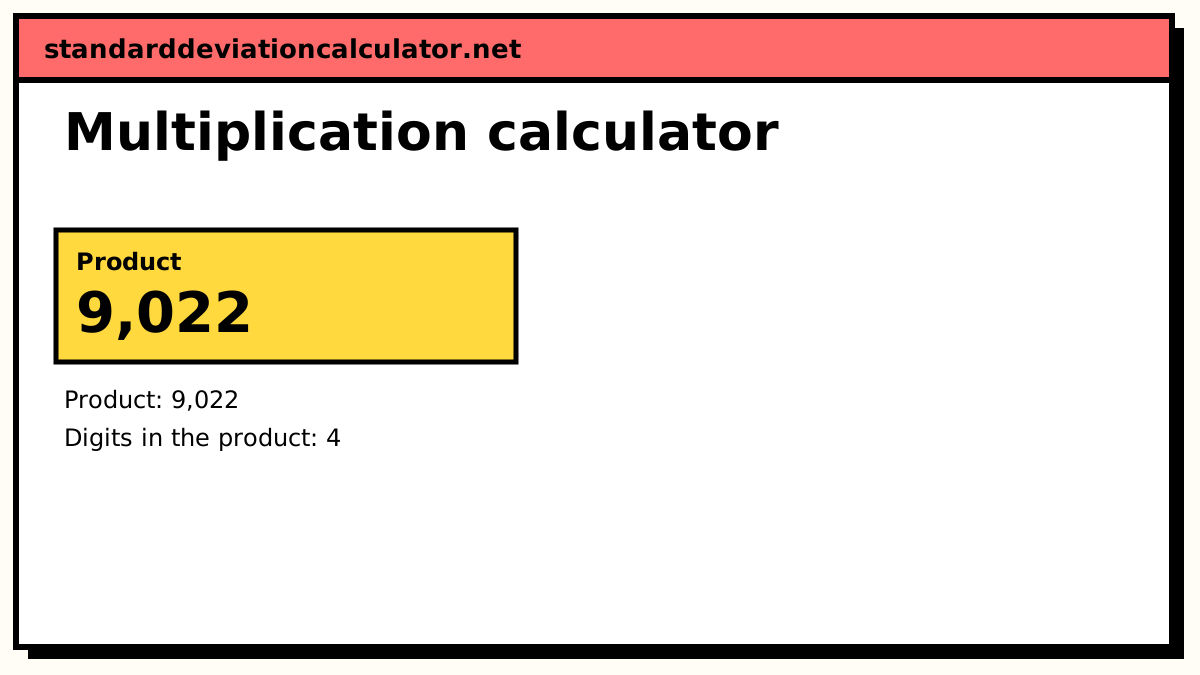
Split 347 into 300 + 40 + 7 and 26 into 20 + 6. Each piece's area is one partial product; together they make the whole: 6,000 + 800 + 140 + 1,800 + 240 + 42 = 9,022.
347 × 26 ────── 2082 347 × 6 + 6940 347 × 2 × 10 ────── 9022
Show the working, step by step
Multiply by the ones digit, 6.
6 × 7 = 42 → write 2, carry 4 6 × 4 + 4 = 28 → write 8, carry 2 6 × 3 + 2 = 20 → write 20 347 × 6 = 2,082
Multiply by the tens digit, 2, and shift 1 place left (write 1 zero first).
2 × 7 = 14 → write 4, carry 1 2 × 4 + 1 = 9 → write 9 2 × 3 = 6 → write 6 347 × 2 × 10 = 6,940
Add the partial products.
2,082 + 6,940 = 9,022
Result:
347 × 26 = 9,022
The idea behind long multiplication
347 × 26 = 347 × (20 + 6) = 347 × 6 + 347 × 20
Long multiplication is the distributive law written in columns. Splitting the bottom number into its place values turns one hard multiplication into several easy ones by a single digit, which are then added.
A worked example: 347 × 26
- Multiply by the ones digit, 6: 6 × 7 = 42 (write 2, carry 4); 6 × 4 + 4 = 28 (write 8, carry 2); 6 × 3 + 2 = 20. The partial product is 2,082.
- Multiply by the tens digit, 2, and write a zero first because it is worth 20: 2 × 7 = 14 (write 4, carry 1); 2 × 4 + 1 = 9; 2 × 3 = 6. The partial product is 6,940.
- Add the partial products: 2,082 + 6,940 = 9,022.
347 × 26 ─────── 2082 347 × 6 + 6940 347 × 20 ─────── 9022
Decimals: count the places
3.47 has two decimal places and 2.06 has two, so their product has four. Multiply 347 × 206 = 71,482 and place the point four digits from the right: 7.1482. The zero digit in 206 gives a partial product of 0, so it can be skipped. Trailing zeros after the point can be dropped at the end, never before counting.
Estimating to catch errors
Round each number to one significant figure: 347 × 26 ≈ 300 × 30 = 9,000. The exact answer, 9,022, is close. If you had forgotten to shift the second partial product you would get 2,082 + 694 = 2,776, which the estimate shows is far too small.
Other methods give the same partial products
| Method | How 347 × 26 is split |
|---|---|
| Long (column) multiplication | 347 × 6 + 347 × 20 |
| Grid (box) method | 300×20 + 40×20 + 7×20 + 300×6 + 40×6 + 7×6 = 6,000 + 800 + 140 + 1,800 + 240 + 42 |
| Lattice method | Six single-digit products (3 × 2, 4 × 6, 7 × 6 and so on) in a 3-by-2 grid, added along diagonals |
All three add up to 9,022. The grid method writes out every single-digit product without carries, which makes it easier to follow but longer.
Common questions
How does long multiplication work?
Multiply the top number by each digit of the bottom number in turn, starting with the ones digit. Each result is a partial product. Shift each one left by the place value of its digit (write a zero for the tens digit, two zeros for the hundreds) and add the partial products. For 347 × 26: 347 × 6 = 2,082 and 347 × 20 = 6,940, so the product is 9,022.
How do I multiply decimals?
Ignore the points, multiply the whole numbers, then count the decimal places in both numbers and put that many in the answer. 3.47 × 2.06: 347 × 206 = 71,482, and there are 2 + 2 = 4 decimal places, so the product is 7.1482.
What is the rule for multiplying negative numbers?
Multiply the sizes, then fix the sign: if exactly one number is negative the product is negative; if both are negative it is positive. −3.47 × 2.06 = −7.1482, and −4 × −5 = 20.
Can it multiply very large numbers exactly?
Yes. Whole numbers are multiplied as arbitrary-precision integers, so 123,456,789,123,456,789 × 987,654,321,987,654,321 comes out as the exact 36-digit number 121,932,631,356,500,531,347,203,169,112,635,269. An ordinary calculator would round it after about 16 digits.
Why is the longer number put on top?
Multiplication is commutative (a × b = b × a), so the order does not change the answer. Putting the number with more digits on top means fewer partial products to write and add.
Related calculators
-
Division
Long division, remainders and repeating decimals.
-
Addition
Column addition with every carry shown.
-
Prime factorisation
Break a product back down into primes.
-
Modular arithmetic
Products and powers reduced mod n.