Math
Division calculator
Enter the number to divide and the number to divide by. The calculator gives the quotient and remainder, the exact decimal (with any repeating digits in brackets), the fraction, and each step of the long division.
Division asks how many jumps of 7 fit into 9,876: 1,410 whole jumps fit, and the shaded piece left over is the remainder.
| Step | Bring down | Working number | Quotient digit | Subtract | Remainder |
|---|---|---|---|---|---|
| 1 | 9 | 9 | 9 ÷ 7 → 1 | − 7 | 2 |
| 2 | 8 | 28 | 28 ÷ 7 → 4 | − 28 | 0 |
| 3 | 7 | 7 | 7 ÷ 7 → 1 | − 7 | 0 |
| 4 | 6 | 6 | 6 ÷ 7 → 0 | − 0 | 6 |
| 5 | 0 (after the point) | 60 | 60 ÷ 7 → 8 | − 56 | 4 |
| 6 | 0 (after the point) | 40 | 40 ÷ 7 → 5 | − 35 | 5 |
| 7 | 0 (after the point) | 50 | 50 ÷ 7 → 7 | − 49 | 1 |
| 8 | 0 (after the point) | 10 | 10 ÷ 7 → 1 | − 7 | 3 |
| 9 | 0 (after the point) | 30 | 30 ÷ 7 → 4 | − 28 | 2 |
| 10 | 0 (after the point) | 20 | 20 ÷ 7 → 2 | − 14 | 6 |
Show the working, step by step
Long division of 9,876 by 7: bring down one digit at a time, see how many times 7 fits, subtract, and carry the remainder to the next digit. The table above lists every step.
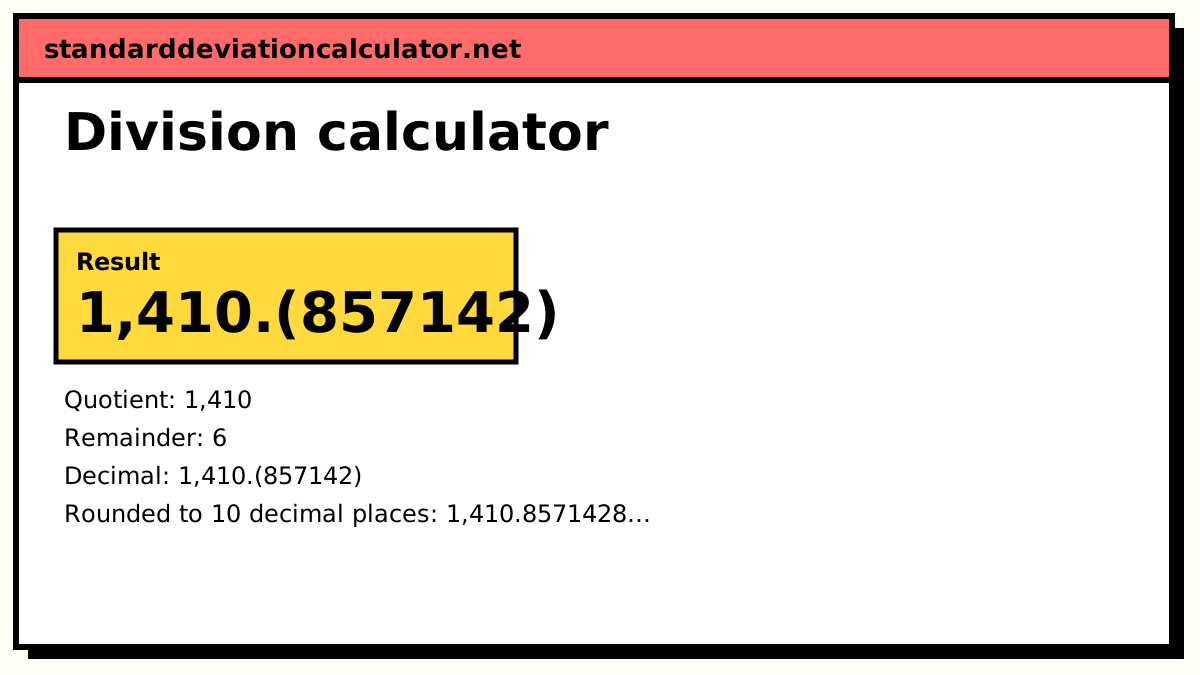
The quotient digits read 1410, with 6 left over.
9,876 = 7 × 1,410 + 6
Carry on after the decimal point by bringing down zeros. The remainders cycle: once a remainder comes back, the digits repeat from there.
9,876 ÷ 7 = 1,410.(857142)
The block 857142 repeats for ever. It is written in brackets here; textbooks put a bar over it.
1,410.(857142)
Quotient and remainder, checked:
9,876 = 7 × 1,410 + 6
The division identity
dividend = divisor × quotient + remainder, 0 ≤ remainder < |divisor| 9,876 = 7 × 1,410 + 6
Every division of whole numbers can be written this way, and there is exactly one quotient and remainder that satisfy it. The decimal answer continues the same process past the decimal point: 6 left over out of 7 is 6/7 = 0.857142857142…
A worked example: 9,876 ÷ 7
- 7 goes into 9 once. 9 − 7 = 2.
- Bring down the 8 to make 28. 7 goes into 28 four times exactly, remainder 0.
- Bring down the 7. 7 goes into 7 once, remainder 0.
- Bring down the 6. 7 goes into 6 zero times, remainder 6.
- The quotient so far is 1,410 with remainder 6.
- Continue after the point by bringing down zeros: 60 ÷ 7 = 8 r 4, 40 ÷ 7 = 5 r 5, 50 ÷ 7 = 7 r 1, 10 ÷ 7 = 1 r 3, 30 ÷ 7 = 4 r 2, 20 ÷ 7 = 2 r 6.
- The remainder 6 has come back, so the digits 857142 repeat: 9,876 ÷ 7 = 1,410.(857142).
Why decimals repeat
After the point, each step depends only on the current remainder, and a remainder can only be 0, 1, …, divisor − 1. So within at most divisor − 1 steps a remainder must repeat (or reach 0, when the decimal ends), and from then on the same digits come round again. Which fractions terminate depends only on the denominator in lowest terms:
| Fraction | Decimal | Denominator’s primes |
|---|---|---|
| 1/8 | 0.125 | 2 only: terminates |
| 3/40 | 0.075 | 2 and 5: terminates |
| 1/6 | 0.1(6) | 2 and 3: repeats after one digit |
| 1/7 | 0.(142857) | 7: block of 6 |
| 22/7 | 3.(142857) | 7: block of 6 |
| 1/97 | 0.(01030927…40206185567) | 97: block of 96 |
Dividing decimals
Multiply both numbers by the same power of ten until they are whole. The quotient does not change, because you have multiplied the top and bottom of a fraction by the same amount: 7.5 ÷ 0.25 = 750 ÷ 25 = 30.
Common mistakes
- Leaving out a zero in the quotient. In 9,876 ÷ 7 the 6 is brought down and 7 goes into it 0 times. Skipping that 0 gives 141 instead of 1,410.
- A remainder bigger than the divisor. If it is, the quotient digit was too small.
- Rounding a repeating decimal and treating it as exact. 1,410.857 × 7 is 9,875.999, not 9,876.
Common questions
How do I find the quotient and remainder?
The quotient is how many whole times the divisor fits into the dividend; the remainder is what is left over. 9,876 ÷ 7: 7 × 1,410 = 9,870, and 9,876 − 9,870 = 6, so the quotient is 1,410 and the remainder 6. Check: dividend = divisor × quotient + remainder.
What does 0.(142857) mean?
The digits in brackets repeat for ever: 0.(142857) = 0.142857142857…, which is 1/7. Textbooks draw a bar (a vinculum) over the repeating block instead. A fraction in lowest terms gives a terminating decimal only when its denominator has no prime factors other than 2 and 5; every other fraction repeats.
How long can the repeating block be?
For a fraction with denominator d, the block is at most d − 1 digits long. 1/7 repeats every 6 digits, 1/17 every 16 and 1/97 every 96. The calculator follows the remainders until one comes back, so it finds the exact block for blocks of up to 3,000 digits.
What is the remainder when dividing negative numbers?
Conventions differ. This calculator keeps the remainder between 0 and the divisor’s size (the Euclidean convention), so −17 ÷ 5 gives quotient −4 and remainder 3, because 5 × (−4) + 3 = −17. Many programming languages truncate instead and give quotient −3, remainder −2. The decimal answer, −3.4, is the same either way.
Can you divide by zero?
No. Division asks which number times the divisor gives the dividend, and nothing times 0 gives, say, 5. For 0 ÷ 0 every number works, so there is no single answer either. Both are left undefined.
Related calculators
-
Multiplication
Long multiplication, the inverse of long division.
-
Modular arithmetic
Remainders as numbers in their own right.
-
Ratio and proportion
Share an amount in a ratio.
-
Divisibility rules
Tell whether the remainder will be 0 from the digits.
-
Percentage
Division by the whole, times 100.