Math
Divisibility calculator
Enter a whole number to see which of 2 to 12 divide it, with the digit rule for each one worked through on your number. Switch to a single divisor to test any other number.
Any whole number, as long as you like.
Each row shows the possible remainders for one divisor, 0 on the left; the filled cell is where 7,560 lands. A filled first cell (remainder 0) means divisible.
| ÷ | Result | Remainder |
|---|---|---|
| 2 | ✓ divisible | 0 |
| 3 | ✓ divisible | 0 |
| 4 | ✓ divisible | 0 |
| 5 | ✓ divisible | 0 |
| 6 | ✓ divisible | 0 |
| 7 | ✓ divisible | 0 |
| 8 | ✓ divisible | 0 |
| 9 | ✓ divisible | 0 |
| 10 | ✓ divisible | 0 |
| 11 | ✗ no | 3 |
| 12 | ✓ divisible | 0 |
Show the working, step by step
2: The last digit is even (0, 2, 4, 6 or 8).
last digit 0 → even → divisible
3: The sum of the digits is divisible by 3.
7 + 5 + 6 + 0 = 18; 18 ÷ 3 = 6 → divisible
4: The number formed by the last two digits is divisible by 4.
60 ÷ 4 = 15 → divisible
5: The last digit is 0 or 5.
last digit 0 → divisible
6: Divisible by both 2 and 3.
by 2: ✓ (last digit 0); by 3: ✓ (digit sum 18) → divisible
7: Double the last digit and subtract it from the rest of the number; repeat. The number is divisible by 7 exactly when the result is.
756 − 2 × 0 = 756; 75 − 2 × 6 = 63; 63 = 7 × 9 → divisible
8: The number formed by the last three digits is divisible by 8.
560 ÷ 8 = 70 → divisible
9: The sum of the digits is divisible by 9.
7 + 5 + 6 + 0 = 18; 18 ÷ 9 = 2 → divisible
10: The last digit is 0.
last digit 0 → divisible
11: Starting from the last digit, alternately add and subtract the digits. The result must be divisible by 11 (0 counts).
0 − 6 + 5 − 7 = −8; not a multiple of 11 → not divisible
12: Divisible by both 3 and 4.
by 3: ✓ (digit sum 18); by 4: ✓ (last two digits 60) → divisible
The rules
| Divisor | Rule | Why it works |
|---|---|---|
| 2 | Last digit even | 10 is divisible by 2 |
| 3 | Digit sum divisible by 3 | 10 leaves remainder 1 mod 3 |
| 4 | Last two digits divisible by 4 | 100 is divisible by 4 |
| 5 | Last digit 0 or 5 | 10 is divisible by 5 |
| 6 | Divisible by 2 and by 3 | 6 = 2 × 3, coprime factors |
| 7 | Rest minus twice the last digit divisible by 7 | 10a + b ≡ 0 ⇔ a − 2b ≡ 0 (mod 7) |
| 8 | Last three digits divisible by 8 | 1,000 is divisible by 8 |
| 9 | Digit sum divisible by 9 | 10 leaves remainder 1 mod 9 |
| 10 | Last digit 0 | Place value |
| 11 | Alternating digit sum divisible by 11 | 10 leaves remainder −1 mod 11 |
| 12 | Divisible by 3 and by 4 | 12 = 3 × 4, coprime factors |
A worked example: 7,560
- 2, 5, 10: the last digit is 0, so all three divide it.
- 3 and 9: 7 + 5 + 6 + 0 = 18, which is divisible by both.
- 4: the last two digits, 60, are 4 × 15.
- 8: the last three digits, 560, are 8 × 70.
- 6 and 12: follow from 2, 3 and 4.
- 7: 756 − 2 × 0 = 756; 75 − 2 × 6 = 63 = 7 × 9.
- 11: 0 − 6 + 5 − 7 = −8, not a multiple of 11. The remainder is 3.
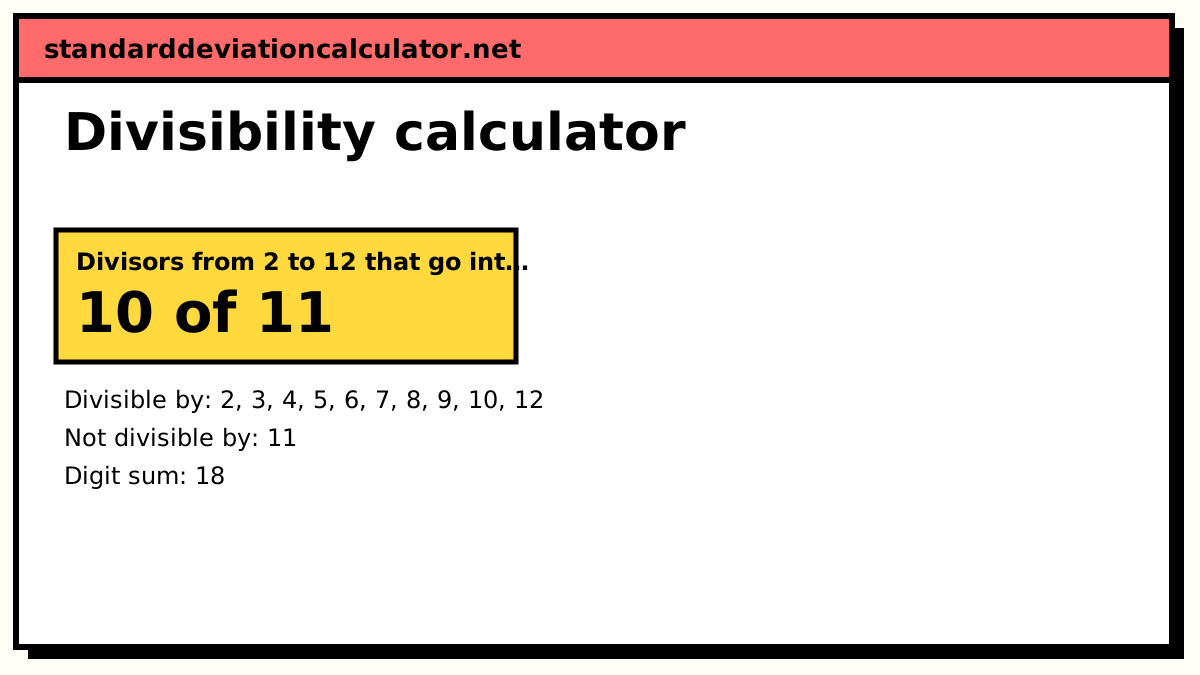
So 7,560 is divisible by 10 of the 11 numbers from 2 to 12, everything except 11. That fits its prime factorisation, 7,560 = 2³ × 3³ × 5 × 7, which has no 11.
Where the rules come from
Every rule is modular arithmetic on place value. Write the number as a sum of digits times powers of ten, and replace each power of ten by its remainder on division by d. For 3 and 9 every power of ten is 1, so the remainder is the digit sum. For 11 the powers of ten alternate between 1 and −1, which gives the alternating sum. For 2, 4, 8, 5 and 25, high enough powers of ten are 0, so only the last few digits count.
Common mistakes
- Combining factors that are not coprime. Divisible by 2 and 4 does not mean divisible by 8 (take 4).
- Starting the 11 test from the left on an even-length number. It only flips the sign, so the verdict is the same, but the remainder is not.
- Using the digit sum for 6. 15 has digit sum 6 but is odd, so it is not divisible by 6.
Common questions
Why does the digit-sum rule work for 3 and 9?
Because 10 leaves remainder 1 when divided by 3 or 9, so do 100, 1,000 and every power of ten. A number such as 7,560 = 7 × 1,000 + 5 × 100 + 6 × 10 + 0 therefore leaves the same remainder as 7 + 5 + 6 + 0 = 18. Since 18 is divisible by 9, so is 7,560.
What is the divisibility rule for 7?
Double the last digit and subtract it from the rest of the number; repeat until the number is small. 7,560 → 756 − 0 = 756 → 75 − 12 = 63 = 7 × 9, so 7,560 is divisible by 7. For long numbers it is quicker to split into groups of three digits from the right and alternately add and subtract them, because 1,001 = 7 × 11 × 13.
How does the rule for 11 work?
Alternately add and subtract the digits starting from the right. For 7,560 that is 0 − 6 + 5 − 7 = −8, which is not a multiple of 11, so 7,560 is not divisible by 11. For 1,331 it is 1 − 3 + 3 − 1 = 0, and 0 counts as a multiple, so 1,331 = 11³ is.
Why is divisibility by 6 checked with 2 and 3?
6 = 2 × 3, and 2 and 3 share no factor. A number divisible by both must be divisible by their product. The same works for 12 = 3 × 4, but not with 2 and 6: 6 is divisible by 2 and 6 yet not by 12, because 2 and 6 share the factor 2.
Is there a rule for 4, 8 and 16?
Yes, look only at the end of the number. 100 is divisible by 4, so only the last two digits matter for 4; 1,000 is divisible by 8, so the last three matter for 8; for 16 it is the last four. 7,560 ends in 60 (divisible by 4) and 560 (560 = 8 × 70), so it is divisible by both 4 and 8.
Related calculators
-
Prime factorisation
All the prime factors at once.
-
Division
The quotient and remainder by long division.
-
Prime numbers
Is it prime, and the nearest primes.
-
Number theory toolbox
Digit sums, digital roots and more.