Fractions calculator
Type two fractions, mixed numbers or decimals, pick an operation and get the answer in lowest terms, as a mixed number, a decimal and a percent, with the working.
Fraction 3/4, mixed number 1 1/2, whole number or decimal.
Show the working, step by step
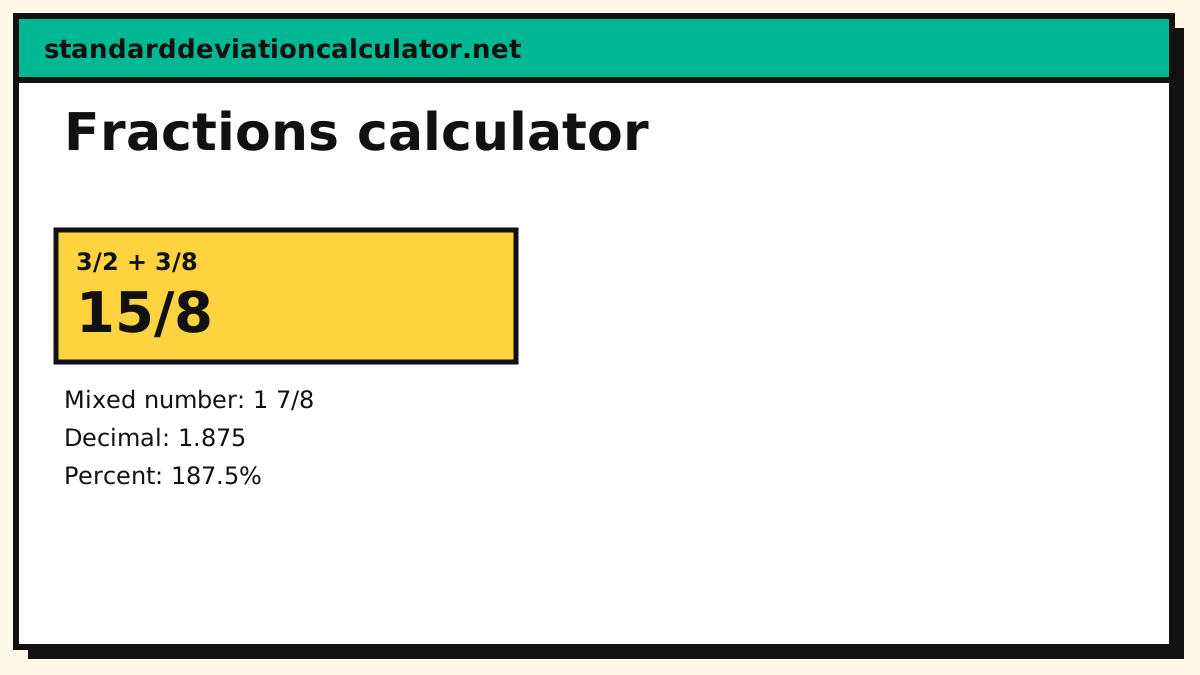
Rewrite both over the least common denominator, 8, then add the numerators.
3/2 + 3/8 = 12/8 + 3/8
Reduce by the greatest common divisor.
15/8
Fraction rules
a/b + c/d = (ad + bc) / bd a/b × c/d = ac / bd a/b ÷ c/d = a/b × d/c
After every operation the result is divided by the GCD of its numerator and denominator, which puts it in lowest terms.
How to use the fractions calculator
Pick an operation, then type Fraction A and, for the two-fraction operations, Fraction B. You can write a fraction as 3/4, a mixed number as 1 1/2 (a space between the whole part and the fraction), a whole number as 2 or a decimal as 0.75. Negative values take a minus sign. The result is shown in lowest terms, then as a mixed number, a decimal and a percent, and the working appears underneath. A denominator of zero is rejected, because division by zero is undefined.
Adding and subtracting fractions
Fractions can only be added or subtracted when they share a denominator, so the first step is a common denominator. The least common denominator is the least common multiple of the two denominators. To add 1/2 and 3/8, the LCD is 8: 1/2 = 4/8, and 4/8 + 3/8 = 7/8. To subtract 1/4 from 5/6, the LCD is 12: 5/6 = 10/12 and 1/4 = 3/12, so 10/12 − 3/12 = 7/12. Add or subtract the numerators and keep the denominator; never add the denominators. The calculator multiplies across to get a common denominator and then reduces, so you always see the answer in simplest form.
Multiplying and dividing fractions
Multiplication is the easy one: multiply the numerators, multiply the denominators, then simplify. 2/3 × 9/10 = 18/30 = 3/5. To divide, multiply by the reciprocal of the second fraction (flip it): 3/4 ÷ 2/5 = 3/4 × 5/2 = 15/8 = 1 7/8. For mixed numbers, convert to improper fractions first: 1 1/2 × 2 1/3 = 3/2 × 7/3 = 21/6 = 7/2 = 3 1/2. Dividing by a fraction smaller than 1 makes the result bigger, which surprises people but follows from the flip.
Simplifying fractions and equivalent fractions
A fraction is in lowest terms when its numerator and denominator share no factor other than 1. Divide both by their greatest common divisor (GCD). For 18/24, Euclid’s method gives GCD(24, 18): 24 = 1 × 18 + 6, then 18 = 3 × 6 + 0, so the GCD is 6 and 18/24 = 3/4. Equivalent fractions are the same value written with different numbers: 3/4 = 6/8 = 9/12 = 75/100. Multiplying or dividing the top and bottom by the same non-zero number never changes the value, which is why reducing is always allowed.
Comparing fractions
To decide which of two fractions is larger, cross-multiply. For 5/8 and 2/3: 5 × 3 = 15 and 2 × 8 = 16, and since 15 is less than 16, 5/8 < 2/3. The comparison mode shows both products. You can also convert to decimals (0.625 and 0.667) or use a common denominator (15/24 and 16/24).
Fractions as decimals and percents
Divide the numerator by the denominator for the decimal, then multiply by 100 for the percent: 3/8 = 0.375 = 37.5%. Some fractions give repeating decimals: 1/3 = 0.333… and 2/7 = 0.285714285714…; the percent is rounded for display. A fraction’s decimal terminates only when the denominator, in lowest terms, has no prime factors other than 2 and 5.
Finding the least common denominator
To add 1/4, 1/6 and 3/10, you need a number that 4, 6 and 10 all divide into. List the multiples of the largest (10, 20, 30, 40, 50, 60) until the others fit: 60 works because 4 × 15 = 60, 6 × 10 = 60 and 10 × 6 = 60. So 1/4 = 15/60, 1/6 = 10/60 and 3/10 = 18/60, and the sum is 43/60. Any common denominator works (you could use 120), but the least one keeps the numbers small and often saves a reduction at the end. You can also find it from prime factors: 4 = 2², 6 = 2 × 3 and 10 = 2 × 5, so the LCD is 2² × 3 × 5 = 60.
Improper fractions and mixed numbers
An improper fraction has a numerator at least as large as its denominator, like 15/8. A mixed number writes the same value as a whole part plus a proper fraction: 15 ÷ 8 = 1 remainder 7, so 15/8 = 1 7/8. To go the other way, multiply the whole part by the denominator and add the numerator: 3 2/5 = (3 × 5 + 2)/5 = 17/5. The calculator shows both forms, so you can use whichever your teacher, recipe or drawing asks for. Arithmetic is easiest with improper fractions, while a mixed number is easier to picture.
Fractions and ratios
A ratio compares parts with parts; a fraction compares a part with the whole. If a mix has 3 parts red paint to 4 parts blue, the ratio is 3:4, but red is 3/(3 + 4) = 3/7 of the whole and blue is 4/7. Turning a ratio into fractions of the total is how recipes, concrete mixes and scale models are scaled up or down. The ratio and proportion calculator solves the missing term when you know three of four values.
Where fractions turn up
Recipes (3/4 cup of flour doubled is 1 1/2 cups), woodworking and sewing measurements in eighths and sixteenths of an inch, probabilities written as fractions, music note lengths and scale drawings all rely on the operations above. A fraction is also a division that has not been carried out yet, which is why the same rules give you decimals and percents.
Common mistakes
- Adding the denominators. 1/2 + 1/3 is 5/6, not 2/5.
- Forgetting to flip when dividing. You multiply by the reciprocal of the second fraction only.
- Not reducing. 6/8 is correct but 3/4 is the expected answer.
- Typing a mixed number without a space. Write 1 1/2, not 11/2.
To turn the answer into a percentage change or compare it with other values, use the percentage calculator; to find the greatest common divisor yourself, see the GCD and LCM calculator.
Common questions
How do you add fractions with different denominators?
Rewrite both fractions over a common denominator (the least common multiple of the two denominators), add the numerators, then simplify. 1/2 + 3/8 = 4/8 + 3/8 = 7/8.
How do you divide fractions?
Multiply the first fraction by the reciprocal of the second: 3/4 ÷ 2/5 = 3/4 × 5/2 = 15/8.
How do I type a mixed number?
Write the whole part, a space, then the fraction: 1 1/2 means one and a half.
How do I add three or more fractions?
Find one common denominator for all of them, convert each fraction, add the numerators and reduce. For 1/2 + 1/3 + 1/4 the least common denominator is 12: 6/12 + 4/12 + 3/12 = 13/12 = 1 1/12. Add two at a time in the calculator and use the result as Fraction A for the next one.
How do I turn a repeating decimal into a fraction?
Let x be the decimal, multiply by a power of ten that lines up the repeating part, and subtract. For x = 0.333…, 10x = 3.333…, so 9x = 3 and x = 1/3. For 0.272727…, 100x − x = 27, so x = 27/99 = 3/11. A terminating decimal such as 0.375 is simply 375/1000 = 3/8, which you can type straight into the calculator.
Can a fraction be larger than 1?
Yes. When the numerator is larger than the denominator the value is more than one whole, such as 7/4 = 1 3/4. These are called improper fractions, and they are perfectly valid answers; a mixed number is only another way to write them.
Related calculators
-
GCD and LCM
The reduction step.
-
Ratio and proportion
Simplify ratios.
-
Percentage calculator
Fractions as percents.
-
Least to greatest
Order fractions.