Least to greatest calculator
Type a list of numbers in any mix of forms. The calculator converts each one to a decimal, sorts them and gives the list back in the form you typed, least to greatest or greatest to least.
Separate with commas or new lines. Fractions (3/4), mixed numbers (1 1/3), decimals, negatives and percentages (45%) all work.
| Rank | As entered | Decimal value |
|---|---|---|
| 1 | −2 | −2 |
| 2 | −0.75 | −0.75 |
| 3 | 45% | 0.45 |
| 4 | 0.5 | 0.5 |
| 5 | 5/8 | 0.625 |
| 6 | 3/4 | 0.75 |
| 7 | 1 1/3 | 1.3333333 |
| 8 | 2 | 2 |
Show the working, step by step
Write every number as a decimal so they can be compared directly.
3/4 = 0.75 −2 = −2 0.5 = 0.5 45% = 0.45 1 1/3 = 1.3333333 −0.75 = −0.75 2 = 2 5/8 = 0.625
Negative numbers come first (the more negative, the smaller), then zero, then positives.
2 negative, 0 zero, 6 positive
Sort the decimals from least to greatest and write each number back in its original form.
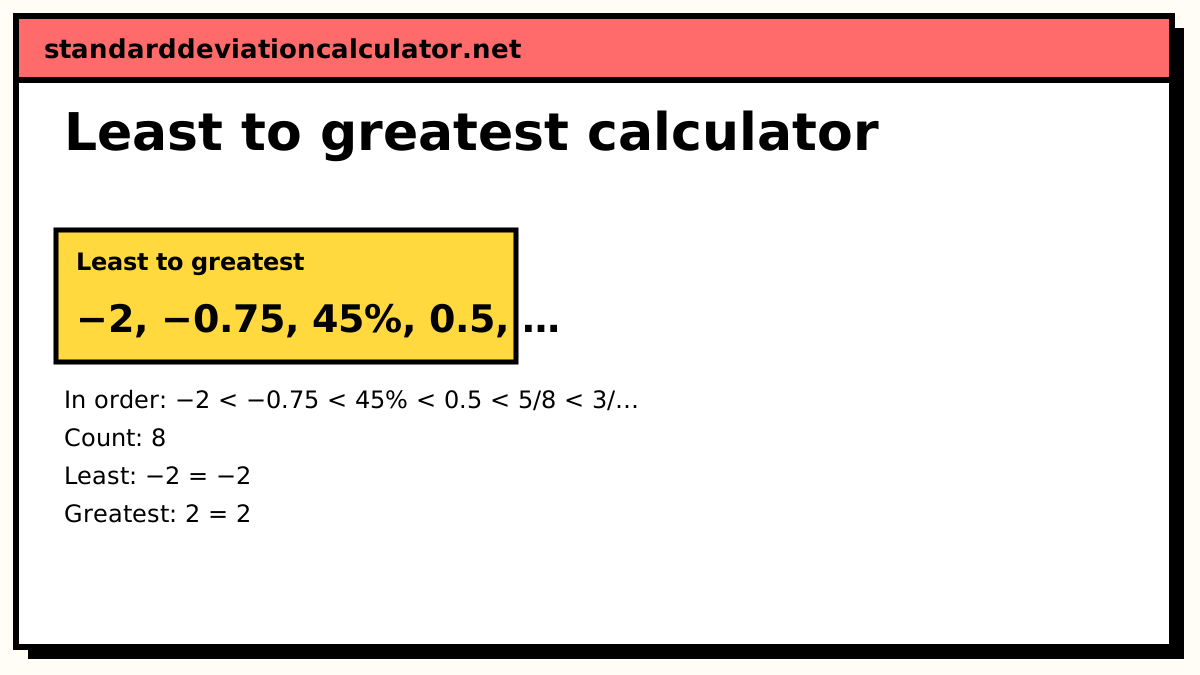
−2 < −0.75 < 45% < 0.5 < 5/8 < 3/4 < 1 1/3 < 2
The method
a/b → a ÷ b w a/b → w + a ÷ b (−w a/b → −(w + a ÷ b)) p% → p ÷ 100
Once every number is a decimal, comparing is a matter of place value: first the sign, then the whole number part, then the tenths, hundredths and so on. The calculator keeps the full decimal for each value, so 1/3 and 0.333 are correctly placed with 0.333 first.
A worked example
The default list is:
3/4, −2, 0.5, 45%, 1 1/3, −0.75, 2, 5/8
Convert each number to a decimal:
3/4 = 0.75 −2 = −2 0.5 = 0.5 45% = 0.45 1 1/3 = 1.333 −0.75 = −0.75 2 = 2 5/8 = 0.625
The two negatives come first. −2 is further below zero than −0.75, so −2 is the least. Next are the numbers between 0 and 1: 0.45, 0.5, 0.625 and 0.75. Comparing the tenths digits, 0.45 and 0.5 have 4 and 5 tenths, 0.625 has 6 and 0.75 has 7. Then come 1.333 and 2. Written in the original forms:
−2 < −0.75 < 45% < 0.5 < 5/8 < 3/4 < 1 1/3 < 2
The least value is −2 and the greatest is 2, so the range is 4. Greatest to least is the same list reversed: 2, 1 1/3, 3/4, 5/8, 0.5, 45%, −0.75, −2.
Other ways to compare fractions
Decimals are the most general method, but for fractions alone a common denominator works too. Written over 8, 3/4 = 6/8 and 1/2 = 4/8, so 1/2 < 5/8 < 3/4. Cross-multiplying compares two fractions without finding a common denominator: for 5/8 and 3/4, 5 × 4 = 20 and 3 × 8 = 24, and since 20 < 24, 5/8 < 3/4. Both give the same order as the decimals.
Typing the list
Separate the numbers with commas, semicolons or new lines. A comma followed by exactly three digits, as in 1,250, is read as a thousands separator, so leave a space after separating commas: “1, 250” is two numbers. If the list has no commas at all, spaces separate the numbers, except inside a mixed number such as 2 1/2. Anything that cannot be read as a number is skipped and listed in a warning, so nothing disappears silently.
Common mistakes
- Ordering negatives by their size without the sign: −2 is less than −0.75, not greater.
- Judging decimals by length: 0.5 is greater than 0.45, even though 45 is more than 5.
- Comparing fractions by denominators alone: 1/8 is less than 1/4, because a larger denominator means smaller pieces.
- Treating 45% as 45 instead of 0.45 when it is mixed with fractions and decimals.
Once the values are in order, the chart and graph makers turn them into a dot plot, stem-and-leaf plot, histogram or box plot.
Common questions
How do you order fractions, decimals and percentages together?
Convert them all to the same form, usually decimals, then compare. 3/4 = 0.75, 45% = 0.45 and 5/8 = 0.625, so from least to greatest they go 45%, 5/8, 3/4. Write the answer with the numbers in their original form.
How do negative numbers fit in?
Every negative number is less than zero and every positive number. Among negatives, the one furthest from zero is the smallest: −2 < −0.75, even though 2 is bigger than 0.75. On a number line, least to greatest means reading from left to right.
How do I enter a mixed number?
Type the whole number, a space and the fraction: 1 1/3 or −2 3/4. Separate the numbers in your list with commas or new lines so the space inside a mixed number is not read as a separator.
What happens to repeated values?
By default they are kept and appear next to each other, joined by “=” in the ordered list. Choose “Remove duplicates” to keep each value once. Equal values written differently, such as 0.5, 1/2 and 50%, count as duplicates, and the form that appears first in your list is kept.
What is greatest to least?
The same list in reverse, also called descending order. Choose it from the Order menu.
Related calculators
-
Min and max calculator
The smallest and largest values of a data set.
-
Median calculator
Order the data, then take the middle value.
-
Percentage calculator
Convert between percentages, fractions and decimals.