Square root calculator
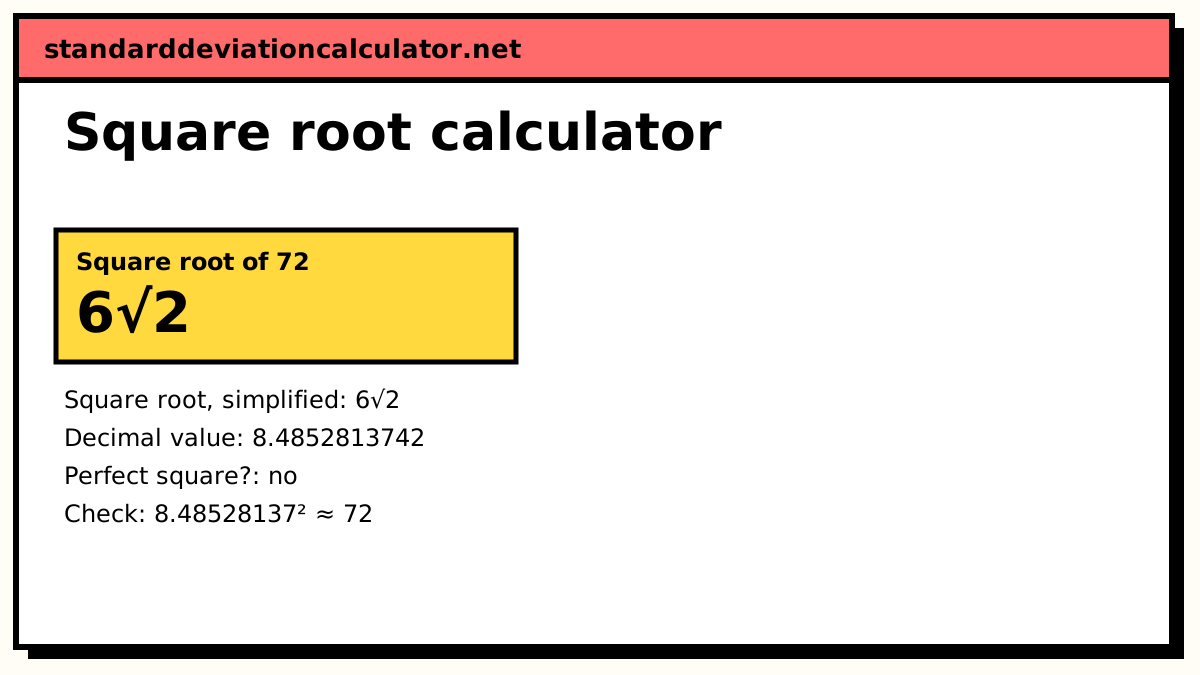
The square root of a number is the value that gives the number when multiplied by itself. This square root calculator returns the decimal value, simplifies the radical when it can (√72 = 6√2), says whether a whole number is a perfect square, and also squares a number or takes a cube root or any n-th root, with the working shown.
Whole numbers are simplified into the form a√b; decimals get a decimal answer.
A whole number from 2 to 100.
Show the working, step by step
Write 72 as a product of primes.
72 = 2³ × 3²
Take each prime out of the radical 2 at a time: every 2 copies of a prime become one copy outside. The leftover copies stay inside.
√72 = √(2² × 2 × 3²) = 6 × √2
Multiply what is outside.
√72 = 6√2
Check the size: 72 lies between the perfect squares 64 and 81.
8 < √72 < 9, and √72 ≈ 8.4852813742
Decimals are rounded to 10 significant figures. Simplified radicals are exact.
How to simplify a square root
A radical √n is in simplest form when no square factor greater than 1 divides n. The reliable method is prime factorisation, the same one used by the prime factorization calculator.
- Write n as a product of primes.
- Group equal primes in pairs. Each pair becomes one prime outside the root.
- Leftover unpaired primes stay inside. Multiply what is outside, and multiply what is inside.
√(a² × b) = a × √b for a ≥ 0, b ≥ 0
Worked example: √72
- 72 = 2³ × 3² = 2² × 2 × 3².
- The squared factors 2² and 3² come out as 2 and 3, and one 2 stays inside.
- √72 = 2 × 3 × √2 = 6√2 ≈ 8.4852813742.
- Size check: 72 lies between 64 and 81, so √72 is between 8 and 9. ✓
More examples
- √200: 200 = 2³ × 5², so √200 = 2 × 5 × √2 = 10√2 ≈ 14.14.
- √144: 144 = 2⁴ × 3², every prime pairs off, so √144 = 12 and 144 is a perfect square.
- ∛54: 54 = 2 × 3³, so ∛54 = 3∛2 ≈ 3.7798, taking primes out three at a time.
Perfect squares
A perfect square is a whole number with a whole-number square root. The first ones are 1, 4, 9, 16, 25, 36, 49, 64, 81, 100, 121, 144 and 169. Whole numbers between two perfect squares have a square root between the two roots, which gives a quick estimate: 72 is between 8² = 64 and 9² = 81. In prime-factor form a number is a perfect square exactly when every prime has an even exponent.
Squares, and the link with square roots
Squaring and taking the square root undo each other for non-negative numbers: √(x²) = x. For a negative x the result is |x|, not x, because the square root symbol means the non-negative root: √((−3)²) = √9 = 3. That is why the equation x² = 9 has two solutions, 3 and −3, even though √9 is just 3. The quadratic equation calculator handles the ± for you.
Common mistakes
- Splitting a sum. √(9 + 16) = √25 = 5, not √9 + √16 = 7. Roots split over multiplication, √(ab) = √a × √b, but not over addition.
- Stopping before the root is fully simplified. √48 = 2√12 is not finished, because 12 still holds a square factor. √48 = 4√3.
- Forgetting the negative root when solving x² = n. The symbol √n alone is the positive root; the equation has both ±√n.
- Trying a real root of a negative number with an even index. √(−4) is the imaginary number 2i.
Square roots appear most often in the Pythagorean theorem, where c = √(a² + b²), and in the quadratic formula.
Common questions
How do I simplify a square root?
Factor the number into primes, pair up equal primes, and move one prime out of the root for every pair. For 72 = 2³ × 3², the pair of 3s and one pair of 2s come out, leaving a single 2 inside: √72 = 2 × 3 × √2 = 6√2. A root is fully simplified when no prime appears twice under it.
How do I check whether a number is a perfect square?
A perfect square is the square of a whole number: 1, 4, 9, 16, 25, … Take its square root. If the result is a whole number, as √144 = 12, the number is a perfect square. If it is not, as √200 ≈ 14.14, it is not. The calculator reports this for each whole number you enter.
How do I square a number?
Multiply it by itself: 1.5² = 1.5 × 1.5 = 2.25. Choose “The square of a number” in the calculator. The square of a negative number is positive, because a negative times a negative is positive, so (−1.5)² is also 2.25.
Can you take the square root of a negative number?
Not in the real numbers, because no real number multiplied by itself is negative. The answer exists as an imaginary number: √(−9) = 3i, where i is defined by i² = −1. The calculator explains this instead of returning an error. Odd roots such as the cube root of −8 are real and equal −2.
How do I find a cube root or a fourth root?
Choose “n-th root” and enter the index n. The same prime method applies, but primes leave the root n at a time: ∛54 = ∛(2 × 3³) = 3∛2 ≈ 3.7798. For a decimal answer without simplifying, the n-th root of x is x raised to 1/n.
Related calculators
-
Polynomial calculator
Add, multiply, factor and find the roots of polynomials.
-
Quadratic equation calculator
Solve ax² + bx + c = 0 with the discriminant and steps.
-
Prime factorization calculator
The prime factors behind every simplified radical.
-
Pythagorean theorem calculator
Hypotenuse and legs, where square roots come from.
-
Simplify expression calculator
Collect like terms and simplify algebraic expressions.
-
Order of operations calculator
Evaluate expressions with exponents and brackets in order.
-
Integer calculator
Add, subtract, multiply and divide negative numbers.