Golden ratio calculator
Enter any one of the three lengths (longer part, shorter part or the whole) and get the other two in the golden ratio, φ ≈ 1.618034.
Show the working, step by step
Two parts are in the golden ratio when the whole is to the longer part as the longer is to the shorter.
(a + b) ÷ a = a ÷ b = φ = (1 + √5) ÷ 2 ≈ 1.618034
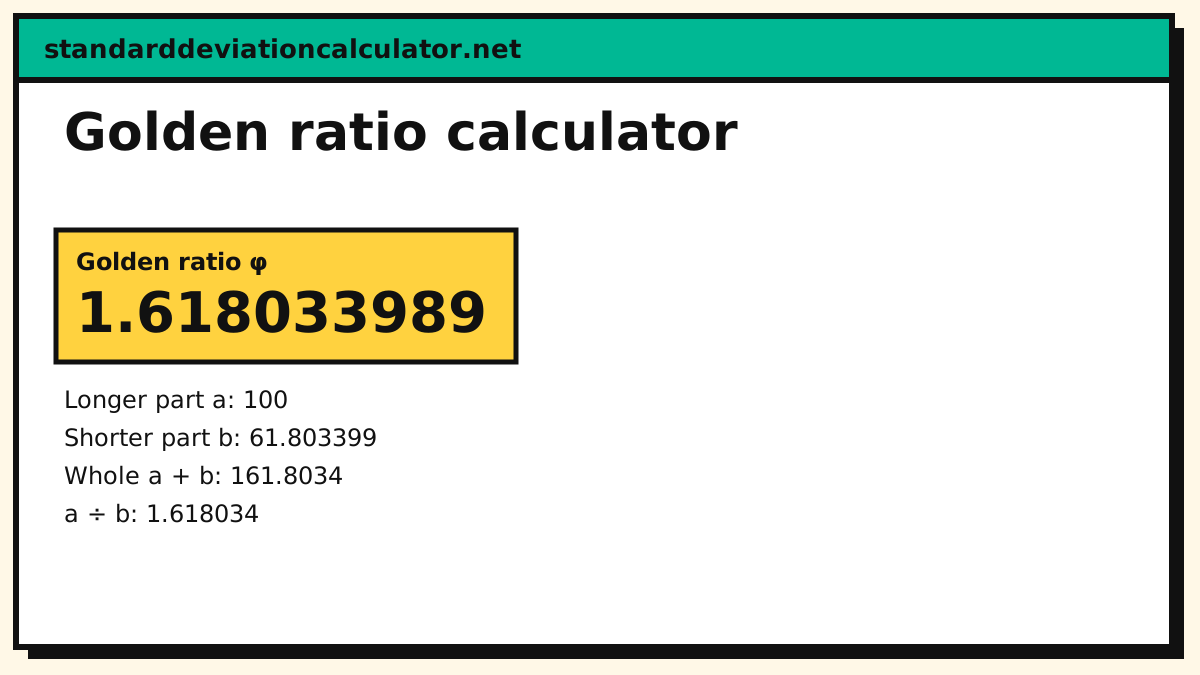
Split the length.
a = 100, b = 61.803399
Definition
(a + b) ÷ a = a ÷ b = φ = (1 + √5) ÷ 2 ≈ 1.6180339887
φ is the positive root of x² = x + 1. The ratio of consecutive Fibonacci numbers converges to it: 89 ÷ 55 = 1.61818. It is used in design and layout as a pleasing proportion.
How to use the golden ratio calculator
Say which length you know: the longer part (a), the shorter part (b) or the whole length (a + b), then enter it. The calculator returns the other two so that the whole divided by the longer part equals the longer divided by the shorter. Use any unit, such as centimetres, pixels or inches: the proportions do not depend on it.
Example
If the longer part is 100, the shorter part is 100 ÷ 1.618 = 61.80 and the whole is 161.80. If the whole is 100, the longer part is 61.80 and the shorter part is 38.20. If the shorter part is 100, the longer part is 161.80 and the whole is 261.80. Each answer follows from the same ratio, φ = (1 + √5) ÷ 2 = 1.6180339887.
Where the number comes from
Split a line so that the whole is to the long piece as the long piece is to the short one. Writing the long piece as 1 and the short as x gives (1 + x) ÷ 1 = 1 ÷ x, which rearranges to x² + x − 1 = 0. The positive solution is x = 0.618, and its reciprocal is 1.618. Both are the golden ratio: 1.618 and 0.618 differ by exactly 1, which no other number does.
The Fibonacci connection
Divide each Fibonacci number by the one before it and the ratios close in on φ: 8 ÷ 5 = 1.6, 13 ÷ 8 = 1.625, 21 ÷ 13 = 1.615 and 89 ÷ 55 = 1.6182. The factorial and Fibonacci calculator generates the sequence. The closeness is a mathematical fact, not a coincidence, because both come from the same recurrence.
Using it in design
Designers use φ to size a layout, a type scale or a logo. A 1000-pixel wide page might be split into a 618 pixel content column and a 382 pixel sidebar, and a 16 pixel body size paired with a 26 pixel heading (16 × 1.618) gives a modest scale. A golden rectangle has sides in the ratio 1 : 1.618, and cutting a square off one end leaves a smaller golden rectangle, which is how the golden spiral is drawn.
Myths and reality
The golden ratio does show up in the geometry of the regular pentagon and in some plant spirals, but it is often over-claimed. There is little evidence that people consistently prefer golden proportions over others, and many famous buildings and paintings claimed to follow it do not do so when measured. Treat it as a pleasant starting proportion rather than a rule.
Worked layout example
You want a 1200 pixel wide banner with a golden split. The whole is 1200, so the longer part is 1200 ÷ 1.618 = 741.6 and the shorter part is 458.4. The text panel gets 742 pixels and the image 458. To size a heading, start from body text of 18 px: 18 × 1.618 = 29 px for a subheading and 29 × 1.618 = 47 px for a title, a simple type scale built from one number.
Common mistakes
- Mixing up the parts. The ratio is whole ÷ longer, not longer ÷ whole.
- Using 1.6 as exact. 1.6 is a rough value; use 1.618 or more digits for precise work.
- Rounding at each step. Keep the full value of φ and round only the final length.
Common questions
What is the golden ratio?
Two parts are in the golden ratio when the whole is to the longer part as the longer part is to the shorter. The value is about 1.618.
How do you find the golden ratio of a length?
Divide the whole by 1.618 to get the longer part, then divide that by 1.618 again for the shorter part.
How is it related to Fibonacci?
Divide any Fibonacci number by the one before it and the answer gets closer to 1.618 as the numbers grow.
What is the golden ratio?
It is the number φ = (1 + √5) ÷ 2 ≈ 1.6180339887, the ratio at which the whole is to the longer part as the longer part is to the shorter.
How do I find the other part of a golden section?
Divide the longer part by 1.618 to get the shorter, or multiply the shorter by 1.618 to get the longer. The whole is the sum of the two.
Is the golden ratio irrational?
Yes. Its decimal expansion never ends or repeats, so every written value is an approximation.
Related calculators
-
Factorial and Fibonacci
The sequence behind φ.
-
Aspect ratio
Screen proportions.
-
Ratio and proportion
Scale and solve.
-
Quadratic equation
x² = x + 1.