Absolute uncertainty calculator
Turn a ± value into a percentage, a percentage into a ± value, or find the uncertainty of a total when several measured quantities are added or subtracted.
Show the working, step by step
Divide the absolute uncertainty by the size of the measurement.
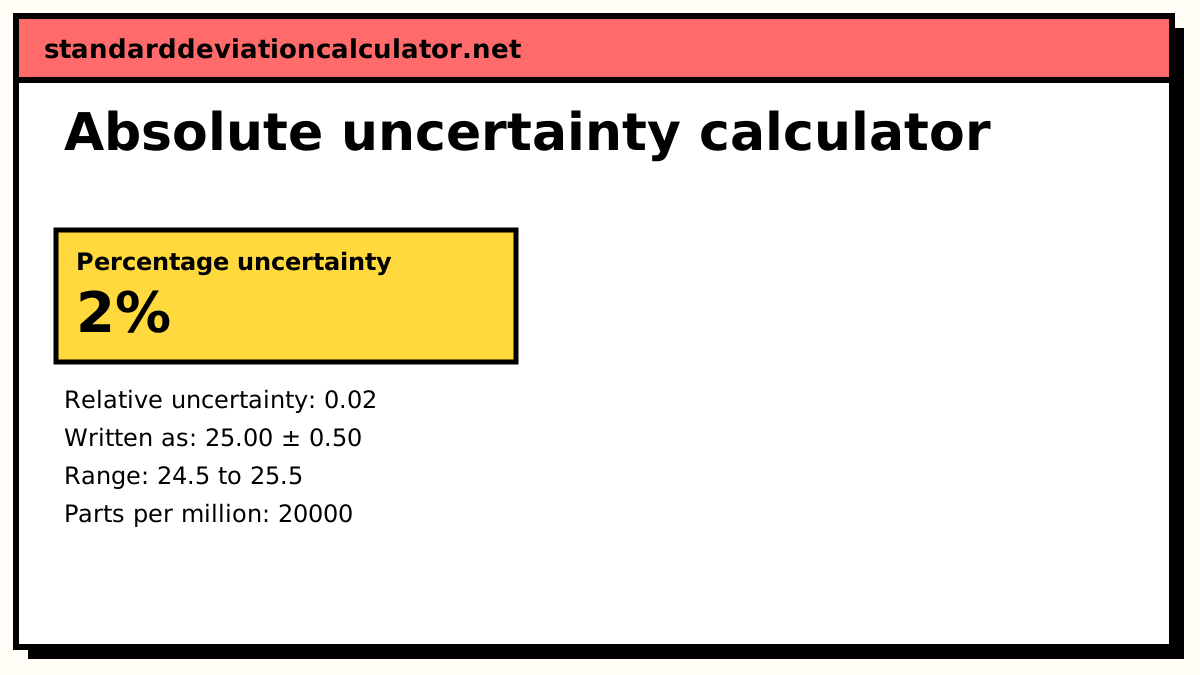
δx / |x| = 0.5 ÷ 25 = 0.02
Multiply by 100 for a percentage.
0.02 × 100 = 2%
The absolute uncertainty has the same unit as the measurement; the relative and percentage uncertainties have no unit.
The formulas
relative uncertainty = δx ÷ |x| percentage uncertainty = δx ÷ |x| × 100 δx = (percentage ÷ 100) × |x|
For a sum or difference q = a + b − c of independent measurements:
δq = √(δa² + δb² + δc²) (quadrature) δq ≤ δa + δb + δc (worst case)
Worked example: converting
The default is a length of 25.0 cm measured to ± 0.5 cm. The relative uncertainty is 0.5 ÷ 25 = 0.02, which is 2%. The result can be written as 25.0 ± 0.5 cm or as 25.0 cm ± 2%. Both say the same thing; the percentage form makes it easy to compare the precision of measurements with different sizes or units. A 2% uncertainty on a length is worse than a 0.5% uncertainty on a mass, even though you cannot compare 0.5 cm with 0.05 g directly.
In the other direction, a value of 25.0 with a 2% uncertainty has an absolute uncertainty of 0.02 × 25 = 0.5.
Worked example: combining
Choose the combine option for the second default: three lengths laid end to end, 25.0 ± 0.5, 12.4 ± 0.3 and 8.1 ± 0.2. The total is 45.5.
δ = √(0.5² + 0.3² + 0.2²) = √0.38 = 0.616 δ_max = 0.5 + 0.3 + 0.2 = 1.0
So the total is 45.50 ± 0.62 in quadrature, or 45.5 ± 1.0 using the worst-case rule. The quadrature figure is smaller because the three errors are unlikely to all be at their maximum in the same direction at once. The relative uncertainty of the total, 0.62 ÷ 45.5 = 1.4%, is smaller than that of the biggest piece: adding measurements tends to dilute relative error, while subtracting close values does the opposite.
Interpreting and rounding
Round the absolute uncertainty to one or two significant figures, then round the value to the same decimal place: 45.50 ± 0.62, not 45.5 ± 0.616441. The absolute uncertainty carries the unit; the relative and percentage uncertainties have none.
Where the absolute uncertainty comes from
For a single reading, start from the instrument: half the smallest division on an analogue scale, or one unit in the last digit of a digital display. For repeated readings, the standard uncertainty s/√n is the better estimate, and half the range is a quick alternative. Whichever you use, say so in your report, because the same measurement can honestly carry different uncertainties under different conventions.
Common mistakes
- Dividing by the uncertainty instead of the value: 25 ÷ 0.5 = 50 is not a percentage uncertainty.
- Subtracting uncertainties when values are subtracted. δ(a − b) is the same as δ(a + b).
- Adding percentage uncertainties for a sum. Percentages combine for products and quotients; for sums use absolute uncertainties.
- Quoting the value to more decimal places than the uncertainty.
For relative error, relative standard error and propagating uncertainty through a formula, see the error and uncertainty calculators.
Common questions
What is absolute uncertainty?
The ± amount attached to a measurement, in the same unit as the measurement. In 25.0 ± 0.5 cm the absolute uncertainty is 0.5 cm. It says the true value is expected to lie between 24.5 cm and 25.5 cm.
How do I convert absolute uncertainty to percentage uncertainty?
Divide the absolute uncertainty by the measured value and multiply by 100. For 25.0 ± 0.5 cm that is 0.5 ÷ 25 × 100 = 2%. To go back, multiply the percentage (as a fraction) by the value: 0.02 × 25 = 0.5 cm.
How do I find the absolute uncertainty of a single reading?
A common rule is half the smallest scale division for an analogue scale (a ruler marked in mm gives ± 0.5 mm) and one unit of the last digit for a digital display. If you have several readings, use half the range or, better, the standard uncertainty from the uncertainty calculator.
Should I add uncertainties or add them in quadrature?
Many school courses add absolute uncertainties directly when values are added or subtracted. That is a safe upper bound. When the errors are independent, adding in quadrature (square, add, square root) gives a more realistic figure. The calculator shows both.
Related calculators
-
Error propagation calculator
Uncertainty of products, quotients, powers and formulas.
-
Relative error calculator
Absolute, relative and percent error against a true value.
-
Uncertainty calculator
Standard and expanded uncertainty from repeated readings.