Relative error calculator
Compare an experimental result with the accepted value. Enter both numbers and the calculator gives the absolute error, the relative error and the percent error, with each step shown.
Show the working, step by step
Subtract the true value from the measured value to get the error.
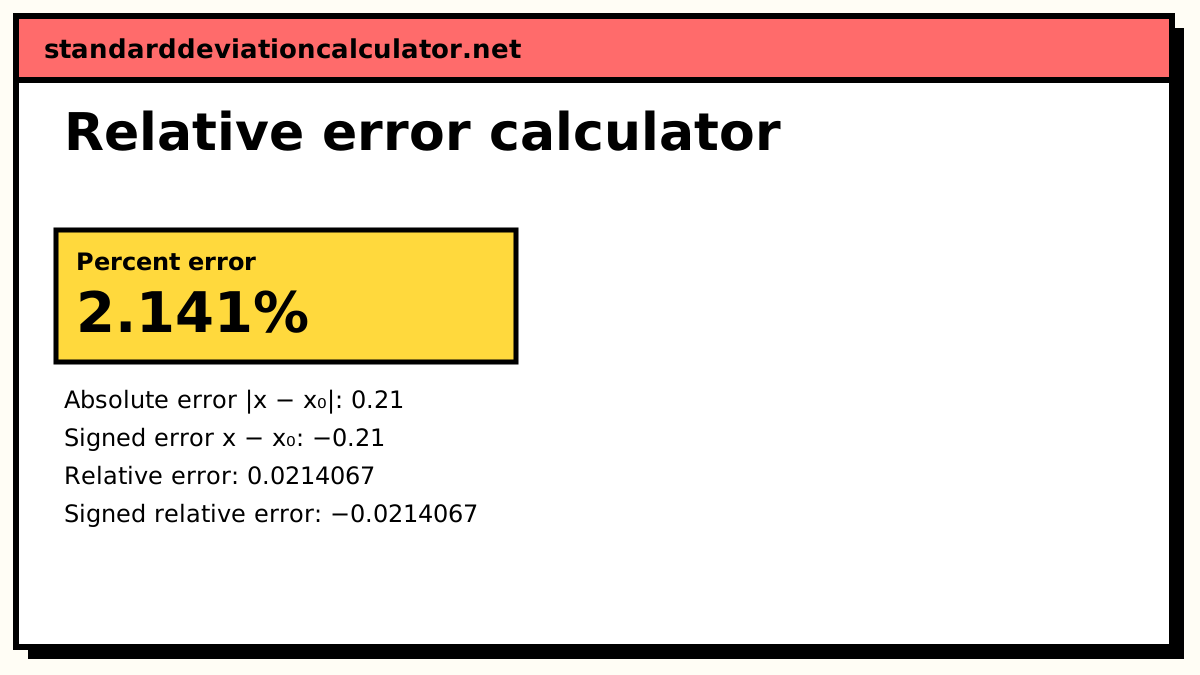
x − x₀ = 9.6 − 9.81 = −0.21
Take the absolute value.
absolute error = |−0.21| = 0.21
Divide by the size of the true value.
relative error = 0.21 ÷ 9.81 = 0.0214067
Multiply by 100.
percent error = 0.0214067 × 100 = 2.14067%
Divide by the true value, not the measured one. Use the signed error when the direction matters, for example to spot a systematic bias.
The formulas
absolute error = |x − x₀| relative error = |x − x₀| ÷ |x₀| percent error = |x − x₀| ÷ |x₀| × 100
Here x is the measured (experimental) value and x₀ is the true, accepted or theoretical value. The denominator is always the true value, because that is the standard you are measuring against.
A worked example
The default is a pendulum experiment that gave g = 9.6 m/s², against the accepted value of 9.81 m/s².
x − x₀ = 9.6 − 9.81 = −0.21 absolute error = 0.21 m/s² relative error = 0.21 ÷ 9.81 = 0.0214 percent error = 2.14%
The measurement is 2.14% too low. The signed error of −0.21 records the direction: this experiment underestimated g. That matters when you look for causes. A pendulum length measured to the top of the bob instead of its centre makes L too small and g too small, so a consistent negative error points towards that kind of systematic mistake rather than random scatter.
Interpreting relative error
Relative error puts errors on a common scale. An error of 0.21 m/s² sounds small, but it is the relative figure, about 2 in 100, that tells you how good the result is. The same absolute error on a quantity of 0.5 would be a 42% error.
Percent error measures accuracy, how close you are to the truth. It says nothing about precision, how close repeated measurements are to each other. A result can be precise and inaccurate (tightly grouped but offset by a systematic error) or accurate on average but imprecise. To judge whether 2.14% is acceptable, compare it with the percentage uncertainty of the measurement: if your uncertainty was ± 3%, the result is consistent with the accepted value; if it was ± 0.5%, something systematic is going on.
The accuracy figure in the results, 100% − 2.14% = 97.86%, is a way some courses and quality reports phrase the same information. It only makes sense while the percent error is below 100%.
Relative error for several trials
With repeated trials, average the measurements first and compute one percent error for the mean. The mean has less random scatter than any single trial, so its error says more about systematic problems. If you want the typical size of the error across trials instead, use the mean absolute error or RMSE from the MSE calculator.
Common mistakes
- Dividing by the measured value instead of the true value. With these numbers that gives 2.19% instead of 2.14%.
- Forgetting the absolute value and reporting a negative percent error where a positive one is expected.
- Reporting the relative error as a percentage without multiplying by 100 (0.0214%, not 2.14%).
- Using percent error for values near zero, where tiny absolute errors produce enormous percentages.
Common questions
What is the difference between absolute and relative error?
Absolute error is the size of the miss in the original units: |measured − true|. Relative error divides that by the size of the true value, so it has no units and lets you compare errors on quantities of very different sizes. Missing by 1 cm is a large relative error for a 5 cm object and a tiny one for a 100 m track.
Is percent error the same as relative error?
Yes, expressed as a percentage. A relative error of 0.0214 is a percent error of 2.14%.
Can percent error be negative?
The usual definition takes the absolute value, so percent error is never negative. Some courses use the signed version, (measured − true) ÷ true × 100, where a negative result means the measurement was too low. The calculator gives both.
What if the true value is zero?
Relative error is then undefined, because it divides by zero. Report the absolute error instead, or compare against a scale such as the instrument's full range.
What is a good percent error?
It depends on the experiment. Under 5% is often considered good in school labs; precision work may need well under 0.1%. Compare the percent error with your percentage uncertainty: if the error is smaller than the uncertainty, the result agrees with the accepted value.
Related calculators
-
Absolute uncertainty calculator
Convert between absolute and percentage uncertainty.
-
MSE calculator
Average errors over many predictions: MSE, RMSE, MAE and MAPE.
-
Percentage calculator
Percentages, percentage change and percentage of a number.