Error propagation calculator
Find the uncertainty of a calculated result from the uncertainties of the measurements that went into it. Pick an operation, or type any formula in a, b and c, and the calculator applies the matching propagation rule and shows every step.
Use a, b and c for the measured quantities, e.g. a*b^2/c, sqrt(a^2 + b^2), a*sin(b).
In quadrature the combined σq is √(sum of squares), so the largest contribution dominates and small ones barely matter.
Show the working, step by step
Work out q.
q = 12 × 3 = 36
For a product or quotient, the relative uncertainties combine.
σa/|a| = 0.2/12 = 0.0166667 σb/|b| = 0.1/3 = 0.0333333 σq/|q| = √(0.0166667² + 0.0333333²) = 0.0372678
Convert back to an absolute uncertainty.
σq = 0.0372678 × 36 = 1.34164
Round σq to two significant figures and q to the same decimal place.
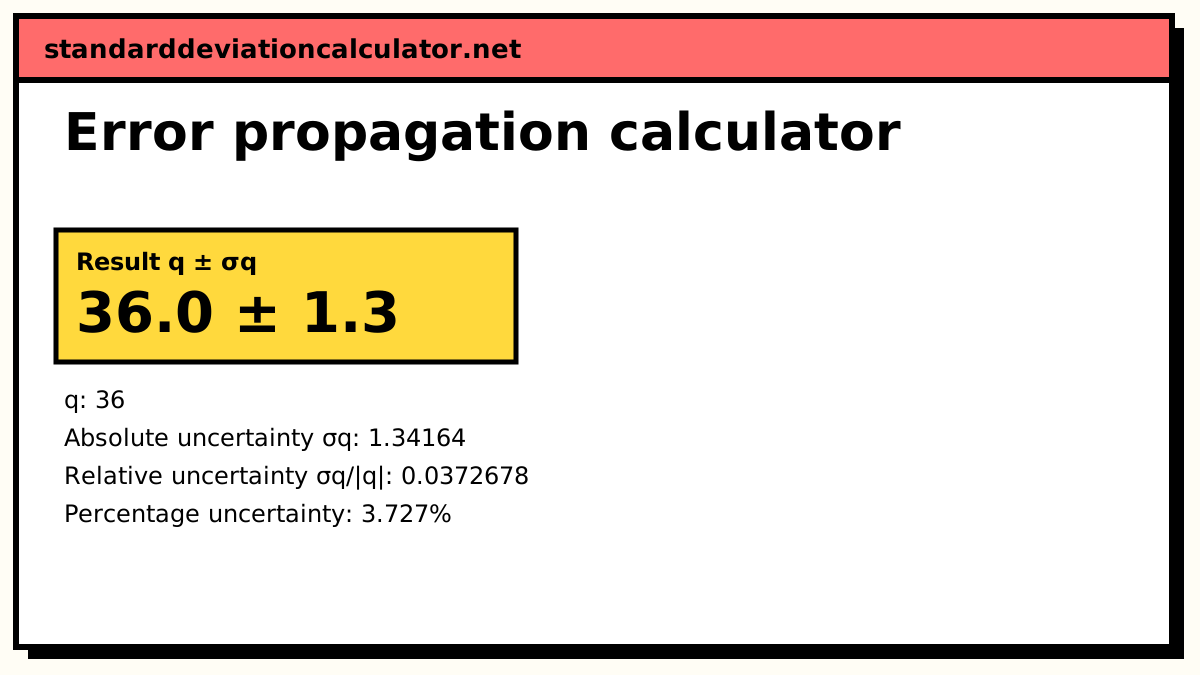
q = 36.0 ± 1.3
Uncertainties added in quadrature, assuming the errors are independent. The rules assume the uncertainties are small compared with the values.
The formulas
For independent uncertainties σa and σb:
q = a ± b: σq = √(σa² + σb²) q = a × b or a ÷ b: σq/|q| = √((σa/a)² + (σb/b)²) q = aⁿ: σq/|q| = |n| × σa/|a| q = f(a, b, c): σq = √((∂f/∂a · σa)² + (∂f/∂b · σb)² + (∂f/∂c · σc)²)
The first three rules are special cases of the last one. The general formula is a first-order Taylor expansion: it treats f as a straight line over the width of each uncertainty, which is accurate when the uncertainties are small compared with the values.
A worked example: a product
The default multiplies a = 12.0 ± 0.2 by b = 3.0 ± 0.1, say the length and width of a plate in centimetres. The area is q = 12 × 3 = 36 cm². The relative uncertainties are 0.2/12 = 0.0167 and 0.1/3 = 0.0333. Combined in quadrature:
σq/q = √(0.0167² + 0.0333²) = 0.0373 σq = 0.0373 × 36 = 1.34 cm²
So the area is 36.0 ± 1.3 cm², a 3.7% uncertainty. Notice that the width, although its absolute uncertainty is smaller, contributes more, because 0.1 is a bigger fraction of 3 than 0.2 is of 12. That is the place to spend effort if you want a better result.
A worked example: a general formula
Choose "Any formula" for the second default, f = a·b/c with c = 2.0 ± 0.05. Then f = 18. The partial derivatives, evaluated at the measured values, are ∂f/∂a = b/c = 1.5, ∂f/∂b = a/c = 6 and ∂f/∂c = −ab/c² = −9. Each is multiplied by its uncertainty:
1.5 × 0.2 = 0.3, 6 × 0.1 = 0.6, 9 × 0.05 = 0.45 σf = √(0.3² + 0.6² + 0.45²) = 0.808
The result is 18.00 ± 0.81. The same answer comes from adding the three relative uncertainties in quadrature, as it should: for products and quotients the derivative method and the relative rule agree exactly.
Reading the result
The uncertainty is rounded to two significant figures and the value to the same decimal place. Quoting 36 ± 1.34164 claims a precision the measurements cannot support. If the inputs were standard uncertainties (one standard deviation), so is the result; to report a 95% interval, multiply by a coverage factor of about 2.
Common mistakes
- Adding absolute uncertainties for a product. Products and quotients combine relative uncertainties.
- Subtracting uncertainties when values are subtracted. Uncertainties never cancel; they always combine.
- Treating a repeated quantity as independent. a² has twice the relative uncertainty of a, but a × a with two independent errors would give only √2 times.
- Using the linear rule and calling the result a standard uncertainty. The linear sum is a worst-case bound.
Common questions
What is propagation of error?
Working out how the uncertainties in measured inputs carry through a calculation to the result. If you measure a length and a width with some uncertainty, the area you calculate from them is uncertain too, and error propagation tells you by how much.
Why are uncertainties added in quadrature?
When the errors in a and b are independent and random, they are unlikely to both be at their worst in the same direction. Their variances add, so the standard uncertainties combine as the square root of the sum of squares. Adding them directly gives an upper bound that is usually too pessimistic; the calculator offers it as the "linearly" option for courses that use it.
When do I use absolute and when relative uncertainties?
For sums and differences combine the absolute uncertainties. For products, quotients and powers combine the relative (fractional) uncertainties, then multiply by the result to get back to an absolute uncertainty.
Does subtracting two values reduce the uncertainty?
No. The uncertainty of a − b is the same as that of a + b. Subtracting two close values is in fact where relative uncertainty grows fastest: 10.0 ± 0.1 minus 9.8 ± 0.1 is 0.2 ± 0.14, an uncertainty of about 70%.
What if my inputs are correlated?
The formulas here assume independent errors. Correlated inputs need an extra covariance term, 2 (∂f/∂a)(∂f/∂b) cov(a, b), inside the square root. If you use the same measured value twice in a formula, write it once (for example a^2 rather than a·a with two separate uncertainties).
Related calculators
-
Uncertainty calculator
Standard and expanded uncertainty from repeated readings.
-
Absolute uncertainty calculator
Convert between absolute and percentage uncertainty.
-
Partial derivative calculator
The derivatives the general formula is built on, with steps.