Mortgage calculator
Enter the home price, down payment, rate and term to get the full monthly cost: principal and interest, property tax, home insurance, HOA fees and PMI when the down payment is under 20%.
| Monthly cost | Amount |
|---|---|
| Principal and interest | $2,022.62 |
| Property tax | $366.67 |
| Home insurance | $150.00 |
| HOA / other | $0.00 |
| PMI | $0.00 |
| Total | $2,539.28 |
| Year | Principal paid | Interest paid | Balance at year end |
|---|---|---|---|
| 1 | $3,577 | $20,695 | $316,423 |
| 2 | $3,816 | $20,455 | $312,607 |
| 3 | $4,072 | $20,200 | $308,535 |
| 4 | $4,345 | $19,927 | $304,191 |
| 5 | $4,636 | $19,636 | $299,555 |
| 6 | $4,946 | $19,325 | $294,609 |
| 7 | $5,277 | $18,994 | $289,332 |
| 8 | $5,631 | $18,641 | $283,701 |
| 9 | $6,008 | $18,264 | $277,694 |
| 10 | $6,410 | $17,861 | $271,284 |
| 11 | $6,839 | $17,432 | $264,444 |
| 12 | $7,297 | $16,974 | $257,147 |
| 13 | $7,786 | $16,485 | $249,361 |
| 14 | $8,308 | $15,964 | $241,053 |
| 15 | $8,864 | $15,407 | $232,189 |
| 16 | $9,458 | $14,814 | $222,732 |
| 17 | $10,091 | $14,180 | $212,641 |
| 18 | $10,767 | $13,505 | $201,874 |
| 19 | $11,488 | $12,784 | $190,386 |
| 20 | $12,257 | $12,014 | $178,129 |
| 21 | $13,078 | $11,193 | $165,051 |
| 22 | $13,954 | $10,317 | $151,097 |
| 23 | $14,888 | $9,383 | $136,208 |
| 24 | $15,886 | $8,386 | $120,323 |
| 25 | $16,949 | $7,322 | $103,373 |
| 26 | $18,085 | $6,187 | $85,289 |
| 27 | $19,296 | $4,976 | $65,993 |
| 28 | $20,588 | $3,683 | $45,405 |
| 29 | $21,967 | $2,305 | $23,438 |
| 30 | $23,438 | $833 | $0 |
Show the working, step by step
Loan = price × (1 − down payment).
$400,000 × 0.80 = $320,000
Principal and interest use the loan payment formula.
M = P·i ÷ (1 − (1 + i)−n) = $2,022.62
Add tax, insurance, HOA and PMI (PMI applies below a 20% down payment).
Total = $2,539.28
What is in a mortgage payment
M = P · i ÷ (1 − (1 + i)^−n) (principal and interest)
Lenders often add escrow for property tax and insurance, and charge PMI when the down payment is below 20%. The result is an estimate: your lender’s figures, local tax rates and insurance quotes decide the real number. For an amortization schedule or extra payments, use the loan calculator.
How to use the mortgage calculator
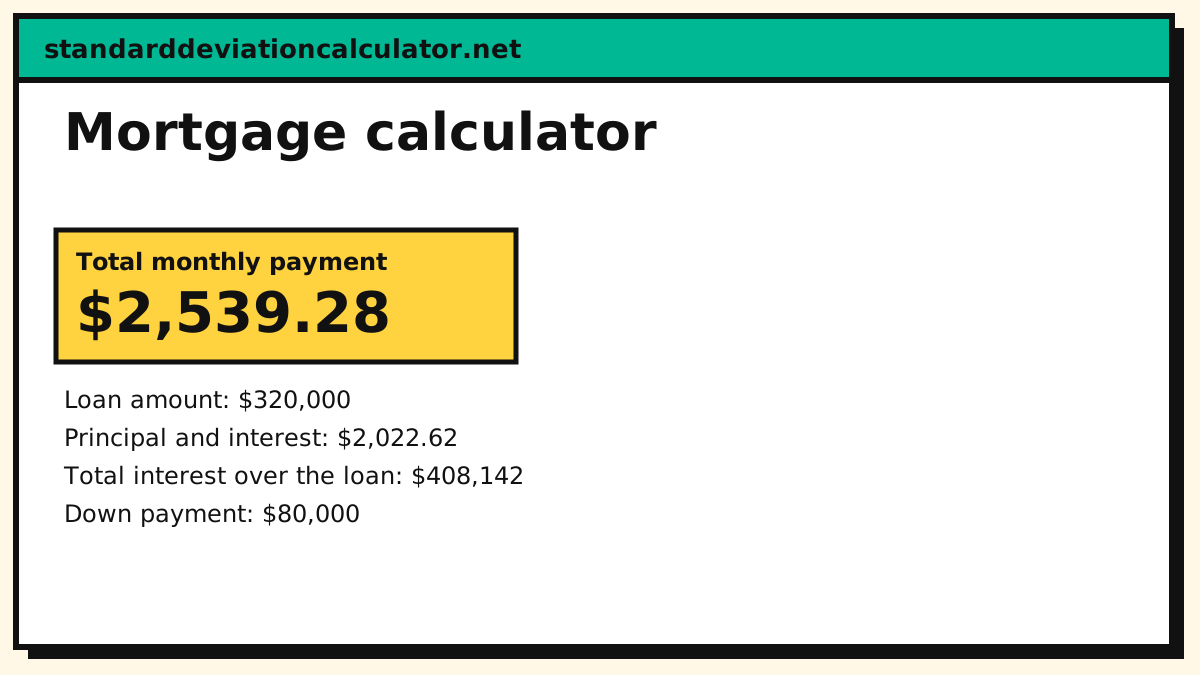
Enter the home price and the down payment as a percentage, the interest rate and the term in years. Then add the costs that sit on top of the loan: property tax as a percentage of the price a year, home insurance per year, any HOA or similar fee per month, and a PMI rate that applies only when the down payment is under 20%. The headline figure is the full monthly cost; the cells under it show the loan amount, the principal-and-interest part, the total interest over the life of the loan and your down payment in money. Two tables follow: a monthly breakdown, and an amortization schedule by year that ends at a zero balance. The “Show the working” panel repeats the arithmetic step by step.
The mortgage payment formula in detail
The principal-and-interest payment is the standard annuity formula. With the monthly rate i (annual rate ÷ 12) and n monthly payments, the payment is M = P × i ÷ (1 − (1 + i)−n). For a $320,000 loan at 6.5% over 30 years, i = 0.065 ÷ 12 = 0.0054167 and n = 360, which gives M = $2,022.62. The same payment never changes, but its make-up does: in month 1 the interest is 320,000 × 0.0054167 = $1,733.33 and only about $289 pays down the principal. Each month the balance falls a little, so interest shrinks and principal grows until the final payment clears the loan.
Worked example: a $400,000 home
Take a $400,000 home, a 20% down payment, a 6.5% rate and a 30-year term. The down payment is $80,000, so the loan is $320,000 and the principal and interest come to $2,022.62 a month. Property tax at 1.1% of the price is $4,400 a year, or $366.67 a month, and insurance of $1,800 a year is $150 a month. With no HOA fee and no PMI (the down payment is at least 20%), the total is about $2,539.28 a month. Over 360 payments the interest alone adds up to about $408,142, more than the amount borrowed, which is why the term and rate matter so much.
Now put down only 10% ($40,000). The loan grows to $360,000 and principal and interest rise to $2,275.44. PMI at 0.6% of the loan a year adds $180 a month, so the total becomes about $2,972.11 a month, roughly $433 more than with 20% down. Try both in the calculator to see how a smaller deposit increases the payment twice over: a bigger loan and the PMI charge.
Down payment, PMI and loan-to-value
The loan-to-value ratio (LTV) is the loan divided by the home’s value. A 20% down payment means an 80% LTV, the usual line below which lenders stop charging private mortgage insurance on a conventional loan. PMI protects the lender, not you, and typically costs a fraction of a percent of the loan a year; the rate depends on your credit score and the size of the deposit. In the United States, under the Homeowners Protection Act, PMI on many conventional loans can be cancelled on request once the balance reaches 80% of the original value, and must end automatically at 78% if you are up to date with payments. Rules and exceptions vary by loan type, so check your own loan documents. Government-backed loans such as FHA and VA loans have their own insurance or fee rules rather than ordinary PMI.
15 years or 30 years?
A shorter term costs more each month and far less in total. On the $320,000 loan at 6.5%, a 15-year term has a principal-and-interest payment of $2,787.54 (about $765 more than the 30-year payment) but total interest of about $181,758, less than half of the roughly $408,142 on 30 years. A longer term keeps the monthly payment lower and the budget flexible, and you can still pay extra when you can afford to: see the loan calculator for the effect of extra payments. In practice lenders usually quote a lower rate for 15-year loans, which this calculator lets you test by changing the rate and the term together.
Reading the amortization schedule
The yearly table shows how much of your payments went to principal and to interest each year and the balance left at year end. In year 1 of the example about $3,577 pays down the principal and $20,695 goes to interest; by the final year almost the whole payment is principal. The schedule covers principal and interest only: taxes, insurance, HOA fees and PMI go to other parties and are not in it. It assumes a fixed rate for the whole term.
Comparing two offers: points and break-even
Lenders sometimes offer a lower rate in exchange for upfront “points” (one point costs 1% of the loan). On the $320,000 loan, an offer at 6.25% with one point costs $3,200 up front and has a payment of $1,970.30, which is $52.32 a month below the $2,022.62 payment at 6.5% with no points. The point pays for itself after about 61 months (3,200 ÷ 52.32), roughly five years. If you expect to sell or refinance sooner, the cheaper rate is the more expensive choice. Run each offer through the calculator, enter its rate, and compare both the monthly figure and how long you plan to stay.
Fixed-rate or adjustable-rate?
With a fixed-rate mortgage the rate, and so the principal-and-interest payment, stays the same for the whole term, which is what this calculator models. An adjustable-rate mortgage (ARM) starts with a fixed period, often with a lower rate, and then resets at intervals to follow a market index, within caps written into the loan. If you consider an ARM, test the payment at the highest rate the caps allow, not only the starting rate, and ask when the first reset happens.
Costs beyond the payment
Buying a home also involves closing costs (lender fees, title and appraisal charges, prepaid taxes and insurance), often a few percent of the price, plus moving costs, repairs and upkeep. None of these is in the monthly payment, and the deposit and closing costs must come from savings. Keep a reserve for maintenance as well: a roof or boiler replacement can cost several thousand dollars.
Common mistakes and limits
- Budgeting on principal and interest alone. Taxes and insurance can add several hundred dollars a month.
- Forgetting closing costs and maintenance. They are not in the payment; the calculator does not include them.
- Using a quoted rate that is not yours. Your rate depends on credit, deposit, loan type and the day you lock it.
- Assuming an adjustable-rate loan behaves like this. An ARM changes its rate after the fixed period; this tool models a fixed rate only.
The results are estimates for planning, not an offer of credit or a quote. Your lender’s figures, local tax rates and insurance quotes decide the real payment.
Common questions
How is a mortgage payment calculated?
Principal and interest use the loan payment formula with the monthly rate and the number of payments. Tax, insurance, HOA and PMI are added on top.
What down payment avoids PMI?
Usually 20% of the price on a conventional loan. Below that, lenders charge private mortgage insurance until the loan balance falls to about 80% of the home’s value.
How much interest will I pay?
Total interest is the sum of monthly payments minus the loan amount. At 6.5% over 30 years it is roughly 1.27 times the amount borrowed.
How much house can I afford?
A common guideline is the 28/36 rule: keep the housing payment (principal, interest, tax, insurance and HOA) under about 28% of gross monthly income, and all debt payments under about 36%. On $8,000 a month of gross income that is $2,240 for housing. Lenders apply their own limits, and the right number for you also depends on savings, other goals and how stable your income is, so treat this as a starting point only.
What is escrow?
Many lenders collect a twelfth of your yearly property tax and insurance with each payment, hold it in an escrow account and pay the bills for you. The tax and insurance rows in this calculator estimate what would be collected, so the total is close to the amount your lender would ask for each month, minus any HOA dues you pay separately.
Does a bigger down payment lower my rate?
Often, though not always. A larger deposit lowers the loan-to-value ratio, which can mean a lower rate and a smaller or no PMI charge. It also cuts the amount you borrow, so total interest falls even if the rate stays the same. Compare lender quotes at different deposit sizes.
Related calculators
-
Loan calculator
Amortization and extra payments.
-
Finance calculator (TVM)
Solve N, I/Y, PV, PMT.
-
Compound interest
Saving for a deposit.
-
Inflation calculator
Prices over time.