Poker hand calculator
Type your cards to see the best five-card poker hand, the three-card poker rank, or your Texas Hold’em chance to win against one to eight random opponents. The hand rankings and the exact odds of each hand are below.
A flush draw has 9 outs; an open-ended straight draw has 8.
Rank then suit: AS, KH, 10D, 7C. Spaces or commas between cards.
| Hand (best first) | Ways to be dealt | Chance |
|---|---|---|
| Straight flush (incl. royal) | 40 | 0.0015% |
| Four of a kind | 624 | 0.0240% |
| Full house | 3,744 | 0.1441% |
| Flush | 5,108 | 0.1965% |
| Straight | 10,200 | 0.3925% |
| Three of a kind | 54,912 | 2.1128% |
| Two pair | 123,552 | 4.7539% |
| One pair | 1,098,240 | 42.2569% |
| High card | 1,302,540 | 50.1177% |
| All five-card hands | 2,598,960 | 100% |
Show the working, step by step
Check every five-card subset of your cards and keep the strongest.
One hand to rank
Rank by category, then by the highest cards within it (ace is high, but also low in A-2-3-4-5).
Straight flush
Poker hand rankings and odds
| Rank | Hand | Example | Chance in 5 cards |
|---|---|---|---|
| 1 | Straight flush | A♠ K♠ Q♠ J♠ 10♠ | 0.0015% |
| 2 | Four of a kind | 9♣ 9♦ 9♥ 9♠ 2♦ | 0.0240% |
| 3 | Full house | K♣ K♦ K♥ 2♠ 2♦ | 0.1441% |
| 4 | Flush | A♠ 9♠ 7♠ 4♠ 2♠ | 0.1965% |
| 5 | Straight | 5♣ 6♦ 7♥ 8♠ 9♦ | 0.3925% |
| 6 | Three of a kind | 7♣ 7♦ 7♥ 2♠ 9♦ | 2.1128% |
| 7 | Two pair | 7♣ 7♦ 2♥ 2♠ 9♦ | 4.7539% |
| 8 | One pair | 7♣ 7♦ 3♥ 2♠ 9♦ | 42.2569% |
| 9 | High card | A♣ 7♦ 3♥ 2♠ 9♦ | 50.1177% |
The counts come from combinations: there are C(52, 5) = 2,598,960 five-card hands. A flush is 4 suits × C(13, 5) = 5,148 hands, less the 40 straight flushes, leaving 5,108. A full house is 13 × C(4, 3) × 12 × C(4, 2) = 3,744. Check the arithmetic with the combination calculator.
Pot odds and outs
Pot odds tell you the price of a call; outs tell you how likely you are to get paid for it. Compare the two and the question “is this call worth it?” becomes arithmetic. Switch the tool above to Pot odds and outs to work through your own hand.
equity needed = call ÷ (pot + bet + call) chance of hitting an out = 1 − ((unseen − outs) ÷ unseen) × ((unseen − outs − 1) ÷ (unseen − 1))
Example. The pot is 100 and an opponent bets 50 on the flop, so you must call 50 to win a pot of 200: you need 50 ÷ 200 = 25%. You hold a flush draw with 9 outs and 47 unseen cards. Over the turn and river you hit with 1 − (38/47 × 37/46) = 34.97%, which is more than 25%, so the call has the right price on the numbers alone. With one card to come (the turn) the same nine outs hit only 9 ÷ 46 = 19.6%, which would not justify a call at 25%.
A common shortcut is the rule of 4 and 2: multiply your outs by 4 on the flop (two cards to come) or by 2 on the turn. Nine outs gives 36% against an exact 34.96%, close enough at the table but increasingly high as outs grow. Typical out counts: flush draw 9, open-ended straight draw 8, gutshot 4, two overcards 6.
These figures ignore implied odds (money you win later when you hit), outs that an opponent’s hand may spoil, and the betting still to come, so treat them as the starting point of a decision. This is probability, not gambling advice.
How Hold’em equity is estimated
The calculator deals the unseen cards at random 8,000 times against random opponent hands, ranks everyone’s best five of seven cards and counts the results. That gives an answer within about one percentage point, using a fixed seed so the same cards always return the same figure. Real opponents do not play random hands, so use equity as a guide to how strong a hand is rather than an exact prediction.
How to use the poker hand calculator
Choose what you want from the menu. Name my poker hand takes 5 to 7 cards and shows the best five-card hand among them. Name my three-card poker hand ranks a three-card hand by the rules of three-card poker. Texas Hold’em win chance takes your two hole cards, the board if there is one, and the number of opponents. Pot odds and outs takes the pot, the bet you must call, your outs and whether the turn or the flop is next. Cards are typed as a rank followed by a suit: AS is the ace of spades, 10D the ten of diamonds, KH the king of hearts and 7C the seven of clubs. Separate cards with spaces or commas.
Examples
- Naming a hand:
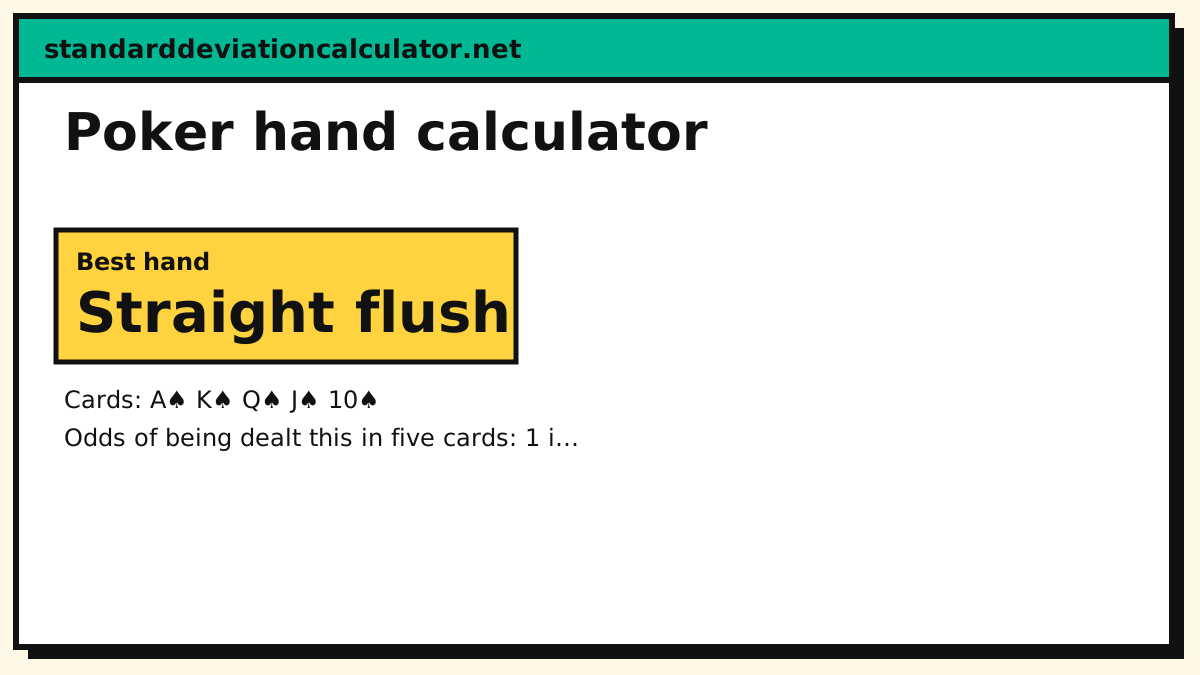
AS KS QS JS 10Sis a royal flush, the best possible hand. - Seven cards:
AH AD 7C 7S 7D 2H 9Ccontains a full house, sevens full of aces, because it picks the best five of the seven. - Pre-flop equity:
AH ADagainst two random opponents wins about 73% of the time (about 85% against one). - Pot odds: a pot of 100, a bet of 50 and a flush draw (9 outs, flop to come) needs 25% and has 34.97%.
Poker hands over seven cards
In Texas Hold’em you make the best five-card hand from seven cards: your two hole cards and five on the board. That changes the odds. Of the 133,784,560 possible seven-card combinations, about 17.4% make only a high card, 43.8% contain a pair, 23.5% two pair, 4.8% three of a kind, 4.6% a straight, 3.0% a flush, 2.6% a full house, 0.17% four of a kind and 0.03% a straight flush or royal flush. Hands that are rare in five cards, such as flushes and full houses, are noticeably more common with seven.
Three-card poker odds
With only three cards there are 22,100 possible hands, and the ranking changes because a flush is easier to make than a straight. In three-card poker the order is straight flush, three of a kind, straight, flush, pair and high card. The chances are:
| Hand | Combinations | Chance |
|---|---|---|
| Straight flush | 48 | 0.217% |
| Three of a kind | 52 | 0.235% |
| Straight | 720 | 3.258% |
| Flush | 1,096 | 4.959% |
| Pair | 3,744 | 16.941% |
| High card | 16,440 | 74.389% |
Starting hands in Texas Hold’em
You are dealt one of 1,326 two-card combinations. Pocket pairs make up 78 of them, 5.9% of deals. Suited non-pairs are 312, or 23.5%, and the rest are offsuit. Pocket aces are the best starting hand, winning about 85% of the time against one random hand, with pocket kings next at about 82%. The weakest hand against a random opponent is 7-2 offsuit, and that is a long way from a certain loser. A pair in your hand becomes three of a kind on the flop about 11.8% of the time, which is the chance of flopping a set.
Outs and common draws
| Draw | Outs | Hit by the river from the flop | Hit on the next card |
|---|---|---|---|
| Flush draw | 9 | 34.97% | 19.57% |
| Open-ended straight draw | 8 | 31.45% | 17.39% |
| Gutshot straight draw | 4 | 16.47% | 8.70% |
| Two overcards | 6 | 24.14% | 13.04% |
“Hit by the river” uses 47 unseen cards after the flop and “next card” uses 46 unseen cards after the turn. Outs that also help an opponent make a better hand are not real outs, so count only cards that give you the best hand.
Understanding equity
Equity is your share of the pot if every remaining card were dealt out and nothing else changed. A hand with 40% equity wins 40% of the time on average, ties are shared, and it should call a bet when the price is lower than 40% of the pot after the bet. Equity changes on every street: a flush draw has about 35% on the flop and either 100% or about 0% after the river. Add the opponent count and equity drops fast, since more hands means more chances that someone is ahead. Aces against eight opponents win far less often than aces against one.
Using the numbers well
- Count only outs that you are sure of, and discount cards that the opponent’s hand might spoil.
- Compare equity with the pot odds before calling a bet.
- Remember that odds only inform a decision. Position, stack sizes and opponents matter too.
- Treat the Monte Carlo equity as an estimate: run it with different boards to see how much it moves.
Worked example: should you call?
You hold AH KH and the flop is QH 7H 2C, giving you a nut flush draw with 9 outs plus a few extra from the overcards. The opponent bets 60 into a pot of 140, so you face a call of 60 to win 260 in total. The price is 60 ÷ 260 = 23.1%. Your flush alone arrives by the river 34.97% of the time, which already beats the price, and your overcards add some more. On the numbers the call is clearly profitable. If the same bet were three times larger, 180 into 140, the price would be 180 ÷ 500 = 36%, slightly above your flush chance, and the decision would depend on how much you could win later.
Why random opponents matter
The equity calculation assumes opponents hold random hands. Real players fold weak hands and bet strong ones, so a hand facing a raise has less equity than the number shown. Think of the result as an upper bound for a hand against a typical wide range, and lower it when an opponent shows strength. The estimate is also random: run the same hand twice with a different board and watch how far the answer moves.
Ties and split pots
When two players make hands of equal rank and equal kickers, the pot is split. The tool counts a tie as a share of a win, which is why your “chance to win” can be a little higher than the outright win figure shown beside it. Board hands, such as a straight on the board, tie most often.
Common mistakes
- Entering a card twice. A deck holds only one of each card, so duplicates are rejected.
- Using 10 or T inconsistently. Write
10Sfor the ten of spades. - Ignoring the board. In Hold’em a board straight or pair counts for every player.
- Treating odds as a guarantee. A 90% chance still fails one time in ten.
This tool is for learning probability. It does not offer gambling advice or links to real-money games.
Common questions
What are the poker hand rankings?
From best to worst: royal and straight flush, four of a kind, full house, flush, straight, three of a kind, two pair, one pair and high card. Within a category the higher cards win, and the ace counts high or low in A-2-3-4-5.
What are the odds of each five-card poker hand?
Out of 2,598,960 possible hands: a straight flush is 40 (0.0015%), four of a kind 624, a full house 3,744, a flush 5,108, a straight 10,200, three of a kind 54,912, two pair 123,552, one pair 1,098,240 and high card 1,302,540. The table below gives each chance.
What does equity mean in Texas Hold’em?
Equity is your share of the pot if all the remaining cards were dealt out many times. Pocket aces heads up have about 85% equity against a random hand; two random hole cards average 1 divided by the number of players.
How does three-card poker differ?
With only three cards, a flush is more common than a straight, so the ranking changes: straight flush, three of a kind, straight, flush, pair, high card.
What is the best starting hand in Hold’em?
Pocket aces (A-A). It wins about 85% of the time heads up against a random hand and about 73% against two. Suited connected cards such as J-10 suited are worth playing because they make flushes and straights.
Related calculators
-
Blackjack
Play against the dealer.
-
Combination calculator
C(52, 5) = 2,598,960.
-
Probability calculator
Your own odds.
-
Hypergeometric distribution
Drawing cards without replacement.