Inverse function calculator
The inverse of a function undoes it: if f turns 2 into 5, f⁻¹ turns 5 back into 2. Pick the form of f(x), enter its coefficients and the calculator shows the swap-and-solve steps, the inverse f⁻¹(x), the domain and range of both functions and the value of f⁻¹ at any y you choose.
Leave blank to skip.
Show the working, step by step
Write y = f(x).
y = x² + 2x − 3
Complete the square to see the vertex.
y = (x + 1)² − 4
Restrict the domain so f is one-to-one: x ≥ −1.
On this branch the vertex is at (−1, −4) and every y in the range comes from exactly one x.
Swap x and y.
x = (y + 1)² − 4
Solve for y: isolate the square, then take the square root, keeping the + root because y ≥ −1.
y = −1 + √(x + 4)
State the result with its domain.
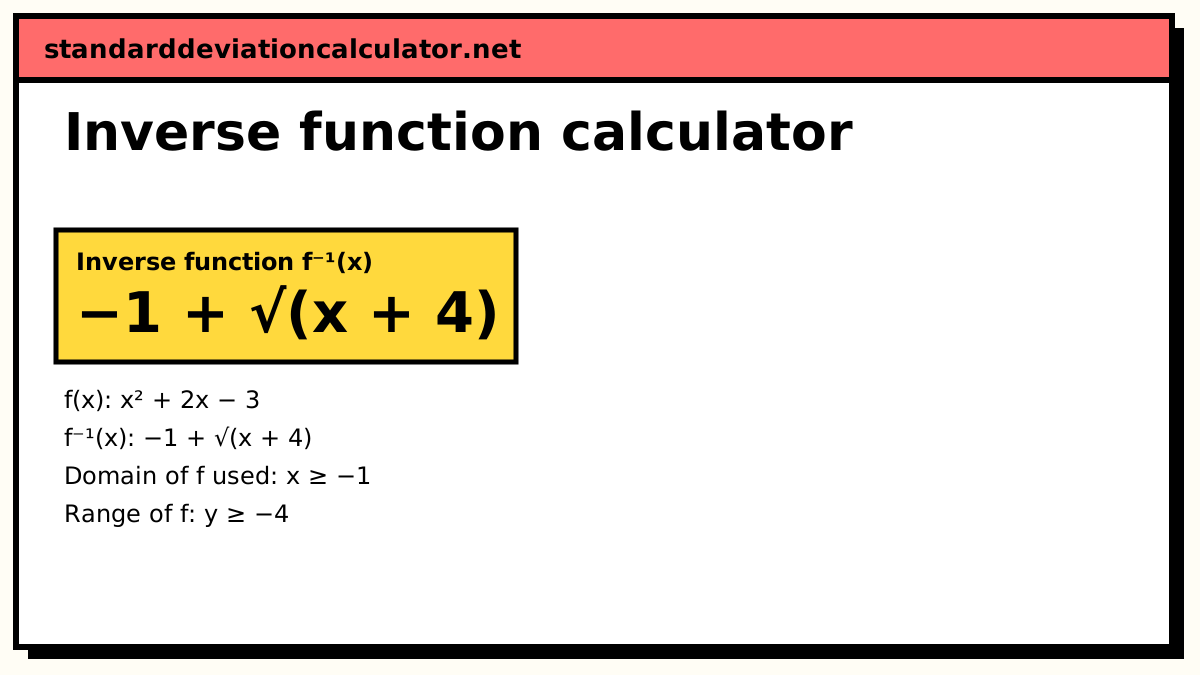
f⁻¹(x) = −1 + √(x + 4), for x ≥ −4
Evaluate at y = 5 and check by applying f.
f⁻¹(5) = 2 f(2) = 5
Reading f⁻¹ as 1/f is the common slip: the inverse undoes f, the reciprocal divides 1 by it. The graphs of f and f⁻¹ mirror each other in the line y = x.
How to find an inverse: swap and solve
- Write the function as y = f(x).
- Swap x and y.
- Solve the new equation for y. That y is f⁻¹(x).
- State the domain of f⁻¹, which is the range of f, and check that f(f⁻¹(x)) = x.
An inverse exists only when f is one-to-one. If it is not, restrict the domain first, as below. The function calculator will find an inverse for any expression you type, and draws f, f⁻¹ and y = x together. This page works from the standard families, so it can show the domain restriction, the full domain and range, and each step.
The five forms and their inverses
| f(x) | f⁻¹(x) | Domain of f⁻¹ |
|---|---|---|
| ax + b | (x − b)/a | all real x |
| a/x + b | a/(x − b) | x ≠ b |
| a(x − h)² + k, x ≥ h | h + √((x − k)/a) | x ≥ k if a > 0, x ≤ k if a < 0 |
| a·eˣ + b | ln((x − b)/a) | (x − b)/a > 0 |
| a·ln(x) + b | e^((x − b)/a) | all real x |
For x ≤ h the quadratic inverse takes the minus root: h − √((x − k)/a). In every row a ≠ 0, because a constant function gives one output for every input and cannot be undone.
Worked example: x² + 2x − 3 on x ≥ −1
The calculator starts with a = 1, b = 2, c = −3, the right branch and y = 5.
- Complete the square: x² + 2x − 3 = (x + 1)² − 4, so the vertex is (−1, −4).
- Restrict to x ≥ −1, the right of the vertex, so each output comes from one input. The range is y ≥ −4.
- Swap: x = (y + 1)² − 4.
- Solve: (y + 1)² = x + 4, so y + 1 = √(x + 4) (the + root, since y ≥ −1) and f⁻¹(x) = −1 + √(x + 4), with domain x ≥ −4.
- Evaluate at 5: f⁻¹(5) = −1 + √9 = 2. Check: f(2) = 4 + 4 − 3 = 5.
On the left branch (x ≤ −1) the inverse is −1 − √(x + 4), and f⁻¹(5) = −1 − 3 = −4. Check: f(−4) = 16 − 8 − 3 = 5. Both −4 and 2 map to 5, which is exactly why x² + 2x − 3 has no inverse until you choose a side.
Example: a reciprocal function
For f(x) = 2/x + 1, swap to x = 2/y + 1. Subtract 1: x − 1 = 2/y, so y = 2/(x − 1) and f⁻¹(x) = 2/(x − 1). The function f never outputs 1 and never takes the input 0; the inverse has exactly those two exclusions, swapped. At y = 3: f⁻¹(3) = 2/(3 − 1) = 1, and f(1) = 2/1 + 1 = 3.
Common mistakes
- Reading f⁻¹ as 1/f. The inverse undoes f; the reciprocal divides 1 by it.
- Forgetting the domain restriction. x² on all real numbers has no inverse; √x inverts only the x ≥ 0 branch.
- Taking ± in the answer. An inverse is a function, so it gets one root. The restriction decides which.
- Losing the exclusions. The inverse of a/x + b is not defined at x = b, even if the formula looks fine there.
- Not checking. Apply f to your answer. If it does not return the input, an algebra step went wrong.
The inverse of a straight line is another straight line with the reciprocal slope; compare the two in the slope calculator. For the vertex form used above, the quadratic equation calculator shows the completed square.
Common questions
How do you find the inverse of a function step by step?
Write y = f(x), swap x and y, then solve the new equation for y. For f(x) = 3x − 5: x = 3y − 5, so 3y = x + 5 and f⁻¹(x) = (x + 5)/3. Finally check by composing: f(f⁻¹(x)) = 3 · (x + 5)/3 − 5 = x.
How do you find the inverse of a quadratic function?
A quadratic fails the horizontal line test, so first restrict its domain to one side of the vertex. For f(x) = x² + 2x − 3 = (x + 1)² − 4 take x ≥ −1. Swap: x = (y + 1)² − 4, so y + 1 = √(x + 4) and f⁻¹(x) = −1 + √(x + 4). On the other side (x ≤ −1) the inverse is −1 − √(x + 4). The calculator asks for the branch and tells you if you leave it unrestricted.
Which functions have an inverse?
Only one-to-one functions: no two different inputs may give the same output. Graphically, every horizontal line crosses the graph at most once. Linear functions with a ≠ 0, eˣ and ln x pass; x² and sin x do not on their full domains, but do once restricted (x ≥ 0, or −90° ≤ x ≤ 90°).
What is the domain and range of an inverse function?
They swap. The domain of f⁻¹ is the range of f, and the range of f⁻¹ is the domain of f. For f(x) = 2/x + 1 the domain is x ≠ 0 and the range is y ≠ 1, so f⁻¹(x) = 2/(x − 1) has domain x ≠ 1 and range y ≠ 0. That is why the calculator states both for every inverse.
Is the inverse function the same as 1/f(x)?
No. f⁻¹ undoes f, while 1/f is the reciprocal. For f(x) = 2x, f⁻¹(x) = x/2 but 1/f(x) = 1/(2x). The −1 in f⁻¹ is a label for the inverse, not an exponent.
Related calculators
-
Function calculator
Type any f(x): evaluate, tabulate, find its domain and inverse, and graph it with y = x.
-
Quadratic equation calculator
Roots, vertex and completed square for ax² + bx + c.
-
Graphing calculator
Plot f and its inverse to see the reflection in y = x.
-
Derivative calculator
The rate of change of a function, with each rule named.
-
Straight line equation calculator
The equation of a line from points or a slope.
-
Slope calculator
The slope a linear function and its inverse swap: m and 1/m.